A Tribute to Tom Stevens: A Leader and a Friend
by Gary Wunder
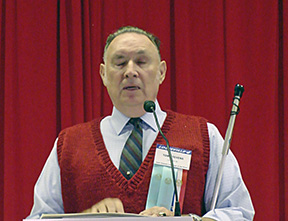 From the Editor: I hardly need to introduce Gary Wunder to Monitor readers, except perhaps to provide the context that among many other things he is a longtime leader in the NFB of Missouri. Here he pays loving tribute to another longtime leader of that affiliate:
Tom Stevens died on Saturday, January 18, 2025, at the age of ninety-two. He was a Federationist since the mid-1970s. When I moved from Columbia to Warrensburg to finish my degree, I got Tom to come to his first meeting. At that meeting or the one just after, he was elected as our Columbia Chapter president.
Tom was not unaccustomed to being a part of leadership, having been a Lieutenant Colonel in the United States Army. He was, however, surprised to be elected, but he learned a lot about the organization quickly and was not at all passive. He led by example and set a pace that would challenge any of us. He soon came to be a part of the State Board of Directors. At his first board meeting, he heard the body talk about closing down its longtime newsletter, the Blind Missourian, and he immediately volunteered to edit it. When he was told the problem wasn't just the editing but that there was no funding, he said, "Well, if I'm going to have something to edit, I guess I'll just have to fund it too.” This was one of the many out-of-pocket sacrifices he made because the affiliate simply had little in the way of money to address our tremendous desire to be active and to have programs.
Tom became the state president in 1977 and served one term, which lasted until 1979. During his tenure, Missouri saw the passage of the Model White Cane Law, the Fraudulent Portrayal of Blindness Act, and a regulation from Missouri's insurance commissioner making it illegal to charge people more for insurance based on blindness alone. When we sometimes decry the length of time to get a bill passed, we should keep in mind that our White Cane bill passed on its eighth introduction.
For all of our work, Tom concluded that we were virtually invisible to the executive leadership of the state. He reasoned that if our governor was going to give a state-of-the-state report, we should do a state-of-the-state on the affairs of the blind, and we did. Whether the governor read that report or not I do not know, but I know that both times that we produced it, he acknowledged its receipt with appreciation and made sure we got invited to some of his press conferences.
For several years, Tom was the director of the Missouri Bureau for the Blind, which is now called Rehabilitation Services for the Blind. To my knowledge he was the first blind person ever to head the agency, and only one agency head since has been blind. During his tenure, the employment of blind people in the agency went up, and those who acted as though they were royalty and blind people subservient subjects were removed. This was no small accomplishment in state government.
After his service at the Bureau, Tom was very involved in what we used to call the Associates Program to raise funds for our national treasury. This meant asking for donations and making people associate members of our organization. It also meant creating a newsletter called The Associate Raiser to encourage recruitment. The newsletter was available in print and on tape. Again, it was financed by Tom and was typed and put on tape by his incredible wife and Federationist, Helen. One of the things that made Tom very sad was that he concluded blind people were reluctant to ask others who were not blind to make donations. He could never figure out whether this was a reaction to being thought of as blind beggars or whether we simply did not spend enough time on the mechanics of fundraising, though all of us knew we needed the money for our programs. These issues remain with us today.
Tom has been active in almost everything we have done. He has actively supported the work we have pursued in our state capitol and in Washington, DC. He did this long before we could afford to send anyone to what we then called the March on Jefferson City and the March on Washington. The harsh truth was that there was not enough funding in our treasury to carry on programs unless people who were elected to positions were willing to make significant financial contributions. Today, calling across the state or country is part of a flat monthly bill, but when Tom was in elective office, calling long-distance was expensive. There was no email, so sharing an important document meant typing it, taking it to a store that made copies, collating, folding, and putting the document into an envelope which then needed to be addressed, stamped, and often delivered to a postal box. Since Tom believed that lack of communication too often translated into the perception that we were doing nothing, communicate he did, again at significant cost in time and his own money.
When the National Federation of the Blind helped in the development of the Kurzweil Reading Machine and we decided that Columbia, Missouri, was the right place to have one, Tom hired a man who had a track record as a fundraiser. Since there was little to no funding in the treasury, Tom not only accepted the responsibility for hiring him but also for paying him. Initially our thought was that we would get back the money we paid when donations started to flow in. It was our good fortune that the buzz we created about the machine was so successful that the Ellis Library Alumni Fund purchased one, and the library agreed to house it. Grateful doesn’t begin to cover the emotion we felt, but what about the month the fundraiser spent and the costs for his hotel, meals, travel, and other expenses? We had no money to reimburse our generous Federationist, but Tom’s laughing response was, “Oh well, that’s the way it goes sometimes. We have our reading machine.”
No tribute to Tom would be complete without acknowledging the significant work of his wife Helen. For a long time Helen has been very active, though at first her visible activity was fairly limited by the raising of their children and making sure that Tom had the time and energy to be actively involved. She drove countless hours. She acted not only as Tom’s reader, but she read many other things on tape that Tom sent to us. His financial sacrifices were also her sacrifices, and to both we offer our undying gratitude.