NFB BELL®: It’s Not just for the Kids!
by Karen Anderson
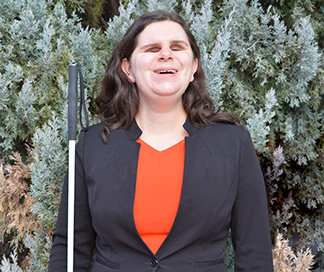 From the Editor: Karen Anderson is Education Programs Coordinator on our national staff, so she knows a thing or two about the impact of our BELL Academies and our other education programs. In this article, she talks about an aspect of that impact that she feels is not considered often enough. Here is what she says:
As a kid, I knew summer as a time to be, well, a little bit lazy. I could sleep in, play outside in the sprinkler or on my swing set, and eat peanut butter sandwiches for lunch in my clubhouse above our back yard. As a college student, I understood summers to be a time for taking a break between semesters, or, if I was really motivated, for taking an accelerated class to get ahead and maybe graduate that much sooner. Instead I, and so many other Federationists, chose a different path, and volunteered for summer youth programs including our NFB BELL® Academy.
When we think about NFB BELL, we often think about the incredible impact it has on blind kids and their families. This will be the eighteenth summer that BELLs will be ringing across the country, and every year we have families tell us how much growth they see in their child over the two weeks of the program. What is less talked about is the effect that NFB BELL has had on the blind mentors who volunteer.
One NFB BELL volunteer told me that she didn’t know if she could really be a teacher. She enjoyed being with young kids, but she wasn’t entirely confident in her own skills to teach or to safely and effectively monitor kids nonvisually. Because of time she spent in one of our NFB BELL Academies, working with other confident blind adults, she learned how to monitor where kids were and what they were doing not only at the usual NFB BELL location but also on field trips out in the community. This newfound confidence led her to work with blind students as a paraprofessional.
Another one of our mentors talked about the joy she has found in helping students and families break down misconceptions about Braille. As someone who was considered low-vision in school, she didn’t have the opportunity to learn Braille when she was young, and, when she did learn Braille in high school, she was told that Braille would always be slow and difficult for her. Working with young students on learning the code has motivated her to practice her own Braille skills. She has had Braille races with BELL students, and she celebrates when they beat her even as it encourages her to work just a little harder herself.
There is also a huge amount of power in the fact that NFB BELL is a program led by blind people. I have the pleasure of traveling to different NFB BELL Academies across the country, and it is truly a pleasure to watch our blind coordinators and mentors taking the lead, even when well-meaning sighted people may want to step in and manage things. Blind leaders are in the kitchen, cooking meals for students and volunteers. They are cleaning up after various activities, because kids can sometimes be just a little bit messy. They are creating and leading lessons, and sometimes making mistakes in front of students, which helps the NFB BELL participants understand that making mistakes is okay. Of course, the blind students see the blind mentors in charge and start exploring more themselves, but our blind mentors also get a boost of confidence from taking the responsibility and seeing the impact their leadership has on others around them.
Finally, people volunteer for NFB BELL because it’s fun! Our volunteers have opportunities to experience things that they might not have gotten to do when they were kids themselves. One NFB BELL Academy last year had a fire truck, police car, and ambulance come visit their academy so kids could check out each vehicle. By encouraging students to explore, volunteers got to experience each of the exhibits themselves. NFB BELL Academies have gone to zoos, science museums, farms, ice cream shops, and to explore ships. All of these experiences were led by blind adults who had as much fun as the students.
All of the NFB BELL volunteers I have worked with over the years have said that they spend their time at BELL because they want to make sure the next generation of blind kids has more opportunities than they had. They take time off work, or travel to a different city or even a different state, because they see the change NFB BELL makes for students. What they don’t expect, and what isn’t talked about, is the change that happens in the mentors. At the end of two weeks our blind mentors are walking just a little more confidently themselves and celebrating at the BELL graduation as hard as any of the families because they see the way they have raised expectations for the next generation. In my opinion, that’s worth trading a lazy summer for any day.