The Power of Audio Description
by Corey Grandstaff
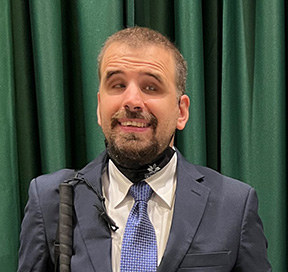 From the Editor: Corey Grandstaff is the treasurer of our Washington affiliate and works as the associate director of Transition and Residential Programs at the Washington State School for the Blind. He also has his own business providing independent living skills training to older blind adults. He lives in Vancouver, Washington, with his wife Arabia. Corey’s work, business, and Federation duties might not seem to leave a lot of spare time, but apparently he finds some to enjoy TV and movies. He says the following about how his appreciation of audio description, which is the narration of visual elements of TV programs and movies for blind and low-vision viewers, has evolved since his childhood:
I remember one of the first times I experienced audio description (AD) as a child. I hated it! I am not sure if it had to do with the quality of the AD or if it was that, for the first time, I got to know each detail of the particular movie. It was the film Old Yeller, and it was one of the Descriptive Video Service (DVS) tapes that you could order by mail at the time. I remember crying every time I watched that movie and wishing the AD had not filled me in during each scene because of how sad the movie was. I also remember theaters offering AD when I went to movies with my friends in high school or college and feeling that I was not “normal” when I wore the headphones to hear it.
Fast forward to now, when I am in my mid-thirties, and I rarely watch a movie or television show that is not audio-described. I even find myself going back to television shows or movies that were favorites of mine as a kid, because as I watch them with AD now, I realize how much I miss them. As a child, I was completely comfortable listening to films or TV shows and applying my own interpretation to what I heard. As an adult, I finally feel fully engaged with these movies and shows because of the enhancement that AD brings to experiencing them.
Take just one example: among my favorite movies as a teen were the films of The Godfather Trilogy. In fall of 2024, I went back and watched all three movies with audio description. I have a much deeper appreciation for the trilogy and love the movies even more than I used to as a teen. In addition, for the first time, I knew what the characters were saying when they spoke in Italian, as the audio description also included reading of the English subtitles.
Another example of the power of audio description is the time that I viewed the Rose Parade with live, real-time audio description. I remember sitting down with my family as a child to watch this annual New Year’s Day event live and having a basic idea of what each float was but no clue as to the details of its appearance or how intricate those details or designs were. Watching the Rose Parade for the first time with audio description gave me a much deeper appreciation for the talent and creativity that went into each float. I never realized how providing audio description of a live event could be life-changing.
This leaves me asking: why did it take me so long to embrace the power of audio description? Is it that when I was a child, you had to go to certain theaters or buy special DVS video tapes to access it, whereas now most movie theaters are required to have AD equipment and I can tune my TV to popular streaming services such as Max, Hulu, Disney Plus, Paramount Plus, and Netflix and they have AD for much of their programming? Or is it that as an adult I do not feel the stigma that I did as a child because I do not care if others see me as different or weird because I wear headphones at the movie theater? Or is it because the quality of audio description has improved since I was younger?
For me, it is a bit of all three: having the ability to turn on my TV to the streaming services I use to access AD, not caring how people look at me, and knowing the quality of AD has improved over the years. I will say it is disappointing when popular channels, such as Starz, have no programming that is audio-described. When I notice AD is not available, it leaves me uninterested in watching the series or movie or in paying for the service.
So, what are my hopes for the future of audio description? The streaming services I listed above have made great advances in what AD they provide, but it is still frustrating when you go to watch a show and it is not audio-described. An even more frustrating experience is when seasons three through six are audio-described, but seasons one and two are not. And then as I mentioned, there are some networks that offer no audio description. So, my hope for the future is that every show can offer AD, that more live events offer live AD, and that the quality and consistency of audio description continues to improve. The work that we must do in advocating for audio description is far from over. However, at least from my perspective, the value that audio description adds is just one example of how providing access can change the lives of blind people and help us to live the lives we want every day.