Blind Enough
by Renée Valdez
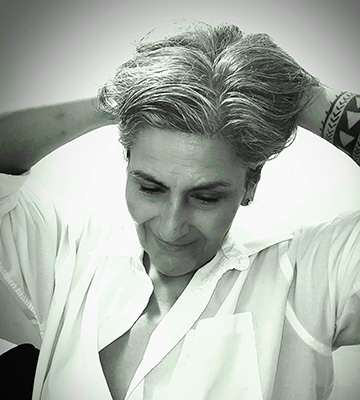 From the Editor: It has become obvious to me over the years through conversations with my Federation family that acceptance of blindness is probably more often a journey than a destination. It can be the most challenging for the majority of blind people who still have some eyesight, but even those of us who are totally blind often experience moments when we wish that our situation was different or that other people could better understand our reality. On the other hand, we also have moments when we are tired of explaining that reality to others and wish simply to be left alone. In this short article, Renée Valdez, who is a member of the current Kenneth Jernigan Leadership in Service cohort, reflects on her own conflicting feelings on her level of eyesight, how others perceive it, and her thoughts about how to react or not react to the questions she perceives others to be asking. Here is what she has to say:
I find it entertaining that, when I walk on a crowded sidewalk in Old Town Alexandria [Virginia] or the busy Tyson’s Corner Mall, my white cane causes people to jump in all directions, giving me plenty of room to pass! It’s like Moses and the Red Sea! Sometimes, someone will say, “Excuse me.” Sometimes they will pass me, oblivious to my tapping. And sometimes, especially when there aren’t many people to hide between or behind, they might press themselves up against a wall and stay very still and quiet, so I won’t know they are there! True story! They don’t know I have enough vision to see them standing there.
In my experience as a blind person, about twelve years, I have found that blindness can be a funny thing. Sighted society is under the impression that a person is either blind or not. Either one can see or not see. If only life were that simple. The truth is what blind people actually “see” is as personal and unique as the individual. And to make it even more interesting, for some blind people, what they can see changes given certain personal or environmental factors, like stress, lack of sleep, sunlight or shade, shadows, or glare.
This can be very frustrating for a novice blind person! People who have been living with blindness for most or all of their lives appear not to sweat this small stuff. Getting from point A to B for a seasoned blind person is as routine as that same task for a sighted person. The only difference is that the blind person might have a guide dog or a white cane leading the way. It was easier for me in the beginning, when I first lost my eyesight and could see nothing at all. At that time, I was completely devastated by my new challenge of blindness. I was fortunate to be under the care and research study of the National Eye Institute, National Institutes of Health. The doctors and other medical staff worked so diligently to get my eyesight back.
I remember the first time I could see that there were two fingers right in front of my face. They belonged to Daryll, the technician working with me at the Eye Institute, who was doing the routine exam to determine if my vision had changed. Prior to this, I couldn’t see a bulldozer in front of me, but that day, I was able to see Daryll’s big fingers! After such a long time of not being able to see anything, suddenly the veil that had obscured my vision had begun to develop small openings, windows to the outside world. We all (Daryll, my NIH doctors, and I) thought it would be a miracle if I ever regained any sight at all.
In the months that followed, my eyesight fluctuated from total obscurity to slits of what would become “enough eyesight to get me in trouble,” but usually somewhere in between. A new normal.
Now that my eyesight is such that I can see some things in certain situations, it becomes interesting. It is all about that long white cane. When I don’t use my white cane out in public, I take small and tentative steps, and sometimes, if I approach stairs, or a curb, or anything in the dim light of dusk or the bright light of day, I stop, feel around with my hands and feet, and then take the step. It slows me down, it is unsafe, and it makes me look ancient! So, I use my white cane most of the time when I venture out in public. Picture this: I’m walking through Barnes & Noble Bookstore headed straight back to the Starbucks, my white cane swishing side to side in front of me. I order my delicious Quad Grande Americano, pay, and navigate to my seat, where I will be for the next several hours. I fold up my cane, take out my laptop, put on my high-magnification reading glasses, and start checking my email. WHAT? I can tell that the couple sitting across from me, who are now staring at me, are wondering “How is this blind woman, whom we just witnessed walk in with the white cane, able to see the computer?” And when I take out my journal and start writing, it almost seems too much for them to fathom. This is counterintuitive! White cane equals blind person. Sighted brain says, “Ok. I compute.” Blind person equals writing in a journal with a pen. Sighted brain says, “Abort! Abort! Do not comprehend!”
It pushes against a sighted reality to see a “blind” person typing on a keyboard, writing in a journal, or taking pictures of the landscape, all hobbies I totally love. This is because society has a rigid idea of what it means to be blind.
Now, here is the kicker. I feel a certain way about this scenario I have just described. I’m not completely sure how to define this feeling. Guilt? Am I blind enough to be considered blind? To you, that might seem a fairly innocuous question. To me, it is laden with shame and anger and denial.
As I am sitting at my table in Barnes & Noble, sipping on my Grande Americano, writing in my journal about that very moment in time, I look up at the couple staring at me, and I smile. What else is there to do? Must I explain to them that I really am blind, but I have enough eyesight to be able to write in my journal, with the help of high-magnification reading glasses, something I absolutely love to do and am grateful to be able to do again because of the doctors at the NIH? Must I explain to them the nuances of what I can and cannot see given the amount of light or the quality of light or the level of stress in my life or a relapse of my illness, all of which can cause fluctuations in what I am able to see in any given moment?
Instead, I smile and continue to write, and check my email, and take pictures of the landscape. It suddenly occurs to me that I can be gracious and understanding when others cannot comprehend the conundrum of my eyesight; at one time in my own life, I was that person. I am grateful that I have enough eyesight to see the handsome face of the man I love, my fur baby MJ, and the smiles of the family and friends I so cherish, and for me, that is enough.