From Fear to Empowerment: Moms’ Stories of Raising Blind Children
by Z’Leah N. Liburd
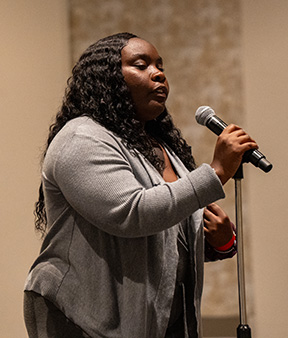 From the Editor: Z’Leah Liburd is the president of the Statewide and Student Divisions of the National Federation of the Blind of Florida and an MSW candidate at the University of South Florida. She is also a participant in the 2025 Kenneth Jernigan Leadership in Service Program. In the true spirit of Federationism, she works with other blind, low-vision, and sighted people to understand and overcome their challenges. In honor of Mother’s Day, here are her interviews with moms—some blind themselves—raising blind and low-vision children. These women powerfully describe their experiences and share their advice for parents like them. The listing of the resources they share does not necessarily imply endorsement by the National Federation of the Blind.
When people encounter others with blindness or low vision, they often ask, “How do you live like that?” or say, “That must be so hard for you!” But rarely do they consider what it’s like for their parents. I’ve interviewed four mothers of blind and low-vision children to share their perspectives and experiences during a few short question-and-answer sessions. They include Jennifer Pascarella of St. Augustine, Florida, a Residential Instructor at the Florida School for the Deaf and Blind (FSDB); Sarah Stolarczyk of Punta Gorda, Florida, a stay-at-home mother and homeschool teacher; Candice Miller from upstate New York, also a stay-at-home mother; and Tamika James from Zephyrhills, FL, an elementary school teacher. Readers on their own journeys of raising blind and low-vision children, or who are simply interested in helpful resources, can refer to the end of the article for their recommendations.
Can you share a little about your children—their ages and diagnoses?
Ms. Pascarella: Both of my children are now adults, ages twenty-seven and eighteen. They are diagnosed with ONH [optic nerve hypoplasia]. I also have a five-year-old granddaughter from my son, Alec. She is also diagnosed with ONH, which we have found is genetic because I also have ONH.
Ms. Stolarczyk: My son is fifteen years old. At two and a half years old, he was diagnosed with retinitis pigmentosa (RP), which is a degenerative condition.
Ms. Miller: My two oldest children have retinal colobomas in both eyes. After they were born, we discovered that I was the carrier and my children had a 50 percent chance of having the condition. They both have some usable vision in the right eye, and less so in the left eye.
Ms. James: I have a twenty-two-year-old daughter who is a very ambitious, vibrant individual who takes life by the horns. She is always up for a good challenge and never lets any task hinder her from succeeding in whatever she puts her mind to. She has been diagnosed with RP. However, her ambition and strengths for living life to the fullest has served as the best role model for everyone in our family. She is simply amazing!
What were your initial thoughts and emotions when you learned about your child’s blindness or low vision?
Ms. Pascarella: With my son, I was sad because as I held him for the first time, I looked at him, saw his beautiful face, and knew looking at his eyes that he had my eye condition. Within eight hours of having my son, I was advocating for him. His pediatrician was not listening to me about his vision. So, I made an appointment at the Children’s Hospital ophthalmology, started the referral process, and had a new pediatrician shortly after leaving the hospital. Ten years later it was like, “OK, I know what I am doing,” and almost had a feeling of relief. By this time raising a sighted child scared me to death. I knew what I was doing with blind kids. With my granddaughter I knew but her mom was in denial, so I had to step back and let her learn. I am supportive in any way I can be.
Ms. Stolarczyk: There was definitely a period of grief as we processed what that might mean for [my son’s] life. It was especially hard to think about the extra challenges he would encounter in his life. My perspective has definitely changed over the years. Actually, my first change in perspective happened very suddenly and unexpectedly when, just six months after his RP diagnosis, he was diagnosed with leukemia. Having your child diagnosed with a potentially life-threatening disease certainly puts blindness into perspective! Thankfully, he has been cancer-free for more than ten years now. As I have had the opportunity to meet and interact with many blind people over the years, my perspective has further shifted. I now know that there are all kinds of tools and resources that will help my son to thrive in life despite his lack of vision.
Ms. Miller: I was surprised when I found out about my daughter’s blindness. When my parents had genetic testing done in the 1980s, they were told that my blindness was not congenital, but further research has been done since then. I was sad, but also relieved because I knew how to fight for my children being blind more so than another disability. I felt like I was more prepared than I feel most parents might feel in a similar situation.
Ms. James: My initial thoughts were how I am going to take care of her and provide a safe stable environment for her. I grew up in a community where blindness wasn’t common. I felt like she would be seen as the outcast. However, my perspectives have changed over time because I loved her enough to make a drastic change and relocate to the US mainland. As a parent with a low-vision child, my emotions fluctuate just like with any other parent. But the understanding of her disability enabled me to adapt to being a supportive mother who knew that just because she is low-vision, that doesn’t mean that she cannot perform and live in the same manner as a sighted individual. As a matter of fact, she has completed way more activities in life than most average individuals.
Has your perspective changed over time as they’ve grown?
Ms. Pascarella: I have learned over the years that there is not one set way to do something. You can find a way to make your goals come true even if it is not in the traditional sense. Our family stands by the mantra that “my normal is not your normal, your normal is not their normal, and that is OK.” Also, before becoming a parent all the things that I said I would not be like changed. Just because of their vision does not mean that my children do not have strong personalities.
Ms. Stolarczyk: My understanding of blindness has definitely changed. Blindness may present some challenges in my son’s life, but the obstacles are not insurmountable.
Ms. Miller: I have been saddened at how much fighting it takes to raise a low-vision child. With a sighted child or a blind child, there is a given about whether to teach Braille or print. When a child has usable vision, the line gets blurred. The school district generally wants to make things easier and cheaper, and wants to push for the students to use large print. It makes more sense to them, and makes it easier for the teacher. The student’s need for nonvisual skills is not taken as seriously. While fighting for my children to be taught in both mediums, I was given pushback from our special education department claiming that I just wanted my kids to know Braille because I know Braille, and it would not be an advantage to my children. Now, my kids are behind in reading, and are still smart, but they only know some Braille, and the print has to be very enlarged with my kids having their faces pressed right up to the screen or paper that they want to read. I found as a blind parent my thoughts were very much dismissed in meetings.
Ms. James: My experience raising a low-vision child has had its pros and cons. There are times when I see the world as a selfish environment where people have no remorse or respect for fellow human beings, disabled or not. Raising a low-vision child has afforded me the opportunity to see that having a visual impairment doesn’t completely disable a person. Yes, there are challenges, but they can be overcome by preparedness and proper training. I have learned that although my daughter doesn’t see the world the same way as a sighted person, she still has her own view through which she depends on her other senses to maneuver around and complete her daily routine.
What has been the most rewarding and the most challenging part of parenting a child with blindness or low vision? How has this changed over time?
Ms. Pascarella: The most rewarding thing about being a parent is watching them reach their goals and surpassing the low expectations that society places on the blind or anyone with a disability.
Ms. Stolarczyk: It has been rewarding to watch my son find many opportunities to thrive. From bowling to drama to music, he participates in many activities alongside his fully-sighted peers. He has also had the opportunity to successfully participate in competitions unique to the blindness community—particularly the Braille Challenge and the Abacus Bee. The most challenging part has been accessing the services that he needs in O&M, Braille, and assistive technology. As a homeschool family, we cannot access those services through the public school. Fortunately, now that he is old enough for the transitions program at DBS [Division of Blind Services], he can get some of those services through them and the Lighthouse [for the Blind organization]. Others we have had to pay for out of pocket and get reimbursed through a scholarship available for homeschooled students with disabilities.
Ms. Miller: The most rewarding part of having children with a visual impairment has been that my kids are able to try to look toward the outside for friendships and within for how they conceptualize the world. The most challenging part has been helping them be OK with themselves and what they can offer. I hate that they feel like they don’t belong in either place.
Ms. James: The most rewarding part of parenting a child with low vision is watching her grow to become who she is. She has never been one to let anything get in her way and hinder her from excelling in the way she is. She has used the skills taught to help her better her lifestyle. Because of this, she is at the height of success in academic and social standing. She serves on many committees such as her current role of being president of the National Federation of the Blind of Florida (NFBF) Statewide Chapter. She was also a member of the Dr. Lydia R. Daniel Honors program at Hillsborough Community College, National Collegiate Scholars, as well as Phi Theta Kappa Honor Societies.
How do you navigate the balance between protecting your child and encouraging their independence, especially at this stage in their lives?
Ms. Pascarella: My thought process is, “Would they be doing this if they had better vision? Is it normal behavior for the age?” I had to learn not to let my fear deter their dreams.
Ms. Stolarczyk: We have tried to encourage [my younger son] to be as independent as his older brother. As he approaches driving age, that may become more difficult as he will not be able to drive himself to different events.
Ms. Miller: I feel like as a blind parent I am less likely to be as protective, and instead want to encourage more independence, but I do find it harder to let go in places where I am unfamiliar because I’m more concerned about where I am and then stressing about what they might be into or what obstacles might be there.
Ms. James: Navigating the balance between protecting my child and encouraging her independence has been challenging, but her strong will to be the best that she can be has made the challenge somewhat easier. She was afforded the opportunity to attend FSDB [Florida School for the Deaf and Blind]. This boarding school in St. Augustine, Florida, is an amazing institution. They not only focused on academics, but they also taught the students independent life skills necessary to become independent adults. Aside from FSDB, my love and urge for my daughter to be the best that she can be has forced me to ease up on my role as a “helicopter mom.” I am now confident and have a sense of security as I realize that she has received all the necessary tools needed to live a successful life as a low-vision individual.
What is one thing you wish society better understood about raising a blind or low-vision child, both at their current life stages and in general?
Ms. Pascarella: That they are more than capable. Sometimes more so than the “normal” person.
Ms. Stolarczyk: I wish more people understood that blindness is not as awful as many seem to think it is. Yes, it provides extra challenges, but life can be fulfilling and wonderful even without sight.
Ms. Miller: I wish people knew that blindness does not mean we have a lack of interest in normal typical activities. I wish they were more inclusive when it does come to programs such as Girl Scouts or Boy Scouts. Most materials are not available in accessible options.
Ms. James: I wish that society could better understand that individuals who live in a blind and low-vision world should never be underestimated. I have seen too many times where individuals have doubted [my daughter’s] and others’ ability to perform daily tasks [like a] sighted person. Blind or low-vision individuals are able to do the same things that everyone else can do. They just require accommodation to ensure that the task that they are attempting can be successful. Giving low-vision and blind people the opportunity to become active participants across communities has proven that they are just as equal as anyone else.
Looking back, what advice would you give to yourself when your child was younger? And what do you think the future version of you might say to you now?
Ms. Pascarella: Relax and enjoy the moment I am in. Also, to hell with what everyone else thinks. It’s my life and my children’s lives, and it has no bearing on what other people think.
Ms. Stolarczyk: I wish we had started assistive technology training at a much earlier age. My future self may remind me that [my son] is doing great in spite of anything I wish I had done differently.
Ms. Miller: I would make myself fight harder before COVID. I wish I could go back and get a lawyer and fight harder for more Braille. I let the school determine a lot of what my kids’ needs would be because I knew my children did have more vision than I ever had, and I was not confident enough in my knowledge to push harder. I also was trying to work with the district because I didn’t want the school to take out the frustration with me as a parent on my children as students.
Ms. James: Looking back, I would trust more in God to know that he had everything strategically planned out. As individuals, we tend to want to move on our own judgment of what we feel is right, and while that may be normal common sense, it also serves as a test to know that God doesn’t give us more than we can handle. Because of all the trials that I have been through, the “future me” can confidently say that putting everything in God’s hands continues to build my faith in other areas that require the same trust and confidence as that of which she and I have endured. Proverbs 3:5-7 teaches this: “Trust in the Lord with all your heart and lean not on your own understanding. In all your ways submit to him and he will make your paths straight.”
What resources have you used or would you recommend to other parents that are raising a blind or low-vision child?
Ms. Pascarella: Other parents of blind children, social media, MaxiAids, and just reaching out to community resources.
Ms. Stolarczyk: Hadley – classes for parents to learn Braille—it’s not that hard!
Lighthouse for the Blind – great programs for teens!
DBS – check into what services may be available.
National Library Service – get your child an account for access to audiobooks through BARD.
Bookshare – get your child an account for access to more audiobooks.
Attend at least one NFB national convention to meet many blind adults and learn about more resources.
If attending a private school or homeschooling in Florida, check into the Family Empowerment Scholarship for Students with Unique Abilities.
Ms. James: There are so many resources out there to assist parents with a blind or low-vision child. The Tampa Lighthouse for the Blind has made a tremendous impact on helping my daughter gain resources she would need, such as teaching independent living and providing employment opportunities, which include computer and vocational training, direct job placement, rehabilitation engineering, and supported employment. There are tutoring sessions/homework assistance, early intervention programs, and a transition program for teens transitioning into the adult world.
The Florida Division of Blind Services assists with life-goal setting, which aids independent lifestyles. They were instrumental in assisting her with assistive technology, transportation, and college/university financial assistance. DBS also has a Blind Babies and Children’s Program as well as Vocational, Independent Living, Braille Library and Talking Books Library, and Career Technology Training.
[Supplemental] Security Income also serves as a financial resource.
Florida School for the Deaf and the Blind was instrumental in helping to pave the path for a successful life and became the best resource to ensure a great start to a wonderful and bright future.
National Federation of the Blind (NFB).
National Library Service for the Blind and Print Disabled. They offer Braille and audio books free of charge.
Florida Association of Blind Students, in which my daughter serves as president.
Florida Braille Challenge.
Florida Cane Quest.
* * * *
In the end, raising a low-vision or blind child is not about limitations or fears, but about feeling empowered. These parents agree that the journey does have its challenges, but is also filled with growth, joy, and many rewards. It’s about advocating for their child fiercely, stepping back and allowing them to navigate their world in their own way, all while trying to educate the world that just because the child is low-vision or blind, and their parents may be fully sighted, they can still live the lives they want.
Many thanks to Jennifer Pascarella, Sarah Stolarczyk, Candice Miller, and Tamika James for sharing their journeys of raising blind and low-vision children.
Resources:
- Bookshare: An online library providing accessible e-books for individuals with print disabilities, offering a vast collection of titles. https://www.bookshare.org/
- Family Empowerment Scholarship for Students with Unique Abilities: A Florida scholarship program assisting families of students with unique abilities, including those who are blind, to access educational options. https://www.stepupforstudents.org/for-parents/scholarship-details/unique-abilities/
- Florida Cane Quest: A competition designed to promote independent travel skills among blind and low-vision students. https://www.fsdbk12.org/cane-quest
- Florida Division of Blind Services (DBS): Provides services to assist individuals who are blind or have low vision in achieving independence and employment goals. https://dbs.fldoe.org/?utm_source=chatgpt.com
- Florida School for the Deaf and the Blind: A state-supported residential school offering educational programs for students who are deaf or blind. https://www.fsdbk12.org
- Hadley: Provides free distance education courses for blind and low-vision individuals, their families, and professionals, including Braille courses for parents.https://hadley.edu
- Lighthouse for the Blind & Low Vision: A nonprofit organization offering programs and services at no charge to individuals who are blind or have low vision, including great programs for teens. https://lighthouseblv.org/?utm_source=chatgpt.com
- MaxiAids: Offers products for independent living, catering to individuals who are blind, have low vision, or other physical challenges. https://www.maxiaids.com/?utm_source=chatgpt.com
- National Library Service for the Blind and Print Disabled (NLS): Offers free Braille and audio books to eligible individuals. https://www.loc.gov/nls/
- The National Federation of the Blind (NFB): A national organization advocating for the rights and providing resources for blind individuals. https://nfb.org
- Tampa Lighthouse for the Blind and Low Vision: Provides services to assist individuals who are blind in achieving independence, including programs for teens. https://lighthouseblv.org/