From the President's Desk
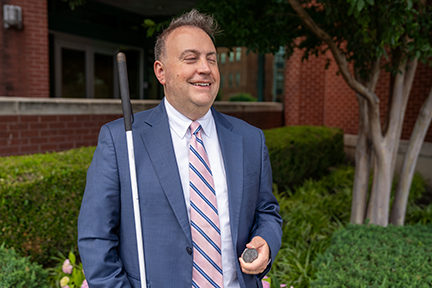 From the Editor: Advocacy is always a full-time job for our President, and the past few months have been no exception. Indeed, the rapid pace of activity from President Donald J. Trump has perhaps necessitated more outreach to policymakers than usual in the first months of a new administration. Below are two letters that Federation President Mark Riccobono has written to Secretary of Education Linda McMahon and members of Congress. The purpose of the first letter was to express our concerns about recent changes at the United States Department of Education (DOE) and plans to shut it down entirely as they affect DOE programs that serve the blind. The second letter addresses an imminent threat to library services for the blind (and indeed many other library services) across the nation. Also included is a letter to the Federal Trade Commission (FTC) concerning recent action that agency took against accessiBe, a company with whose activities many readers will be all too familiar. Here are the letters:
March 25, 2025
The Honorable Linda McMahon
Secretary
United States Department of Education
400 Maryland Avenue, SW
Washington, DC 20202
Dear Secretary McMahon:
The National Federation of the Blind, the transformative membership and advocacy organization of blind Americans, is deeply troubled by the recent executive order regarding the directive to close the United States Department of Education. The programs outlined below are essential to promote education, independence, and economic opportunity for millions of American citizens. Without clear plans for how these statutorily established programs will be maintained, blind Americans and their families have no transparency into future plans, no clear lines of advocacy for due process, and an abundance of uncertainty regarding their current educational and rehabilitation services.
Within the Department of Education is the Office of Special Education and Rehabilitative Services that houses the Office of Special Education Programs (OSEP) and the Rehabilitation Services Administration (RSA) providing essential resources for blind people to obtain education and employment. These divisions are responsible for the enforcement and oversight of the Individuals with Disabilities Education Act (IDEA) (20 U.S.C. § 1400 et seq.), the American Printing House for the Blind’s (APH) federal quota program (20 U.S.C. § 101 et seq.), vocational rehabilitation services (29 U.S.C. § 701 et seq.), the Randolph-Sheppard program (20 U.S.C. § 107 et seq.), and the Independent Living Services for Older Individuals who are Blind (OIB) program (29 U.S.C. 796j-796l). Additionally, the loss of the Office for Civil Rights, including its Digital Accessibility Team, will mean schools can discriminate against blind and other disabled students without recourse. We are gravely concerned that the drastic reduction in workforce, and the ultimate closure of the Department of Education, will result in diminished service for millions of students, employees, entrepreneurs, and older Americans with disabilities across the country who utilize the above programs.
According to the OSEP webpage, it is “dedicated to improving results for infants, toddlers, children and youth with disabilities ages birth through 21 by providing leadership and financial support to assist states and local districts.” This office ensures that blind students have the right to a Free Appropriate Public Education (FAPE) in the least restrictive environment available outlined under the Individuals with Disabilities Education Act. The IDEA provides federal funding to states to provide required “special education” services for public school students with disabilities. While states provide most of the special education funding, the federal government provides about 15 billion dollars. This serves some 7.5 million students. Special education services for the blind include Braille instruction, access technologies, and specialized teachers of the blind. This instruction is important for blind people to learn so we may be able to use the skills to find employment in our chosen fields. Any reduction in services and funding to enforce these laws will leave blind and disabled students vulnerable to civil rights violations and loss of services.
The OSEP also plays an essential role in supporting the APH’s Federal Quota Program, which was established by Congress in 1879, nearly 150 years ago. According to the APH website, the Federal Quota Program determines “the per-student funding allocation for purchasing educational materials from the American Printing House ... Educators and parents can use these funds to obtain specialized educational products and materials for students who are blind or low vision.” Without this statutorily required federal funding, blind and low-vision students will lose access to these critical products and materials, which will in turn create a new barrier to our education.
The RSA oversees vocational rehabilitation services that provide formula grants to State agencies assisting blind people in finding employment opportunities after we have concluded our educational endeavors. Specifically, these grants provide vocational rehabilitation programs to help people with disabilities become employed. The federal government provides about 79 percent of the funding, with states providing the rest. Vocational rehabilitation programs serve over 800,000 individuals each year. A reduction in this funding will lead to service cuts in these programs, leaving blind people who want to work, travel independently, or learn Braille and technology unable to find the support they need.
In addition, the specialized employment program governed by the Randolph-Sheppard Act, one of our nation’s oldest programs specifically intended to promote the entrepreneurial spirit of blind business owners, receives assistance from the RSA helping blind people be a productive driving force in the American economy. The Randolph-Sheppard Act provides blind vendors a priority to operate on federal properties like military bases, government buildings, and highway rest stops. This priority has existed in federal law for nearly ninety years and the program is currently administered by the Department of Education. The closure of the Department may leave blind vendors vulnerable to being shut out of these facilities.
The Independent Living Services for Older Individuals who are Blind program provides grants to states to support services for blind individuals aged fifty-five and older in order to help these Americans adjust to their blindness by increasing their ability to care for their individual needs. This often comes in the form of specialized blindness mobility training and learning how to use various pieces of access technology. The OIB program is currently under the jurisdiction of the Department of Education, and the closure of the department could lead to increased dependency upon other governmental programs for these Americans who simply want to live a dignified and independent life.
While we are sympathetic and understanding of the need to reduce overall federal spending, we also believe that these programs are essential to promote education, independence, and economic opportunity for all American citizens, particularly those who are blind or have other disabilities. We urge you to maintain the personnel and capability to administer these four programs to their fullest and most beneficial extent to serve blind and other disabled Americans.
If you have any further questions, please do not hesitate to contact me.
Sincerely,
Mark A. Riccobono, President
National Federation of the Blind
March 19, 2025
The Honorable Robert Aderholt, Chair
House Appropriations Subcommittee on Labor, Health and Human Services, Education, and Related Agencies
272 Cannon House Office Building
Washington, DC 20515
The Honorable Rosa DeLauro, Ranking Member
House Appropriations Subcommittee on Labor, Health and Human Services, Education, and Related Agencies
2413 Rayburn House Office Building
Washington, DC 20515
The Honorable Shelly Moore Capito, Chair
Senate Appropriations Subcommittee on Labor, Health and Human Services, Education, and Related Agencies
170 Russell Senate Office Building
Washington, DC 20510
The Honorable Tammy Baldwin, Ranking Member
Senate Appropriations Subcommittee on Labor, Health and Human Services, Education and Related Agencies
141 Hart Senate Office Building
Washington, DC 20510
Dear Chairs Aderholt and Capito, and Ranking Members DeLauro and Baldwin:
The National Federation of the Blind, the transformative membership and advocacy organization of blind Americans, is deeply troubled by the recent executive order regarding the instruction to eliminate the Institute of Museum and Library Services (IMLS). Specifically, IMLS funding is essential for many of the state libraries for the blind and print disabled, which serve as a critical source of Braille and other specialized audio books for blind and low-vision Americans. Without this funding, the critical services provided by these libraries will be dramatically reduced or eliminated altogether.
We call upon the House and Senate Appropriation Subcommittees on Labor, Health & Human Services, Education, and Related Agencies to ensure the Library Services and Technology Act (20 U.S.C. § 9121) and its supporting Grants to States program (20 U.S.C. § 9141) remain fully funded for the 2025 Fiscal Year and beyond, ensuring the institutions it funds may remain open and operational for all communities served.
According to the 2023 American Community Survey conducted by the United States Census Bureau, there are approximately 8.3 million blind or low-vision Americans. That is about 2.5 percent of the overall population. According to the most recent census, 66 million Americans live in rural areas. Even if only 1 percent of those living in rural areas are blind or low vision, that still amounts to more than half a million people who are at risk of losing access to a vital source of Braille and other specialized services provided by state libraries for the blind in rural settings.
However, it won’t only be the blind who are affected by a decrease or elimination of funding. There are an estimated 124,903 libraries across the United States. These locations serve as important centers for community engagement, the furtherance of literacy, extended research, and internet access for Americans in every locality. In rural communities these libraries are doubly essential because they may be the sole source of free available internet, allowing for people to study and research for school assignments, search for employment, and engage with the wider world.
It is of the utmost importance that these critical institutions continue to be funded, and we urge you to ensure the funding continues in the next fiscal year appropriation authorization under consideration by your subcommittees. If you have any further questions, or if the National Federation of the Blind can be of assistance in any way, please do not hesitate to contact me.
Sincerely,
Mark A. Riccobono, President
National Federation of the Blind
January 27, 2025
Office of the Secretary
Federal Trade Commission
600 Pennsylvania Avenue, NW
Washington, DC 20580
RE: accessiBe; File No. 222 3156
Dear Secretary:
The National Federation of the Blind appreciates the opportunity to comment on the terms of the consent order regarding accessiBe’s alleged deceptive practices. This is an issue that the National Federation of the Blind has been aware of for several years, and we applaud the Federal Trade Commission’s (the “Commission”) actions in this area.
We made our first public objection to accessiBe’s practices in July 2021 with our national Resolution 2021-17 “Regarding accessiBe’s Disrespectful and Misleading Business Practices.” In this resolution we brought to light that accessiBe both “overstates the effectiveness of automated testing” and “promotes the false claims of attaining Web Content Accessibility Guidelines compliance through the integration of one line of code.” The Commission’s consent order appears to agree with our assertions through the prohibitions and requirements of Provisions I, III, and V. These provisions are a tacit acknowledgement that accessiBe’s representations of what its products are capable of were misleading and deceptive, as the National Federation of the Blind had been stating for years.
True accessibility is essential for blind people to be able to live, work, and participate in their communities. Rather than improving accessibility, misleading and exaggerated claims about accessibility tools undermine and inhibit the full participation of the blind. Unfortunately, such claims have gained tremendous traction in the digital sphere, leading many businesses to contract with providers like accessiBe. It is essential that such bad actors be held accountable for their misrepresentations and that businesses be aware that their claims are untrue.
For the reasons above, the National Federation of the Blind fully support the Commission’s proposed consent order as it is currently written. We hope you will broadly disseminate the consent order to the business community and we would be happy to help in that regard. If there are any questions or concerns, please do not hesitate to reach out to me.
Sincerely,
Mark A. Riccobono, President
National Federation of the Blind