My Antarctic Journey
by Erin Daley
From the Editor: Erin Daley is an active member of the National Federation of the Blind of Colorado and secretary of the Denver chapter. She was raised by a single blind father in Massachusetts, where she was introduced to the Federation at the age of five. She currently works full-time in the insurance industry but is also pursuing her masters in assistive technology. Her passion is traveling the world to learn about new cultures, taste new food, and share the unique obstacles and joys of traveling while blind. Here is her fascinating and thrilling account of one of her travel adventures:
It wasn’t until I was standing in my bathing suit ready to jump off the edge of a ship navigating through rocks and icebergs that it really hit me that traveling to Antarctica was much different than any trip I had ever taken. One of the crew reached around to secure a belt to my waist to ensure that they could pull me back in should there be any issues, and I was ushered to the edge. Another crew member showed me where the ladder was and of course told me which way to turn for the best photo op. I had this grand plan for an epic pose, but it went out of my head as I leaped into the Southern Ocean.
I have always felt that there is nothing like the feeling you get before a trip you have been dreaming about, saving for, and are finally ready to make a reality. As a blind traveler, there is also an added layer of apprehension: will this trip be accessible? Will I encounter any additional costs, be denied entry to a tourist site, or perhaps even be denied on a trip or tour at all? I, like everyone else, go on vacation to get away from the real world. Sometimes I go to relax, and sometimes I go to explore, but I always go as a blind woman, and even at the bottom of the world, traveling while blind was not without its unique challenges.
My friend, a travel blogger and YouTuber, started broaching the idea of a trip about three years before I found myself on the seventh continent. The season to visit is only a few months long for a variety of reasons. First, it must be summer in the southern hemisphere, and then you want to go during peak wildlife months. Even though the season keeps getting longer and longer, January and February are arguably the best months, especially if you, like me, were dying to make friends with a penguin. My friend researched different options, and we eventually put our deposit down about nineteen months before the trip. It didn’t seem real, and I was just so excited to be doing this with a few friends, as this always lowers my stress levels while traveling. We designed a shirt for our group; talked endlessly about all the whales, seals, and penguins we would see; and checked in on each other as different milestones came and went.
When we were a few months out, reality started to hit me: would they have a problem with a blind person on the ship? Would they let me off the ship onto the continent? I knew I wasn’t the first blind person by far to make that journey to the bottom of the world, but this wouldn’t be the first time I experienced some form of discrimination. When I landed for a tour in China, I was informed I would need to pay for a sighted guide to accompany me in every city or I would have to leave the tour and the country. When I traveled to Turkey, one of my city guides told the group that we would not be visiting an attraction, but when I left the van for my room, the rest of the group was then taken to that site without me. When I asked about it, one of the people who went said, “It was very hard to navigate; you wouldn’t have liked it.” I have tried to avoid these and other similar experiences by informing tour companies beforehand that I am blind. The majority outright said that they would not be willing to accommodate me. The excuses ranged from locations not being wheelchair accessible to they don’t have time to dedicate a tour to me personally to, my favorite to date, they absolutely will not carry my bags. Suffice it to say, when I filled out my medical forms for the company’s review, I was not surprised when they came back and told me that blind people are not allowed because “the ship was not designed for blind people.” I asked what a ship designed for blind people would look like, exactly. I never got an answer, but I think that would be a fun project! I reached out to my friend who arranged and booked the trip, and she forwarded emails where she had inquired about this in order to prevent this very problem. The company held to their current stance, and I made a decision: I amended the form to say that I was not really blind, just had vision issues. People asked me what I would do if they turned me away when I flew down there, they saw my white cane, and realized that I was blind. While I didn’t have a plan, I just told myself that once I got on the ship, they couldn’t drag me off if they tried. A number of people have expressed shock that I have experienced this kind of discrimination, but this is pretty common, as most countries do not have ADA-like protections. Just as in China when I was threatened unless I paid extra money, there is often no recourse.
The time came to fly to Punta Arenas, Chile, and I was riddled with anxiety about being denied. The first step was to go through orientation, which included fitting our boots, cleaning our outerwear of any biological matter, and learning about everything we would experience in Antarctica. A member of staff asked me to show him that I could get in and out of the Zodiac® safely, as we would be using this inflatable boat with an outboard motor for our landings. It was fairly easy, and that was the only pushback I got. I was elated that they did not appear concerned with my blindness. I was officially going to Antarctica!
Now, I wish I could say that I was always a perfect traveler and kept my cool the whole time, but the truth is if I don’t get my sleep, a six-foot radius around me should probably be enforced. Our tour was different in that we would not be sailing the notorious Drake Passage to Antarctica; we would be flying to King George Island and board the ship there. Flying into Antarctica is entirely dependent upon weather and visibility, so there are no scheduled flights. We were informed at around 9 PM that we needed to get up at 3 AM because they just got clearance from the airline. We rushed back to the hotel to pack and prepare. I tried to catch some sleep at the airport and on the quick flight, but it was not helping. By the time I was boarding my first Zodiac to the ship, I was panicking and overwhelmed. It didn’t help that we learned the biocontainment procedures—which included a boot-cleaning machine, standing in a box filled with this foamy decontamination liquid, and then changing out of our outer items and into our ship clothes and shoes—would be completed four times a day as we stayed on the ship, once every time we left the ship and once when we returned.
Then, it was time to learn the layout. Everyone was excited and running around checking out the lounge and the other rooms, but I had never felt so alone. For the first time, I felt like all the people who thought me coming was crazy were right. I had no business being here. I participated in the lifeboat drill and had an anxiety attack. No one gave directions; hands would just come out of nowhere and push me down a hallway or turn me in a different direction. It was all too much, and I fought to control my tears. There are some times as Federationists that we do not react how we think we would or want to in these situations, and this is a hard moment for me to look back on. I wish I had spoken up for myself, but I went back to my room and opened my BARD app. I checked how many books I had and determined that I had enough for a few days. I intended to leave the room for meals and just hide the rest of the time. My friend who arranged the trip noticed that I was not my usual self, and announced that she was giving me a tour of the ship. I thought some pretty unkind things, but anyone who knows me knows that I have more stubbornness than sense. She showed me to the dining room, the espresso machine, the bar, and the mudroom where we went through the decontamination process. She helped me find tactile ways to tell which room was mine, and she had me lead a route through the ship to ensure I knew my way. I am so blessed with friends who are blind at heart, and I am filled with gratitude that when I gave up on myself, she didn’t give up on me.
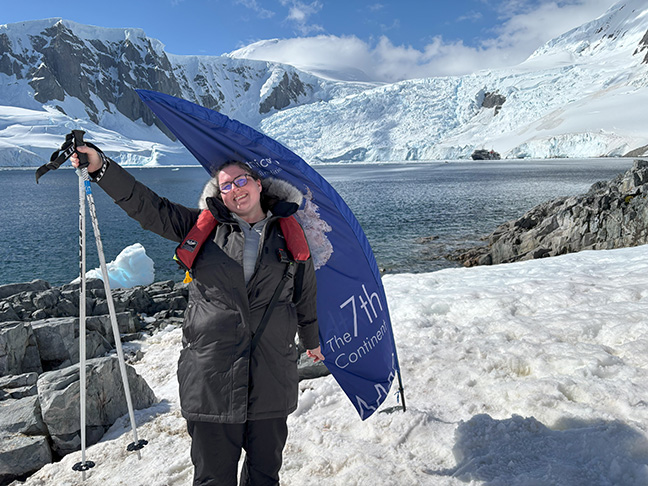
I went to bed with glaciers outside my window and my mind racing with everything that could go wrong tomorrow. When I woke, I was a new woman. It was like all the anxiety had vanished, and I was filled with pure anticipation for the first outing of the day—a Zodiac tour through a bay full of whales, seals, and glaciers. The second expedition was a landing on an island with a hike up a mountain—well, maybe a steep foothill—with a penguin colony at the top. This was my first up-close experience with the topography of Antarctica. There are no docks, no soft sand beaches, and plenty of sharp slick rocks that you have to climb over to get to the shore. The boots you wear are knee-high and waterproof for a reason. We jumped off the side of a Zodiac into the frigid waters and picked our way to shore. Once there, we were given hiking poles to help stabilize us on the feet of snow that blanketed the slope we were to climb. This process was repeated at all of our landings. I liked some more than others, but each was special in their own way. I did get to meet penguins (and smell them) as well as humpback whales and leopard seals. We passed through picturesque channels and took a Zodiac tour of an iceberg graveyard. I learned about the history of the continent and all about the different species of wildlife (the Adélie penguins were my favorite). I also can’t forget to mention the crew and food, the first of which were so kind and always helpful to everyone they met, and the second of which I wished I could bring home! This was not your average cruise food!
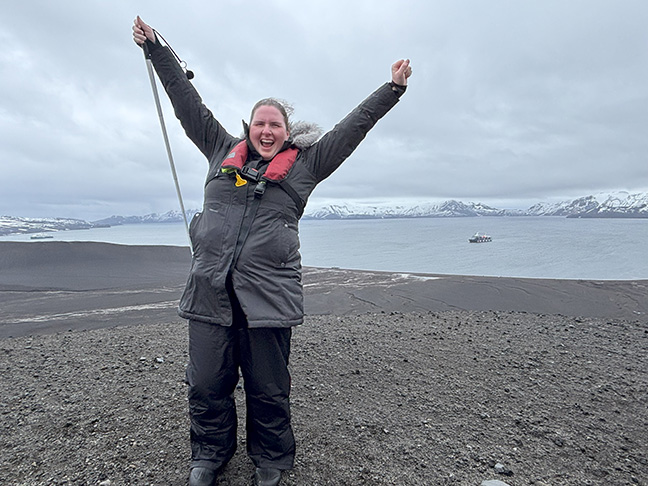
Without a doubt, the highlight for me was our landing at Deception Island. I remember being about six years old holding the globe in my hands and spinning it around and around to look at the different parts of the world. At the very bottom was a tiny island with a big name: Deception Island. I wish I could say that my secret dream to visit there was because it is only one of two active volcanos in Antarctica, or that in order to reach the island you sail into Port Foster, the harbor that is actually the flooded caldera of the volcano. In all honesty, I was just a little girl who loved the name, which was given because, as I just mentioned, the island is a volcano with a flooded caldera, not a normal island.
Because there are so many factors that go into landing on Antarctica, there is never a set itinerary. Each landing has to have paperwork completed, weather taken into account, and also ensure that the limit on how many people can be on land at one time is met, among other requirements. Because of this, you could go to Antarctica twice in the same month and not have the same landings. We would find out the evening before what the landings would be for the next day. We were sitting in the lounge waiting for the announcement of the final day’s landings, and when I heard Deception Island, I began to cry. I had obviously hoped we would land there, but I didn’t want to get my hopes up. I was absolutely ecstatic when I boarded the Zodiac the next day, and I did a little dance on the ash-covered island. While the island definitely had snow, much of the land was barren rock reminiscent of Mordor, the fictional wasteland in J.R.R. Tolkien’s The Lord of the Rings. We were told to stay away from the various equipment around the island that monitored the volcano, but also told not to worry because while the volcano is due to erupt in 2025 based on its prior eruptions, the seismologists had checked before our arrival and there were no indications it would blow that day. It’s always an adventure in Antarctica.
The polar plunge that I mentioned at the beginning of this story was not only a photo-op, it was also the capstone of a truly one-of-a-kind experience, and proof that I am not afraid to push myself out of my comfort zone. When I hit the water of the Southern Ocean, my first thought was “Wow, this is not that cold at all!” I barely had enough time to wonder if a whale was swimming beneath me before I burst out of the water and realized that, while the water was not as bad as I thought, the air was freezing, and I almost seized in shivers. Climbing up the ladder felt impossible, but the shot of vodka I was given at the top helped warm me up.
My friend and I got to talking, and maybe it was the vodka, but she told me that while we were back in Chile getting our orientation, one of the cruise directors had approached her and told her that I would not be able to do any of the landings or expeditions because there was no way I could navigate the rocks on shore. I was surprised, as nothing had been mentioned to me, but, then again, I have been ignored countless times by servers and employees who attempt to locate any sighted person in the vicinity who could be responsible for the blind person instead of speaking to me. My friend told the director that I would be trying every single landing, as they did not know what I was capable of. My friend apologized for not telling me, but didn’t want to ruin my trip and regretted telling me now. I thanked her, as I do like to know these things, but I also thanked her for what she said. Knowing how sleep-deprived and emotionally unregulated I had been on that first day, I do not know how that knowledge would have affected me. I would like to say that I would have been my regular stubborn self and proven them wrong, just like I had already been doing, but then again, I would have liked to educate the person who had been pushing me to the lifeboat. Regardless, I was so grateful to have a friend that understood the assignment and stood up for me. Without knowing it, I had proven the director wrong: I had completed every landing, which is not something that everyone on that ship could say.
I think we all have dreams that we wish we could accomplish but have given them up for one reason or another, and maybe that reason is the little voice inside our head that says it is impossible or that we are crazy. We often get treated as brave and inspirational for just buying milk and bread at the grocery store, but we should never lose sight of the fact that other people’s low expectations do not define what we are capable of. Traveling the world was always my dream, and before I attended the Colorado Center for the Blind and truly embraced the philosophy of the National Federation of the Blind, my grief was not just over losing my vision, it was over losing my dreams. Not everyone’s dream is to hike up Deception Island, but whatever it is, you can accomplish anything with determination and a good night’s sleep.