Back to School Bags for Braille Readers
by Peggy Chong
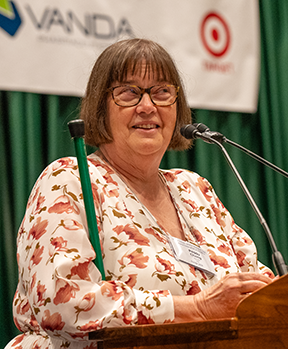 From the Editor: These days you may be most familiar with Peggy Chong as the Blind History Lady, but she has been a leader in the National Federation of the Blind for decades and currently serves as president of the Aurora Chapter of the Colorado affiliate. In this short article, she tells of a Braille and tactile literacy project that her chapter undertook, and which others might wish to replicate. Here is what she says:
The Aurora Chapter of the National Federation of the Blind of Colorado, a chapter of mostly seniors, gave five Braille readers from the greater Denver area public schools a back-to-school bag at our September meeting this fall. Each bag was valued at more than two hundred dollars.
Over the past few years, several of our members worked with blind high school and college students and were surprised to learn that many of them had exposure to Braille learning options but had no idea how to take advantage of them. Even some of the Teachers of Blind Students (TBS) had no idea that their students could order their favorite books in Braille through the National Library Service for the Blind and Print Disabled (NLS) and be allowed to keep the book using NLS’s Braille on Demand service.
Last January the new board of the Aurora Chapter met to discuss the upcoming year’s chapter goals and activities. Several worried that our blind kids in the area were not getting enough Braille and reading and writing practice. It was noted that the schools were generous in purchasing Braille notetakers and other high-tech devices, but that the blind students often could not take their devices home. Some members said that their sighted children and/or grandchildren, now teachers in public schools, received back-to-school bags for their students, but everything was in print and not inclusive for our blind kids. Everyone felt that each blind child should be able to have at home their own tools to allow them to do their homework independently, along with inclusive tools so mom, dad, grandparents, or guardians could help them understand and complete homework assignments. We talked about what a back-to-school bag could look like and how our chapter could raise the money to supply a bag. Over the next several months, members researched and gathered supplies. Michelle Chacon, board member of the chapter and a TBS, began contacting other TBSs throughout the Greater Denver area to whom we could present the bags. To our sadness, the search took months, but we were ultimately able to find five Braille readers.
Each bag included items that would encourage the reading and writing of Braille; tactile literacy; inclusive family time; and better access to school, home, and community participation for the kids. We included:
- A tote bag sold by our Parents of Blind Children Division that was large and strong enough and had large pockets to separate the smaller items from the Braille books.
- A Braille novel.
- Cornerstones, the National Federation of the Blind of Colorado’s history of blind leaders in both print and Braille.
- A slate and stylus with a Dymo tape slot.
- Dymo tape.
- Braille paper.
- A Braille ruler.
- A Braille protractor.
- A Braille number line.
- A Braille calendar from the American Action Fund for Blind Children and Adults.
- A Sensational BlackBoard to create raised-line drawings, made by Colorado’s own inclusive artist Ann Cunningham. The BlackBoard weighs little, is easy for the youngest students to carry in their backpack, and is simple enough to use so that a fellow student can trace a drawing with an ink pen and create a raised-line picture for their classmate.
- Drawing paper for the BlackBoard.
- Scented markers to make their artwork at home fun and creative.
- An accessible game. Each bag had a different game.
- A bag of off-the-shelf, do-it-yourself accessibility tools.
- An envelope with handouts for Mom or Dad.
After the bags were presented, snacks were served, and the parents and children got a chance to work with the blind adults to learn how to use the items in the bag. We encouraged the families to reach out to us if they have any future questions about accessibility and inclusion for their blind child.