Accessible Independent Checkout: Blind-Centered Leadership Makes All the Difference
by Jake Konerza, Rick Walstrom, and Steve Decker
From the Editor: At the 2025 National Convention, a team from Target gave the following presentation. Since it is the time of year when many are visiting stores to purchase holiday gifts, we thought it was a good time to share their presentation about an industry first from this partner company: a completely accessible self-checkout process for blind shoppers. Here is the presentation, beginning with President Riccobono’s introduction:
PRESIDENT RICCOBONO: We’re going to roll right into this next presentation about technology, but from a little bit different point of view. We’re going to talk about accessible independent checkout. [Applause and cheers] How about that? So Target and the National Federation of the Blind are now forever tied together in history. Our relationship started about twenty years ago or so because we sued Target. [Laughter] And that case on web accessibility gets quoted in many places. That’s a piece of history that some of you might not have known because for the majority of the past twenty years, we’ve been proud to work closely with Target as a partner in the accessibility journey, and we want to start this morning by honoring the fact that Target moved from that part of our relationship to really being an industry leader in innovating accessibility. [Applause]
One of the things that Target has done is they’ve gone out to find the best and brightest to work on accessibility and, no surprise, many of those are members of the National Federation of the Blind. [Applause] Our presenter today is the director of digital accessibility at Target, and he’s brought a number of members of his team with him. He is responsible for leading the corporate efforts to ensure that its digital platforms and experiences are inclusive and accessible. It’s not an easy task, both dealing with the in-person experience and the digital experience. He comes with a proven track record in this area, and I’ve already told you that Target has made a commitment to hiring some of the best folks to work on accessibility. And as evidenced by their longstanding partnership and being here at this convention, they take very seriously the idea of feedback from blind people. How many of you made it to check out—to check out!—[Laughter] the Target efforts earlier this week? [Light applause] I didn’t make it over there myself, but I heard many people talking about it, and I’ve been talking to them about the work that they’ve been doing, and I think it’s going to be a, you know that I don’t use this phrase lightly, a game-changer. So here to talk about it, to lead us off is the Director of Digital Accessibility at Target. Please welcome Jake Konerza. [Music: “Check This Out”]
 JAKE KONERZA: I kind of wish we had “Baby Shark,” but we’ll take that one. [Laughter] Well, thank you President Riccobono and good morning NFB. I’m honored to be here today with some fellow leaders from both our accessibility as well as our technology teams. We’re here to share our accessibility journey as an organization. Our last address to the convention was ten years ago, and today we’re here to talk to you about how we have advanced both in our accessibility journey as well as our journey for disability inclusion as an organization. But let me start with a quick introduction of myself. As President Riccobono said, I’m the Senior Director of Digital Accessibility for Target. I spent the last fifteen years in a number of different technology roles, always focused on improving the customer experience, and it’s been the absolute honor of my career to spend the last six years leading digital accessibility. When people ask me about the impact of digital accessibility, I answer this in a couple of different ways. First, from a personal standpoint, this space gives me the opportunity to be an ally for disability inclusion in a large organization, which really matters. But even more important than that, it gives me the opportunity to give people with disabilities a seat at the table to share their voice directly. [Applause] What we find when people with disabilities have a seat at that table, they can bring their lived experience and their unique perspectives to allow us to make even greater innovations. This work impacts friends of mine, it impacts family members, and when done right, digital accessibility creates the type of inclusive world that I want to be a part of. [Applause] But beyond that, if I think about why accessibility matters to business, accessibility creates a more enjoyable experience for all consumers. And what I know and what we’ve seen is that everyone enjoys an experience like that and it drives business results. So our message to every organization that may listen to this presentation is that accessibility is the right thing to do. We can all agree to that, but it’s really, really important to remember that accessibility is also the smart thing to do to drive business results.
[Applause] So throughout our presentation today, we hope to bring to life how we’ve infused this mentality into our organization. Today at Target, accessibility is at the forefront of how we develop and design every experience. So today we hope to share three things with you. One, we want to walk through the accessibility journey we’ve been on for the last seventeen years. Two, we’re excited to share with you what the path looked like for us to create the accessible self-checkout experience that we’re rolling out. And thirdly, we’ll end with the lessons and learnings that we’ve had from this journey we’ve been on.
So President Riccobono mentioned this a little bit, but let’s go back to where our journey began. Our journey into accessibility as a company began seventeen years ago, initially because of a push from the NFB with a mandate to us to make our website accessible. Early on, we were working in a really reactive way. We were fixing issues that existed on our website, meaning we were fixing issues that were causing blockers for people that use assistive technology. We spent a lot of time inside our company educating people on why accessibility matters and why we were focused on accessibility. We used our own internally developed standards rather than industry standards to determine accessibility. It is an absolute understatement to say that those early days were a really tough and uphill battle. However, if we flash forward to today, seventeen years later, we have certainly grown, matured, and evolved as an organization. I’m really, really proud to say that we are strategic members or we are strategic partners of the NFB. And what this means is that we go to NFB leadership early in the development of creating new and innovative solutions to get their perspective, to get their unique experiences. And in fact, we had a member of NFB’s leadership at our Target headquarters recently to check out self-checkout before we brought it here. [Applause] Thank you. That partnership with NFB really, really does matter.
Accessibility is now a part of our culture as a company. We no longer have to fight for accessibility. Accessibility is not seen as a barrier in technology. Accessibility is seen as an innovation driver at Target. [Applause] We have a culture of accessible design, and this culture is embedded within our product, our technology, and our user experience teams. I’m really proud to work in an organization where accessible experiences are the norm and they are the expectation. They’re no longer the exception. And what this culture means is that our website, our digital apps, and all consumer digital experiences are fully accessible. Why this matters is that all customers can independently experience the joy and delight of shopping at Target, including all customers with disabilities. [Applause]
As we’ve matured as an accessibility team, we’ve spent the last number of years expanding our reach to create accessible tools for our employees because we know that it’s as important to have accessibility for employees as it is for our customers. One example of this is the main handheld device that’s used in-store by our employees to do their job. These handheld devices are used by hundreds of thousands of employees every single day to do their jobs, and these devices are a fully accessible experience, [Applause] and that’s important because that unlocks opportunities for everyone. We continue to look at how we leverage technology to enhance accessibility for customers and employees. We’ve not fully arrived because this is a journey and this is a journey which we need to continue on because there is always more to do, but we are really pleased to share our progress, and progress that was started because of a really important push from the NFB.
So now let’s shift gears. We’re excited to discuss with you all the development of the first accessible self-checkout in US mass retail. [Applause] Many of you have had the chance to experience it this week, and we’re excited to share with you the behind-the-scenes work and partnership that it took to get to what you’ve experienced this week. So with that, I’ll turn it over to my peer from the technology team, Rick Walstrom.
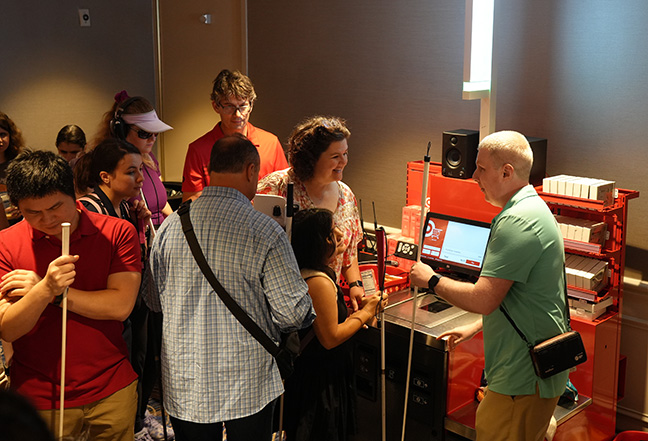
 RICK WALSTROM: Thank you, Jake, and thank you NFB. By way of introduction, my name is Rick Walstrom and I own Target’s guest-facing hardware in our stores, including our self-checkout. Creating a sense of belonging for all of our guests is part of our DNA at Target, which is one of the many reasons I’m thrilled to share our work in accessibility with all of you. To further that mission, I’m so excited to formally announce the first retail self-checkout experience that is fully accessible to the blind. [Applause] By early 2026, Target will have deployed an adaptive controller and screen reader to every single self-checkout in our stores. [Applause] This will give blind and low-vision guests the option to independently check out across the nation.
Intentionality is baked into all aspects of our controller, with large tactile buttons, Braille incorporated in important touch points, and an easy-to-grip mount that allows guests a more steady experience while using it. We’ve also fully integrated the credit card reader into the same audio experience, so guests don’t have to move their headset between devices. [Applause] And through this deployment, we’re also able to help sighted guests who would otherwise have difficulty using a touchscreen, including those living with Parkinson’s, multiple sclerosis, and other motor control disabilities. [Applause]
And while I know many of you have tried out the experience, I do invite all of you to check it out in more detail up on the fourth floor in the Bonaparte room today between twelve and two to experience it yourself.
Now, this achievement didn’t happen overnight. Over five years ago when we set out to completely redesign our self-checkout experience, we made a commitment: accessibility had to be integrated from the start. We collaborated closely with internal and external accessibility experts during the design process, ensuring that all physical touch points were well within reach for wheelchair users. From there, we turned our focus to the needs of the blind and low-vision community. We incorporated Braille interactive elements, introduced high-contrast UI modes, and enabled text enlargement. We added audio prompts on our payment devices, but we knew we could and should do more. So we began the journey toward full screen-reading capabilities for the entire checkout software experience.
The turning point came through a powerful encounter. My principal engineer, Adam Nawrocki, who’s with us here in the audience today, witnessed the real-world frustration a blind coworker faced when trying to use an ATM. That moment inspired Adam to build a prototype on his garage workbench using just a basic circuit board and $10 worth of parts. His goal was simple: create a controller that would work with tools the community already uses. From this humble beginning, we partnered with UI/UX researchers, product designers, software engineers, manufacturers, my teammates here on stage, and of course the Federation to bring the idea to life. And Target isn’t keeping this to ourselves. We freely handed our designs to our manufacturing partners at ELO Touch Solutions so that they can bring this controller to market in order to increase the availability of accessible shopping for all. [Applause] We’re laying out a challenge to other retailers to bring accessibility to the forefront, not as an afterthought. [Applause] And the best part is that it doesn’t end here. We plan to refine our experience over time and have already collected great feedback from many of you here at the convention that will be incorporated as we roll out. Continuous improvement is our commitment, and we’ll keep evolving to serve our guests better. With that, I’m incredibly lucky to introduce Steve Decker, a leader on our accessibility team [Applause] and over twenty-year member of the NFB, who will walk you through what we’ve learned and where we plan to go from here. Steve?
 STEVE DECKER: Good morning, fellow Federationists. Thank you, Jake and Rick. I am Steve Decker. I’m a senior manager of digital accessibility. I’ve been working at Target in accessibility for over thirteen years, and I’m so excited to be with all of you today. [Applause] So I want to share some learnings and lessons from this journey, and there are so many that I don’t have time to cover them all today, but I will say we’ve learned so much even this week, and we will always continue learning and making this better. When we first set out to make our self-checkout kiosks accessible, we knew that there weren’t any reliable existing models that we could directly emulate. Things like voting machines, food service kiosks, and ATMs gave us lots of great inspiration, but there was nothing that specifically existed for blind users that was like ours. That meant we had to build something new from the ground up, but still rooted in familiar intuitive patterns. One of the most recognizable pieces we designed was the physical controller that Rick mentioned. We worked very closely with many from the Federation staff to ensure we were aligned with real-world needs. I want to shout out Jack Mendez [applause] for spending several days at our headquarters sharing invaluable insights and honest real feedback and even helping our engineers make better changes in real time. Also, Karl Belanger with our Center for Excellence in Nonvisual Accessibility, or CENA, [Applause] who saw a much rougher prototype in January in New York and gave us great feedback as well, pushing us to do more and do better. Because our kiosks run Linux, we selected Orca as the screen reader, even though it doesn’t fully support touch screens. This limitation turned into a benefit, as it reinforced the need for physical buttons, which benefit users with disabilities other than blindness. [Applause]
Another key insight was how frustrating it would be to swap earbuds between audio sources. So really early on, we prioritized a unified audio experience between the card reader and the checkout from the start, knowing we could find a way. As we tested flows and interfaces, we discovered lots of things. For instance, scanning items turned out to be very fast and easy, but users could initially benefit from some clear instructions on the motions of scanning and bagging items, something sighted people see others doing all the time. And since Orca doesn’t have touchscreen support, team members can still use the screen naturally while blind users can follow along through the audio, building trust in these shared interactions. We also know that we have more work to do to train our team members on the best ways to interact with blind users and help them understand this new experience.
Finally, the process itself was deeply educational. Building this internally at Target forced dozens of people to become deeply engaged with accessibility in a hands-on way more than ever before, including our UX research team, two of whom have been here with us this week. We’re not only including blind people in research, we’re systemically building long-term processes to do so moving forward. But our journey doesn’t stop here, as Jake and Rick both mentioned. We are committed to refining this experience. Guided by your feedback, we’ll make the interactions easier, the speech better, and the instructions even clearer. So much of the work we’ve done to serve our guests has also laid a really solid foundation to create opportunities for blind and low-vision team members in stores, and I’m so excited, so excited, as well as the rest of the entire team, to work on this in the coming year and beyond. [Applause]
Accessibility at Target is not new. It’s already a core part of how we build digital products, and now it’s becoming a deeper part of our in-store culture too. As that foundation expands, we’re scaling our efforts to make accessibility something everyone at Target can own. To that end, we’ve launched champions programs for designers and developers, equipping even more people with the tools and knowledge to build inclusively. These programs are growing fast, and they’re a big part of how we plan to keep accessibility a default mindset, not a one-time project. We’re also exploring lots more, like the role of AI and how we might use it to generate more meaningful alt text for all of those product images out there. But no matter how we innovate, the core remains the same. Blind and disabled people must be at the center of everything we create. Ultimately, we know that innovation can foster access and accessibility drives innovation. As we continue to build for access, we’re unlocking new ways to innovate across Target.
I want to close with a couple personal reflections. How many of you are excited to try out the first accessible checkout in the US? [Applause] I have a confession to make. I never used self-checkout before Target (that’s not the confession), but I honestly didn’t think it mattered that much. I mean, I could always ask someone for help or order online through our fully accessible apps and website, and I love to do that. But after spending a few days demoing what we had built in New York, I was genuinely excited about the independence this would offer. I could grab junk food without judgment. [Laughter] I could make a purchase without small talk or explaining how I became blind for the fifth time that day, and I could have the same privacy as any other shopper. [Laughter and applause] Most importantly, I could shop like everyone else with all of the same choices on how to do so. My three kids, Kyra, Serina, and Malia, love roaming the aisles of Target. And while they can help me find the things they want and maybe the things I want, I’m the one who knows how to check out, and that shift is powerful. [Laughter and applause]
Now, the Federation has always invested in blind-centered leadership, and this is deeply personal to me. Twenty years ago in Louisville, I received a Federation scholarship, but far more than that, I received the training and the philosophy, the skills, and the attitudes that shaped my path. [Applause] From my first job at BLIND Inc., now the Minnesota Center for the Blind, to the work I do today. The NFB’s leadership and advocacy, including its legal action with Target in 2006, helped spark needed change later. Our partnership grew because the Federation knows when to fight and when to collaborate, but always it pushes us to do better, raising the expectations so that blind people can live the lives we want. [Applause] It’s high expectations that helped Target build a world-class accessibility team, one that’s now a model across the industry. Accessibility is a part of our culture. It’s backed by our leadership and it’s embraced by our partners today. We’ve laid the foundation for accessible independent checkout, and we will keep improving it through your feedback and our partnership with the National Federation of the Blind. [Applause]
Finally, blind-centered leadership comes full circle. Recently I visited my local Target store with my thirteen-year-old, Kyra. Like her amazing mom, Kallie, she’s blind, and while she has some usable vision, it’s not enough to easily check out, but she was able to plug in those earbuds and she learned how to check out on her own. [Applause] Most importantly, she learned that working together as part of a movement, we can make the world better, and that blind-centered leadership makes all the difference. [Applause]
PRESIDENT RICCOBONO: Thank you very much, Target! [Applause]