A Failure of Access, a Betrayal of Trust: Why Two Blind Students Are Suing West Virginia University
by Gary Wunder
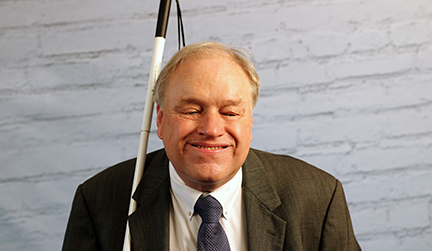 From the Editor: Although we try to avoid litigation if we can, the National Federation of the Blind brings many lawsuits to vindicate the rights of blind students, blind employees, and other blind people who experience discrimination and unequal treatment. Too often, however, many Federationists never meet the courageous individuals who are the faces of our litigation. Gary Wunder has rectified that in this case by interviewing two bright and brave West Virginia University students who are challenging their institution’s failure to meet its legal obligations to them. Readers who want to take an even deeper dive can hear part of this story in their own voices on the Nation’s Blind Podcast. Here is Gary’s article:
For Harold Rogers and Miranda Lacy, graduate school was supposed to be the final step toward achieving their dreams. Both are high-achieving West Virginia natives enrolled in the Master of Social Work (MSW) program at West Virginia University (WVU), and both share a passion for serving their home state’s most vulnerable populations. But as they would soon discover, individual competence and good-faith advocacy are often no match for institutional inertia and university reluctance to pivot from a departmental struggle to avoid blame to unified action to create real and equitable opportunity for blind students. Instead, WVU has systematically denied them the tools, materials, and opportunities necessary to learn.
Now, they and we are plaintiffs in a federal lawsuit against the university, alleging widespread and persistent discrimination that violates the Americans with Disabilities Act (ADA) and Section 504 of the Rehabilitation Act. Recognizing that individual students, no matter how competent, often cannot win this kind of battle against a state university on their own, the National Federation of the Blind and the National Federation of the Blind of West Virginia have joined the suit as co-plaintiffs. Using our limited and precious resources, our involvement brings the collective power, legal expertise, and organizational resources necessary to challenge systemic discrimination. In keeping with the Federation’s tradition, discussion and negotiation always come before any lawsuit. These negotiations began with these students, came to include the NFB of West Virginia, and eventually involved our national body. The students’ story is not just one of inaccessible websites; it is a case study in institutional failure, retaliation, and the profound personal cost of being denied an equal education.
“We Went Back in Time”
Both Harold and Miranda are members of the National Federation of the Blind and came to WVU with impressive academic records. Harold was a member of Alpha Delta Mu and an active member of its local chapter. He graduated with honors from West Virginia State University (WVSU) with a B.S. in Social Work. He was one of only twenty-three trainees nationwide selected for a prestigious fellowship funded by the United States Health Resources and Services Administration (HRSA). Miranda, also a WVSU honors graduate, is a 2024 NFB National Scholarship winner. She was a member of Psi Chi International Honor Society and the Phi Alpha social work honor society.
Miranda and Harold chose WVU, believing its masters-level program would best prepare them for their careers, but the barriers began immediately. Miranda, who lost her remaining vision just before starting the program, found the online new-student orientation inaccessible. She was unable to operate on-screen buttons to move through the modules and ultimately had to ask a sighted volunteer for help. She finds it ironic that the process to take her money was accessible but not the process that would begin her learning at the university.
This lack of accessibility, they soon learned, was the norm. Harold described the situation at WVU bluntly in our interview: “It’s like we’ve gone back in time to before the passage of the Americans with Disabilities Act in 1990.” The lawsuit and our subsequent interview detail a staggering list of accessibility failures that permeate every aspect of the MSW program.
Inaccessible Learning Platform
The university uses Blackboard Ultra. Harold and Miranda report that core functions like the gradebook and course messaging are inaccessible. Interactive elements like true/false or multiple-choice quizzes cannot be operated with a screen reader. Even basic navigation fails, with “back” buttons that don’t function with a screen reader, forcing them to log out and log back in just to move between a module and the main course page.
Delayed and Unusable Materials
Textbooks provided by the Office of Student Accommodations (OSA) arrive piecemeal, not as a whole book at the start of the semester. The PDF files are often improperly tagged or untagged, making it impossible to use a table of contents, search function, or glossary. Images, such as a brain scan students were meant to analyze, are provided with no alternative text. There is more to a book or an article than text alone; navigation—the ability to move by sentence, paragraph, heading, page, chapter, part, and other important sections—is absolutely essential if one is to compete productively. With many of these documents, being able to read continuously was impossible because the malformed document would cause the screen reader to jump erratically.
Broken University Systems
The barriers extend beyond the classroom. The WVU library website’s search filters are so complex and poorly organized for a screen reader that it took Miranda an hour to apply filters a sighted student could apply in seconds. Even then, the filtered results were not what she needed. She is forced to have librarians select research articles for her, denying her the ability to conduct her own independent research. Other essential platforms, like Handshake (for scheduling meetings) and Tevera (for managing field placements), are also inaccessible.
A “Personal Aid” or a Reader?
When faced with these barriers, the university’s response, according to the students, has been a masterpiece in blame-shifting and gaslighting. Miranda, in particular, has been asked to spend five to ten hours a week in meetings with WVU staff demonstrating the inaccessibility of their systems—effectively performing unpaid accessibility testing for the university that is failing her. “You may be surprised to find how long it takes to find a problem, be requested to show it to them, and then have them ask for a Zoom call to see if the problem has been fixed,” she said. When Miranda requested a human reader to access the vast amount of inaccessible content—a standard accommodation—her request was met with confusion and denial. Miranda was told by Disability Services that a private reader would be considered a “personal care attendant”—an assertion she called “degrading and so humiliating.” The request was formally denied as recently as February 2025, but the university has suddenly granted her use of a visual interpreter through Aira and limited assistance by a graduate student.
The Field Placement “Cornerstone” Crumbles
The most critical failure, and one that figures prominently in the lawsuit, involves their field placements. The MSW field experience is described by WVU as a “cornerstone” of the degree, where students learn from practicing social workers. For both Harold and Miranda, this cornerstone crumbled because WVU failed to ensure their placement sites were accessible.
Harold’s Story: Retaliation
Harold was placed at an agency called The Counseling Connection in the fall of 2023. He quickly found that the agency’s computers did not have the screen-reader or magnification software he needed to perform his duties. The complaint filed noted that the WVU field placement office was “unwilling to assist him” in obtaining accommodations. The stress from the inaccessibility exacerbated Harold’s pre-existing health conditions. The agency ultimately terminated his placement.
What happened next was retaliation. The university brought him up on academic charges. They accused him of falsifying his timesheets—timesheets he had to log in the inaccessible Tevera system. They accused him of falsifying a signature on a form, which he explains was a simple formatting error due to his screen reader. As a result, WVU placed him on probation, removed him from his prestigious HRSA fellowship, and forced him to pay back the $5,000 stipend. His graduation, originally set for August 2024, is now delayed by nearly two years to May 2026.
Miranda’s Story: Isolation
Miranda’s first field placement was at the Appalachian Center for Independent Living. When she requested JAWS screen-reading software on the agency computers, WVU refused to pay for the license. She was forced to negotiate for access herself. The agency eventually installed the software on an old, isolated computer in the back of a hallway, limiting her ability to integrate with her colleagues.
For her current placement at the YWCA, she credits the agency with high marks and believes it is doing everything it can to accommodate her. What they don’t know, they are willingly and enthusiastically trying to learn. In contrast, she says, the university has done nothing to facilitate access other than to help her with scanning eleven documents, the forms used as part of the intake process.
The Human Cost of Injustice
The toll of this fight has been immense. Harold has been hospitalized for depression directly related to the stress. Miranda, a single mother, has found some of her health conditions exacerbated and has developed a new one, which she attributes to the stress of the program. “The time that this program has taken from me is time that I have missed with my children,” she told me, her voice heavy. “That is precious.”
Of course, these students are fighting not just for themselves but for a principle. “We just want systemic change,” Miranda said. Harold hopes the lawsuit will set a critical legal precedent. “What’s at stake here,” he explained, “is whether or not the university has a legal obligation to facilitate the accommodations... at the field placement. I don’t believe there is any twenty-first-century legal precedent that will be as meaningful as the one for which we’re pressing.”
When asked whether the students were looking for real change or a settlement, both were firm in their responses. “We are poor folks and could really use the money, but that’s not what this is about,” Miranda says. Their message is unmistakably clear in their words and emphasis. They are entitled to an education preparing them for the noble profession they seek, and nothing short of that will do. They are also committed to making the experience of future students seeking their degrees as free of pain and stress as they can.
This is precisely why organized, collective action is essential. Their goal, and the goal of the National Federation of the Blind in bringing the suit, is to ensure no student has to endure what they have. Every blind person must recognize that the law is not self-enforcing. Filing and following through with a lawsuit normally requires money, expertise, and a collective commitment to the people and principles at stake. Through the National Federation of the Blind, we marshal these forces and demand first-class treatment for blind citizens. We provide the structure needed to raise the money, hire the legal experts, and develop the deep organizational expertise required to hold a major institution like WVU accountable. As Harold so powerfully stated, laws “are only as powerful as the people who are willing to fight to protect them.” Harold Rogers and Miranda Lacy are fighting, and now they have the organized strength of the nation’s blind behind them. Their university should be ashamed that it came to this. We should be heartened by their willingness to stand up for their rights, to exercise the humility and good sense to ask for help, and to lend their strength through involvement with us as together we work to help those of us who are blind to live the lives we want.
In the National Federation of the Blind, we do what we do out of love and respect for our fellow blind people. Everything we do is based on a shared belief in one another, and that belief carries with it nothing less than the responsibility to extend our hands and hearts in a spirit of helpfulness through action.