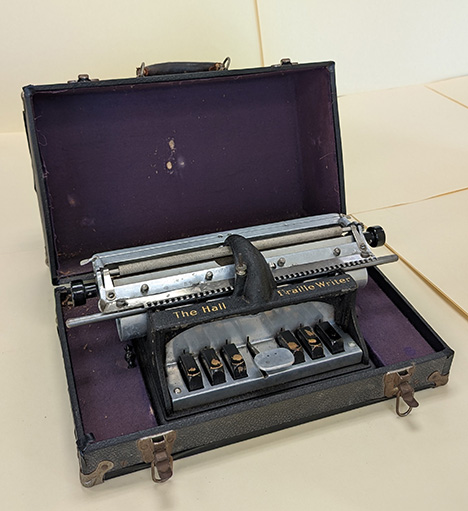
Illustration: A Brailler from Early in the last Century
As readers will learn in this issue, the National Archives of the Blind People’s Movement contains a number of artifacts from throughout the history of our movement and beyond. Since January 4 is World Braille Day (in honor of Louis Braille’s birthday), we thought we would include an image of a Braille innovation from around 125 years ago, likely one of the first Braille-writing implements since the slate and stylus. This moving-head Braille writer, produced by Hall, dates to around 1900, and serves as an example of the first successful and widely-used mechanical embossing system for Braille. The layout is similar to today’s Braillers, as it features six piano-like keys that are pushed to make different combinations of dots. This Brailler is housed in a carrying case made of wood, fabric, and leather for relatively easy transport.
Archives accession #C2025.999.453, courtesy of National Archives of the Blind People’s Movement