Razor-Blade Reflections: What You See Isn’t Always What You Get
by Marie Kouthoofd
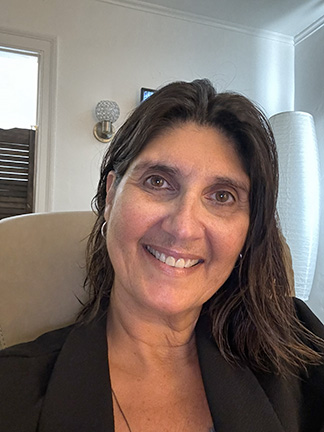 From the Editor: Marie Kouthoofd has been a member of the National Federation of the Blind for thirty years. She became a Federationist in 1996, when she also won her first of two NFB scholarships; the second was three years later and was the prestigious Kenneth Jernigan Scholarship from the American Action Fund for Blind Children and Adults. She hails from New York, where she served as first vice president of the Federation affiliate there for several years. These are accomplishments enough, but Marie obviously wished to continue to improve her blindness skills, and to that end she attended BLIND Inc., now the Minnesota Center for the Blind, in 2012 and 2013. Now a retired college professor and entrepreneur, she lives in Hawaii with her husband Rodney and guide dog Mango, where she is very active in the Honolulu chapter. She has three adult children, two of whom reside in New York and one in Hawaii. Here is her funny and thoughtful take on the misperceptions we sometimes have, and more often face, as blind people:
Perspective is everything. Ever think you saw one thing, only to find out it was something completely different? Give me a quiet nod if you’ve been there—maybe even a little chuckle.
I live with retinitis pigmentosa (RP). I wasn’t born blind—my eyesight has changed slowly, unevenly, over time. Like many of us, I’ve gotten pretty good at navigating the world with less sight. Still, there are the silly moments in my own life, like the time I mistook a covered pool for a tennis court. And there are the daily illusions that come with RP, where sunbeams pose as poles and dark shadows whisper, “This is how it ends!” (To my RP people, you know exactly what I’m talking about.) Those misreads are easy to explain. They come with partial vision, strange angles, bad lighting—easy enough to laugh off. But there are deeper kinds of misreadings.
I used to love watching the rainbows swirl in puddles after a good rain; the colors seemed to dance and shimmer, smiling back at me. Then someone had to ruin it with, “You know that’s just pollution, right? Gasoline runoff. It’s toxic.” Thanks for shattering the magic.
Then there was the highway off-ramp my husband and I always took on the way to our favorite lunch spot. Every summer, I’d see what I thought were tiny wild daisies lining the median. One day, I told my husband how they absolutely delighted me–how I marveled how they came back in force every year. He paused, gave me a look of reluctant pity, and said, “Honey, I’m sorry, those aren’t flowers. That median’s full of cigarette butts.” Great. So much for the world being sunshine, daisies, and red rubber balls.
But even those moments, once the sting wears off, are still surface-level. They challenge your view, sure, but they don’t shake your foundation. Then come the moments that do.
I recently bought a set of stemless wine glasses. I liked how they felt: smooth, clean, no-nonsense, and just a bit refined. When I drink water, I want it to feel like an experience. I like to add a little elegance to the routine.
After a few dishwasher runs, I noticed what felt like buildup on the bottom—gritty, tacky, and annoying. I figured it was hard water or dishwasher grime. I tried wiping, scrubbing, and abrasive sponges. Nothing worked. So I did what any stubborn, half-delusional perfectionist would do—I went full-on Marie and pulled out the razor blade. For weeks, every time the glasses came out, I’d attack the bottoms like I was restoring an artifact. They felt wrong, and I wanted them smooth again.
Then one day, my son Alex came over. I picked up a glass and said, “These things are driving me nuts. I think the dishwasher’s going. Look at this residue.” He took the glass, ran his fingers around the bottom, and said, “Oh shoot!” Enter that sinking feeling. “That’s not residue,” he said with a good-natured chuckle, the kind we always seem to find when things go sideways. “That’s the tint. These glasses are color-dipped and you’ve been scraping the design off.”
Turns out the glasses weren’t dishwasher safe, and they definitely weren’t razor-blade safe. And then it hit me: I suddenly remembered my husband saying, when we first bought them, “Oh, those are nice. They have a pretty tint.” I thought I was fixing a flaw. But instead, I was erasing the design. The glasses weren’t the problem; my perspective was.
That moment reminded me of one of the Kernel Book stories by Dr. Kenneth Jernigan. He described being given a toy horse as a child—a gift he cherished. It felt rough in his hands, so he got to work. He rubbed and polished and wiped away the imperfections. He worked hard to make it smooth, to make it shine the way he believed it should. When he was finished, he was proud. He had made it beautiful—perfect, even. But when he showed it to others, they gasped. The horse had originally been covered in gold glitter. He thought he was smoothing out a rough surface, making it better. In truth, he was scraping off the glitter. What felt like perfection to him looked like destruction to them.
But this article isn’t really about toy horses or stemless wine glasses. It’s not even about cigarette butts dressed as daisies or rainbow puddles made of gasoline. It’s about what happens when we assume something’s broken just because it feels unfamiliar. It’s about how easy it is to strip away something meaningful, something beautiful, without even realizing it, all because it doesn’t fit our idea of what’s “supposed” to be.
Both my wine glasses and Dr. Jernigan’s horse were acted on by good intentions. My glasses were damaged, that part is true. But I didn’t understand what kind of damage I was looking at. I assumed I knew what was wrong and set out to fix it, to make it better.
Instead, I destroyed the glasses. I scraped away something I didn’t fully understand, thinking I was helping, thinking I was restoring it to what it was supposed to be. But my perspective was flawed, and therefore, so was the fix I applied. Dr. Jernigan’s horse wasn’t damaged at all. Sighted people saw glitter and thought it was beautiful. But to a blind kid, the rough sparkly surface didn’t mean much. He polished it until it felt smooth, until he uncovered what he thought was its true form, its real beauty.
That’s the real trick with perspective. We see the world through our lens, shaped through our lived experience. But others see us through theirs. And when it comes to blindness, those perspectives don’t always line up. We may not see blindness as a defining characteristic, but what others see can tell a very different story.
In the Deep End Without a Belt
I go to water aerobics at my local pool. I take the bus there, get off at the drop-off point, cross mid-block, pick my moment between cars, and make my way through the lot toward the pool. I walk in on my own, set my dog up safely outside the splash zone, take my cane, and get myself to the edge of the pool. No drama, no need for applause. Just a blind woman who wants to move her body and enjoy the water.
Most days, that’s exactly what happens. I get in, do my drills, and no one says a word. But one day, In the middle of class, a woman turned to me with concern and asked, “Do you know you’re near the deep end? Why aren’t you wearing a flotation belt?” I rebutted with my usual sarcastic humor, “The question is, why are you wearing one?” “So I don’t sink and drown,” she replied. “Do you see me sinking?” I rejoined. Then came the awkward silence—my favorite—finally broken by, “I’m just concerned for your safety.”
Ah yes, the old “I’m concerned for your safety” line. But let’s talk about what she was really saying—not out loud, but in the unspoken perspective behind her questions. What she was really asking was whether I was competent, whether I could be trusted to assess my surroundings and my own body, whether I should be allowed to make decisions at all. And here I was again, in familiar territory, defending my autonomy while educating someone who had appointed herself my protector. Her concern wasn’t about safety. It was custodial, rooted in the belief that someone like me needs to be looked after. She didn’t know me. She couldn’t see me. She saw blindness, and her perspective filled in the rest.
The Checkout That Checked Me
And then there’s Walmart. My husband and I were doing our regular shopping. I asked our checkout clerk for a bottle of Malibu rum. The alcohol was behind glass, so an associate needed to unlock the display case. She looked right past me and said to my husband, “I need you to come with me.” I said, “No. I’m the one buying it. I’ll go.” She resisted. I insisted. She wouldn’t give me directions, so I found my own way. I walked across the store using memory, layout, and instinct, the same way I handle far more complex routes every day.
And that’s where things shifted from misunderstanding to hostility. She left without a word. Just slipped away. I didn’t even know she was gone; my husband had to tell me.
Sometimes, you run into people who want to manage you, guide you, and protect you, whether you asked for it or not. Other times, it gets darker—a little colder, a little more emotionally draining. This wasn’t about care or concern. This was about control, about proving a point. She didn’t believe I could do it, and when I pushed back, she wanted me to fail. She wanted me to get lost, to need help, to justify her decision to bypass me in the first place. That’s what happens sometimes. You don’t comply, so they set the bar higher just to watch you trip.
She met me at the case with attitude loaded. “Do you even know what kind you want?” “Yes,” I replied. “A magnum of Malibu Coconut Rum, please.” I asked to feel the bottle. She handed me a mini. “No, I said a magnum, that’s the larger one.” She handed me the magnum and said, “Are you sure?” “Yes.” I wasn’t on a scavenger hunt; I knew what I came for. But, at this rate, I was about two stupid questions away from cracking the seal and taking a swig. But I digress.
As we walked back, my dog made a slightly early turn. Nothing major. But she panicked. “You’re going the wrong way!” she shouted, like I was about to walk off a cliff. I calmly redirected him. “Mango, find Daddy.” He did, exactly as trained. We reached the register. I could tell something was off. I heard her say something about the alcohol, asking my husband, not me, followed by him saying, “Ask her.” I stopped cold. “What is happening right now?” Then, directly to her: “Please speak to me. Do not ask my husband. I’m the one purchasing this.” Her silence said everything. She didn’t just ignore me, she tried to remove me from the equation. She handed my agency to someone else, like it was hers to give away.
But the battle of wills didn’t end there. She had to get in the final slap by pointing to an inaccessible touchscreen and telling me to “press yes.” I thought, “Don’t we all feel powerful now?” My husband tapped the touchscreen and I finished the transaction. I then turned to her and asked, “What’s your name?” She hesitated, and then said, “Patty.”
I said, “Patty, I hope you have a wonderful Mother’s Day. Please know that blindness does not make me incompetent. I am a mother, a wife, a professional, and a woman, just like you. I believe it important we treat each other with mutual respect. Thank you for your assistance today.” Because, once again, there we were at that teaching moment.
Why am I telling these stories? It’s not just a venting session, although I do enjoy commiserating with my fellow travelers. It’s about perspective. It’s about how, when you’re alone, those constant little cuts—those quiet challenges to your autonomy—can start to wear you down. They can chip away at your confidence, your sense of self.
Because sometimes when people look at us, they don’t really see us at all. They don’t even see the blindness; they see their idea of what blindness means. Their perspective is warped by their fear, their pity, and their projection. And that perspective? It’s not usually intended to be cruel, but it cuts just the same. People think they’re helping, fixing what they think is broken, but all they’re really doing is carving away at who we are—not with one brutal slice, but with a thousand tiny, well-intentioned cuts, like my razor-blade strokes on those wine glasses. But once you know who you are and that you don’t stand alone, even the sharpest cuts can’t diminish you. Instead, they fuel your conviction.
Our perspective as blind people is not optional. It’s not theoretical. It’s valid. It’s lived. It’s ours. We know what blindness is, because we live it every day. You are not the problem. You are not broken. And you are most definitely not alone. We have each other, our shared experiences, our shared wisdom, our shared knowledge. Others may misjudge us, but our perspective is grounded in truth. We are rooted in the strength of those who came before us, people who knew the sting of judgment, who pushed past the same barriers, who believed in us before we ever showed up. They paved this road. They built the foundation. And because of them, we walk with assurance.So if I’m allowed to offer some unsolicited advice, here it is: The next time someone tries to offer you a floatie you didn’t ask for, questions your ability to buy rum, or assumes your blindness makes you less, remember that what they perceive as a flaw is nothing more than a reflection of their own limits, and that so-called flaw became the fire that forged us into something stronger, sharper, and more relentless than they’ll ever be able to comprehend. Federation family, keep that fire burning.