Case Closed: The Story of Technology, a Blind Woman, and an Eyewitness Account to Solve a Mystery
by Kristen Dockendorff
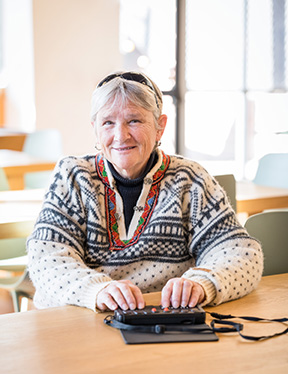 From the Editor: Kristen Dockendorff is a retired art teacher and has been blind for twenty-five years. She resides in Manchester, Connecticut, with Winny, her Golden Retriever guide dog from The Seeing Eye. She collaborates with UR Community Tech Center and works to increase technology knowledge within her Federation chapter and affiliate. Here is what she says about a recent experience where she used her blindness and technology skills not only to help a person starting their blindness journey but a sighted colleague as well:
I have been working with a community group that helps blind and low-vision people, and this experience is proving to be some of the most rewarding of my life. Together, Michelle Puzzo and I run a support group at UR Community Tech Center, and thanks to her tireless efforts securing grants, the center now offers more than thirty-five different devices for people to test. We strive to ensure that those with blindness and low vision can access and try a wide range of equipment, from electronic magnifiers to high-tech smart glasses.
Michelle often recruits high school and college interns, introducing them to both the challenges and the rewards of working alongside people with disabilities. She views this as an opportunity not only for career exploration, but also for promoting greater inclusion.
Recently, during one of our support sessions, we met a young man with unique eye issues. My connections in the low-vision tech world seemed especially relevant for him, so I scheduled time at the center to show him available resources and demo devices. When I arrived, Michelle introduced me to a new teenage intern. Keeping with our support group custom, as a low-vision person I reached out my hand first, a small gesture that avoids the awkwardness of trying to find someone else’s when you cannot see it. She shook my hand, and I realized I was wearing my smart glasses, which I quickly removed, thinking perhaps they were distracting.
A moment later, the intern’s gaze lingered on my Ray-Ban Meta smart glasses. Suddenly, she gasped, “Oh my God, it’s Mrs. D!” To my astonishment, I recognized her as Morgan, a former student from my years as a public school art teacher, before retinitis pigmentosa prompted my retirement from the classroom. She had been in second grade when we’d last met; now, after ten years, she was a high school senior seeking her future career path. The reunion was deeply moving, and the day became even more meaningful as we helped our young guest explore technology options, connect with resources, and learn about the latest advancements.
Morgan was especially curious about my Meta smart glasses. I demonstrated the hands-free camera and video features, showing how easy it was to take pictures, read signs, and send images to contacts, a boost for someone who lives with low vision. Sharing these innovations, along with the many other devices available at the center, filled our visit with excitement and community spirit.
Toward evening, I received a text from Michelle. “You’re not going to believe this,” she wrote, “but the police from a neighboring town just called. They say my car was involved in a motor vehicle accident!” We both knew this was impossible, as Michelle had been at the center all day, with her car parked outside. She named me as a witness, but soon after, she texted again: “Is there any way to prove I was at the center?”
Thinking it through, I realized that, with ParaTransit services unavailable, I had arrived by Uber instead. Thankfully, the Uber app’s activity tab clearly logged the date, time, and location. I took a screenshot of the trip details and sent it to Michelle, who forwarded it to the police. Soon another message came: “That proves you were here, but it doesn’t prove that I was.”
Michelle wondered if any further evidence existed. I remembered that, while demonstrating my Meta smart glasses, I had snapped a photo showing Morgan, Michelle, and the young man together. Because the picture was a candid, with no attempt at formal composition, I had deleted it from the gallery. On a hunch, I asked my glasses how to recover deleted photos. Following the instructions, I checked my phone, and there it was: the photo from that precise date. I promptly sent it to Michelle.
The image clearly showed Michelle at the center, yet there was another obstacle, the police insisted on a timestamp. Thankfully, my phone’s information button provided both the location and timestamp. I took a screenshot of this data and sent it on. Minutes later, the police called to confirm: “Did you take the picture with your glasses?” Yes, I replied. “Thank you,” the officer said, and hung up.
Half an hour later, Michelle texted again. Two words: “Case closed.”
This day stands out not simply for having solved a puzzle, but for the sense of empowerment and camaraderie that permeated my every interaction. Sharing knowledge with others who have just begun their journey of vision loss is deeply rewarding. Seeing a former student again, I realized teaching creativity doesn’t require paint or clay, it’s the gift of new tools and possibilities. Connecting all the technological threads to support Michelle meant putting my blindness and technology skills to the test.
I will continue to encourage people to take the step to jump into technology and share their new knowledge with others. And you never know, it might keep a friend out of jail. As someone who cherishes mysteries, I find it a delightful irony that the person who acquired all the eyewitness evidence to resolve the case was, despite low vision, me.