Sexual Health Education and Research: A Community-Centered Approach Driven by the Blind
by Mika Baugh, PhD
CW: The following article contains content about sex, sexual anatomy, and sexuality.
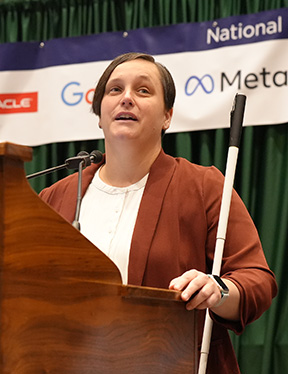 From the Editor: Sunday morning, July 8, at the 2025 National Convention included perhaps the most uncomfortable but necessary discussion that has ever been had on the convention floor. The fact that the speaker, Dr. Mika Baugh, was willing to take on the topic and the Federation’s efforts around it speaks to the reason that, later that day, she received one of the 2025 Dr. Jacob Bolotin Awards. Here is what she shared, beginning with President Riccobono’s introduction:
Mark Riccobono: Okay, this next presentation is Sexual Health Education and Research: A Community-Centered Approach Driven by the Blind. I learned many years ago through the Federation that the best way to be a teacher or a leader is to continue to learn things from the perspectives and lived experience of those that you are honored to teach or lead, and I try to do that on a daily basis in this movement.
The first time I remember getting to know our next presenter, was during our 2006 Rocket On Program, which I was in charge of. That was not her first experience with the Federation. I looked back and noticed that she was published in Future Reflections in 2004. I told her that recently. I’m not sure she looked it up, because she might be not so happy with what she said twenty years ago, but then most of us aren’t, right? When she was in the program, she was only a sophomore in high school, but I can point out very significantly that in the Rocket On Program, she was selected to be the mission director for our Rocket Project, which says something about her leadership and how early she started showing leadership potential. My experience has been she always has keen insight to offer and does not fail to share with you her perspectives, which always are informative. She was educated in schools including the School for the Blind, and so she knows well the failures of the education system for blind children, and I particularly love her dedication to doing something about it. She works often in our Texas Federation youth programs, and she and I have often shared thoughts. She shared thoughts with me about how the blindness field and the materials produced around sexual health education are greatly lacking. So last year I appointed a committee, a subcommittee of the board, to work with her on our first sexual health education program here at the National Convention, and I know many of you went to participate in that because I dropped by and I noticed that it was a great success. So, I asked if she would come talk about it here. I was really honored to be in our Betsy Zaborowski conference room in April when this young lady defended her dissertation, calling out many times the work of the National Federation of the Blind and adding further academic credibility to the lived experience that we share combined with real research methodology. I’m certain that this won’t be her last time with us. She will be making many, many more contributions to our movement, but I’m really honored to be introducing her for the first time and this stage as Dr. Mika Baugh [Applause and music].
Dr. Mika Baugh: Thank you. This is my eighteenth convention and in all those years, this is one of the first times we’re discussing sex education on the convention floor, but something I learned at my very first convention: this is the National Federation of the Blind, and we’re not scared to tackle difficult things together. We’re not afraid to get comfortable with uncomfortable topics.
We don’t shy away from tough conversations with others or among ourselves, and we certainly don’t sit idly when we recognize injustice or inequity. I’m going to talk a lot about what other people say to us and about us, but I’m also going to invite you to consider what we blind people say to ourselves and each other collectively as a movement. Are we amplifying messages of hope and courage and inherent human value? Or to what extent—and I know it’s hard to think about our faults—but to what extent have we amplified the messages of cruelty, neglect, and injustice foisted upon us by others’ erroneous assumptions and misconceptions that we could never be sexual beings? But most importantly, what are we doing about it?
You might have some feelings here in the next twenty minutes. They might even be some unpleasant feelings. You probably weren’t expecting deep emotions on your Sunday morning. I wasn’t expecting deep ones when I wrote this, but here we are, so at least we’re in it together.
Let’s start with what other people say to us. The good news is these are not our people, in case you were wondering. These people—often well-meaning experts in the vision field—send us messages about our needs, our desires, our hopes, our values in the world. Sometimes these messages are edifying, but usually they’re just not. They said that blind kids don’t need to learn Braille because it’s too outdated. So, we said, “If they won’t teach them, we will.” And now we have the NFB BELL® Academy. Then they said, “Blind kids can’t learn science, technology, engineering, and math because it’s too visual.” We said, “If they won’t teach them, we will.” And now we have a whole generation of science nerds and tech geeks. And then they said, “Teachers of students with visual impairments know everything they need to know.” We said, “First, let’s try teachers of blind students. Secondly, no, they really don’t. And yet again, if they won’t teach them, we will.” Say hi to a Teacher of Tomorrow cohort member if you see one today. There’s twenty of them here at this convention. They’re learning how to be our people. Let’s make sure we’re their people too.
One of my favorite things about our movement is the spunk and feistiness with which we attack injustice. Usually when the messages we’re hearing are as mired in misconceptions as those I’ve just highlighted, we spring into action. In other words, challenge accepted. But messages about reading and careers aren’t steeped in the same social stigma and taboo as other messages. They don’t wound us to the core of our worth as humanity like other messages. Do you know what else they’ve been saying for all these years? Do you know what they say when it comes time for the talk in fifth grade or middle school? What they say when it comes time for health class in high school? If you think for a second, you know what they say because somebody said it to you or a blind person that you care about. The things that hurt most are the most difficult to forget. And as the kids say, these messages hit different still. I’ll state it plainly and just so we’re clear, everything I’m sharing here is backed by real-life research conducted by real-life disabled scholars, which as a researcher myself, quells my ever-present anxiety about whether the statement I’m about to make is valid or not. Luckily, I did the entire literature review for you. You’re welcome. So, I can say with total confidence that everything I’m sharing is legit.
So, here’s what they say. They say, in summary, “Blind kids don’t need sex education. It’s too awkward, it’s uncomfortable. How would we even teach them that? We could just let them skip that class, and if we can’t get them out of the class, maybe we’ll just forget to make the materials accessible so that way no one will feel awkward about them touching a picture of a vagina. Blind kids don’t even need this information anyway. They’re all so weird, and nobody’s going to want to have sex with them. Let’s just discreetly encourage the parents to put her on the pill so that we can avoid periods and, God forbid, pregnancy.”
I hope we know how untrue and wildly misguided these statements are, but false or not, they sink in. What others say to us too often becomes what we say to ourselves, the underlying squeamishness here. It’s not just about sex education. It’s about whether we blind people deserve the information and opportunity to live full and enriching lives, lives full of love, intimacy, and yes, good sex, if that’s what we desire, as everyone else. [Applause] But you know what the worst part of this is? And here’s where my raging feelings entered the chat, and I hope yours do too. The worst part of this is that in my fifteen years of working with blind kids, I hear these messages from them. They tell me how “I’m just not relationship material and nobody’s going to date me anyway, so I don’t need to learn that stuff, and my family says they’ll take my baby if I ever have one, so I’ll just never have sex.” If young blind people tell me these things in today’s modern, enlightened, hip world, I know the things our elders could share would be even harder to hear.
These messages are insidious. They hurt, sometimes so profoundly that we’d rather pretend that they don’t apply to us or they don’t affect us than engage in meaningful efforts to address the hidden kernels of truth behind them. But whether we address them or not, we carry the things that people say to us within us. They grow and they flourish, and we risk projecting them onto others in our movement, sometimes the most vulnerable folks around us. What do we say to the survivor who’s trying to heal? What can we offer the blind parents who are trying to support their queer teenager? What answers do we have for a young blind woman who finds herself pregnant and doesn’t know how she got that way because she didn’t understand how menstrual cycles work? Do we respond in scoffing tones, that sex has nothing to do with blindness or blind parents can figure this out on their own? It’s not our job? Or my personal favorite, “Well, I didn’t need sex education to figure out how things worked.”
These started as things that others have said to us, but they’ve become things that we’ve said to ourselves and each other because it’s really difficult to confront the systems that perpetuate these norms. But is this who we are? Do we cede the right to write our own narrative in all aspects of life, even those that usually occur in the dark behind closed doors?
I think not. I think—in fact, I know—that we’re better than that. So, they said blind kids don’t need sex education. So even though it’s hard, even though it’s uncomfortable, even though we are tired, and even though we don’t all agree on the specifics of how and when and what to teach with sex education, we already know what solves this. It’s the same refrain from the Braille, science, and teacher crises: “If they won’t teach us, we’ll teach us.” They wouldn’t teach us. So, we taught us. We, the blind, developed the Sexual Health, Education, Research, and Training (SHERT) project, which to my knowledge is the first research-based, blind-led, blind-centered sexual health education effort for blind adults. It was designed by blind people for blind people.
Lest anyone think we approached this haphazardly, I’m going to throw out some fancy research lingo to assuage your worries. This is for all those science nerds who appreciate a long, over-complicated description, but it’s also for those skeptics who aren’t sure if we ought to be venturing into research or sex education or research on sex education.
The SHERT project employed a community-based participatory research (CBPR) model, which is a social-justice-oriented approach that was adapted for public health in the late twentieth century. It’s only about twenty-five years ago. In case you were wondering, this approach follows nine key principles, which you can find in the peer-reviewed literature if you’re so inclined. But suffice it to say that in this kind of research, it’s the researched, not the researcher, that holds decision-making power in leadership. It’s not academic experts telling blind people what we need. It’s people with academic expertise and people with community-based expertise working together to solve agreed-upon problems using agreed-upon methods.
We also used a critical disability theory (CDT) lens. CDT scrutinizes the systems within which disabled people live, as opposed to scrutinizing the disabilities or the people themselves. Here’s how I like to think of CDT: instead of the traditional breakup line of, “It’s not you, it’s me,” CDT says to ableist systems and the people that perpetuate them, “Actually, it is you who are the problem.” And that’s a view that I would venture to guess resonates with many of us here today. So, with the CBPR approach and CDT lens in mind, we developed a sexual health education intervention, which is just what public health folks call a program, for blind adults, because we know from previous research from Drs. Wild, Kapperman, Kelly, and others that blind adults did not get adequate sexual health education in high school.
And because we do obviously have standards, we use the National Sex Education Standards (NSES) as the basis for what content to include in the intervention. The NSES details all the skills and knowledge that one should have after leaving high school, so it was a logical place to start when trying to fill those gaps. SHERT also combined thirteen constructs from three conceptual frameworks during intervention, design, implementation, and evaluation. Conceptual frameworks are just roadmaps for researchers, and they tell us what elements to think about and how those elements relate. During the research process, we chose the reach, effectiveness, adoption, implementation, and maintenance, or REAIM framework, and its companion, the practical robust implementation sustainability model, or PRISM, because these are widely used, robust evidence-based frameworks in the field of public health.
They’ve been tested, retested, critiqued, and critiqued some more. So, in short, these frameworks work. While REAIM and PRISM contemplate every aspect of the intervention design process, including the target audience, they lack the detailed consideration of the specific and unique attributes of each target audience, like blind people. And that’s where our third framework, the five principles for disrupting compulsory sightedness comes in. This framework was developed by blind scholar Natalie Shaheen and it maps [applause], yep, it maps in hierarchical order the necessary infrastructure for a given educational endeavor to cultivate success for blind learners. Now, these things might seem obvious to us, like embracing nonvisual techniques, creating an empowering environment, ensuring that all equipment and materials are accessible, but they’re sadly novel concepts to some of those experts in the vision field. The combination of interdisciplinary frameworks addresses a key problem with much of the programming, sexual health or otherwise, developed for blind people. In my experience, well-meaning content-specific experts like sex educators want to be inclusive, but they develop programs that do not meet the needs of blind individuals.
Conversely, professionals in the blindness field want to address identified knowledge and information gaps, but they lack the content-specific expertise—like credentialing and sexual health education—to do that effectively. It’s the combination of blindness-specific and content-specific expertise that’s critical here. And though it took us three frameworks and thirteen constructs from them, we achieved that goal with SHERT.
So, at this point, I’ve introduced to you lots of acronyms; SHERT, CBPR, CDT, NSES, REAIM, PRISM, framework, five principles, we’ve got a whole alphabet soup. Since we all know that the quality of your work directly correlates to the number of fancy acronyms you have, I posit that I have thus adequately convinced you of the validity of this endeavor. Sarcasm aside, the fact that our work is grounded in science is profoundly important, but it’s also a bit of a drag if research isn’t your thing. So let me turn now to some of the things we learned from our years long meticulous effort to bring the SHERT project to fruition. I’ll spare you the research specifics this time and just say that we learned these things because we asked blind people, both the fourteen facilitators that helped run the event and the 178 participants that attended it, what they thought. So, this information comes from us. It doesn’t come from somebody else who thought they might know what blind people need.
It’s clear from our data that there’s a resounding need for continued sexual health education work in our community. Both participants and facilitators emphasized that they were excited and relieved that our organization was engaging in this critical work. Here’s what two participants said. One said, “The positive blindness philosophy and complete openness of the facilitators was amazing. Every table I visited was patient, kind, and happy to answer questions. The fact that this was happening at all changed my life, and I cannot name just one thing that was great about this particular activity. I’ve been saying for a long time that we needed a way to learn about sexual and relationship health that would be inclusive to blind people, and this was it.”
Our data also highlights that for sensitive information like sexual health, it is imperative that blind people have autonomy over what and how they learn. So rather than creating a seminar where folks would be exposed to prescribed content, we developed a self-directed open house where participants could decide what and how they learned. Some folks were just interested in anatomy. Others were there for the contraception. Many were interested in gender and identity, but most folks wanted to visit every table to learn all that they could. It sounds so simple to let people choose what and how they learn, but for many attendees, this was the very first time—these are adult attendees, and this was the very first time that they could one, choose what topics they wanted to know about; two, have time to explore those topics without fifty-seven people asking if they needed help; three, have access to somebody who knew non-visual techniques and could answer their questions; four, decide that they didn’t want to talk to that person who was there to answer questions because they wanted to explore on their own; and five, have everything—not just one thing or two things, but everything—available in accessible, high quality formats.
Here’s what this meant for just one participant. It’s a story that was shared by one of our facilitators: “I had an asexual, aromantic person come to my table and she was in tears, and she said, ‘I never thought I’d be welcome at an event like this.’ And then she said, ‘I can just leave the tables where I’m uncomfortable, and I never thought I’d be able to do that.’” This person was asexual, meaning they don’t experience sexual attraction to anyone at all. They’re also aromantic, which means they don’t have romantic feelings either. Essentially, this is perhaps the last person we might expect to attend an event about sex, but she showed up because—well, I don’t know why she showed up, we’ll have to do more research to know why people came to these things—but I would hypothesize that it’s because she got all the wrong messages growing up. But regardless, this person had a transformative experience because her autonomy was respected, because we made space for all of us, and because we had the courage to tackle these difficult things together [applause].
We learned plenty of other things about what makes sexual health education effective, what we did well, and what we could do better. But with my remaining time today, I want to share with you a few more glimpses of what happened at the SHERT Project. We didn’t shy away from tough conversations, and these stories, these are our collective reward. At the end of the evening, a blind woman, probably in her early twenties, who didn’t know how to use a tampon, was learning how to use a tampon, asking questions about “Why is this here, and how does it stay in?” and having all these questions answered for her that nobody’s ever answered before. This is incredibly important information that somebody should have shared with this person, and it didn’t happen until this event. And we had someone come up who wanted to be a blind parent. She had never met a blind mom before, and she didn’t really think it was possible. She burst into tears hearing our stories about how we were parenting positively in the community and how it really was possible. Then she starts being all apologetic about crying, and I was like, “No, no, it’s fine. Please keep crying.” And at that point, that’s when I knew that this is where I’m supposed to be. [Applause] And finally we had a family who lost a baby at thirteen weeks, and seeing the 3D printed thirteen-week ultrasound, they connected with it so emotionally and so hard. It was such an important moment for them to see what their baby might’ve looked like. They finally got some closure.
We don’t have to continue to simply absorb the messages of others. We’re not empty vessels just waiting to be filled with whatever they decide we should hear. We don’t have to wait and hang on and hold tight while someone else determines what crumbs of knowledge we are allowed to have. If we ask nicely, maybe someone will explain how to use a condom. If we don’t make a fuss, perhaps they’ll describe labor and delivery or lactation. Maybe we’ll get enough to get by and maybe we won’t. But make no mistake, unless and until blind people are at the center and at the helm of this sex education ship, we will never experience the freedom to live the sexual, asexual, or anywhere-in-between lives that we want. [Applause] We decide what messages, ideas, and values and priorities flow freely within our movement. And when we do that, by extension, we also decide what flows freely from our movement into the hearts and minds of those vision experts and anyone else who hasn’t yet realized that when we say blind people live the lives we want, it applies to every aspect of our existence. Whether you are a blind, black, queer, or a kinky retired pastor from rural America, or you’re a young, blind, deeply devout Catholic from the inner city who’s just trying to conceive a child, you belong here. And if none of these struggles resonate inside you because you did get adequate sexual health education or because you did figure it out all on your own, pick up a brick and help us build something, because you especially belong here. Maybe you don’t need blind-led, blind-centered sex education or research, but I assure you that blind-led, blind-centered research needs you. It’s not about your personal views on sex. It’s about our collective right to have equal, if not superior, access to all educational opportunities, including sexual health. We didn’t stay silent when they wanted to do away with Braille. We didn’t sit still when they said that STEM careers just aren’t for you. We’re moving to make sure that teachers have the tools and philosophy they need to nurture our next round of blind leaders. Wherever there’s educational injustice, wherever blind people are getting the short end of the stick, and whenever they tell us that you are not eligible for all that life has to offer, we’ll be there. We’ll step into weird, awkward, uncomfortable spaces together. We’ll do the work to generate the data that will tell us how to make it better, and we’ll use that data, along with courage and commitment and a solemn promise forged from shared pain and shared resolve, that we will not let their messages win.
We’ll do research on Braille and science and sex and whatever comes next. We’ll craft our own messages to share with others. And most importantly, those messages, our messages, are the ones we’ll amplify back to ourselves. Thank you.