Filling in the Gap
by Shawn Callaway
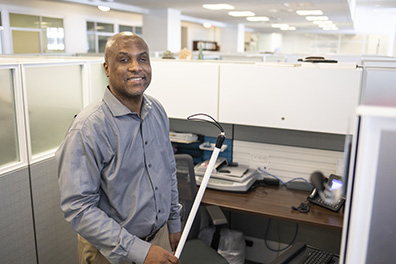 From the Editor: Among many other roles, Shawn Callaway is the co-chair of the Federation’s Diversity, Equity, and Inclusion Committee. Since March is Women’s History Month, he has contributed an article about two outstanding blind women in his community. Here is what he shares:
As we celebrate Women’s History Month, I would like to recognize the contributions of Joyce Brooks, Lois Staves, and the Inspirational Three Foundation (i3s) for their significant contributions to the blind community. I am extremely honored to express my appreciation in this periodical, because the i3s was originally founded by Joyce Brooks, Lois Staves, and Reggie Pratt due to concern about the minimal blind and low-vision services in Prince George’s County (PG), Maryland. Currently, Joyce and Lois are carrying on the mission of the i3s and continue to serve as active members of the National Federation of the Blind (NFB) of Maryland’s Prince George’s County Chapter.
Since becoming members of the NFB, Joyce and Lois have developed a passion for supporting the blind community in obtaining sufficient behavioral health services and intensive case management services. Many blind people that Joyce and Lois have encountered have not received behavioral health services, have received minimal case management services, are from underserved populations, and have low income. I humbly believe that the Division of Rehabilitation Services of Maryland is working diligently to provide services to the blind residents of PG County, but due to budget restraints and high caseloads, it is difficult for the agency to fulfill the demands of independent living skills training services that are required for blind residents.
Also, Prince George’s County government has provided minimal financial resources for training services for its blind residents. For example, I continue to serve as a board member for a nonprofit training center that provides training services for blind residents of the District of Columbia, Southern Maryland, and Northern Virginia. I am therefore aware of the funding to provide independent living services to blind consumers in the above jurisdictions. In fiscal year 2022 and 2023, the nonprofit received less than $25,000 to provide services to county residents. On the other hand, Montgomery County, Maryland, and the District of Columbia governments allocated substantial funding for their blind residents to receive independent living skills training services.
Determined to help blind consumers obtain some standard of quality of life, the i3s provides case management and peer support groups to consumers from the blind community and continues to be the only organization not receiving government funding that provides the above services in Prince George’s County for blind residents. Indeed, Joyce and Lois have provided intensive case management services to blind county residents on a volunteer basis. There have been dozens of residents who had no guidance after experiencing vision loss but were provided with instant direction and resourceful information from Joyce and Lois. These two dynamic individuals have taken calls from blind county residents as early as 7:00 a.m. and as late as 10:00 p.m. to ensure that they are given sufficient guidance to receive the correct services so they can live as independent blind people.
Because of their connections to blind organizations, blind county residents are quickly engaged in activities provided by the i3s until they receive independent living skills training. In addition, the i3s have assisted blind unhoused individuals with locating shelter, food, and clothing. Assistive technology trainings are held on an as-needed basis. There are many blind county residents who have not received any assistive technology training after receiving their equipment from their state agency. However, i3s have referred individuals to organizations that provide basic JAWS keyboarding and smartphone training until the consumer receives a call from a state agency to begin more formal and intensive training. The i3s have called on the assistance of Federationists Libra Robinson and Tajuan Farmer to conduct the assistive technology training, which includes their wildly popular Tech Talk Tuesdays.
Since 2014, the i3s have facilitated weekly support groups for over 550 blind people. These support groups have been impactful in multiple ways. First, historically after experiencing vision loss, blind consumers are rarely referred for behavioral health resources by any agency that serves the blind. However, the i3s have conducted behavioral health discussions and provided resources to blind consumers who have participated in the support group. The i3s have collaborated with multiple behavioral health clinicians, and many of the consumers have acquired assistance to address their behavioral health needs. Second, there have been blind working-aged consumers who decided that they had no desire to be employed, or they thought that obtaining employment was a long shot. After participating in the daily support groups from the i3s, which included guest speakers from the employment sector who facilitated discussions on disability employment, these same county residents became motivated and sought out employment training services from their state agency. Third, the i3s have provided support to family members who have loved ones who have lost their vision.
Often, we fail to understand that family members are having a difficult time accepting that their loved one has lost their eyesight and feel that their loved one will no longer be independent. The i3s have developed support group sessions for family members to help them understand that their loved one who has lost their eyesight can be independent and can live the lives they want. Fourth, the i3s have been engaged in their local community events. For example, they have provided support to patrons at the Prince George’s County chapter resource day and the Reed Temple Mega Church community day. Lastly, some blind consumers who have participated in the i3s support groups have become members of the NFB. Many have joined the Prince George’s County Chapter and Greater Washington, DC, chapters and have made meaningful contributions to the organization and the blind community. Support group guests such as Melissa Riccobono, Ever Lee Hairston, Anil Lewis, and Ron Brown were helpful in encouraging support group members to consider the Federation. Furthermore, despite personal health challenges, Joyce and Lois have continued to provide case management services to blind consumers. It is important to note that both Joyce and Lois are over seventy years old and work harder than individuals half their age to serve the blind community.
The i3s have been recognized by multiple community stakeholders. After their first year of service, the i3s received the 2015 Community Service Outreach Award from the Prince Georges County Department of Child and Family Service and Department on Aging, and in 2019 they received the National Federation of the Blind of the District of Columbia Presidential Award.
In conclusion, the i3s have gone above and beyond in preparing blind PG County residents to live the lives they want. As I write this article, I am amazed that i3s continue to be the only non-government-funded organization in Prince George’s County to provide support groups, case management services, and referrals for assistive technology training to blind residents. If the i3s did not exist, it is highly probable that there would be dozens of blind county residents sitting at home and wondering if it is truly possible that they can live the lives they want. Therefore, for Women’s History Month, I tip my cap to Joyce Brooks and Lois Staves for their unselfish contributions to the blind community and for being a beacon of hope for blind people who now know that they can lead productive lives.