From the President's Desk
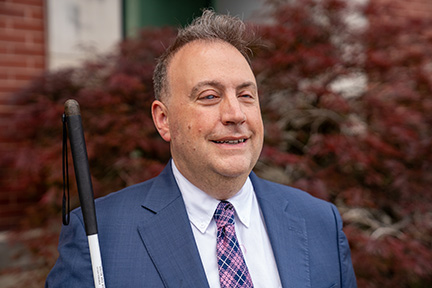 From the Editor: The following are recent letters that President Riccobono sent to key senators and to the administrator of the Office of Information and Regulatory Affairs (OIRA), an executive agency. The first letter urges Senate action to advance legislation that would establish a national framework for the advancement of autonomous vehicle technology, including important nondiscrimination and accessibility provisions. The second seeks to protect the integrity of the forthcoming regulations applying Title II of the Americans with Disabilities Act to websites operated by state and local government entities, including K-12 school systems and institutions of higher education. OIRA has issued an announcement that, while vague, signals that it may delay, amend, or otherwise undermine the new regulations which, as the letter documents, were well over a decade in the making. Here are the letters:
February 2, 2026
The Honorable Ted Cruz
Chair
Senate Committee on Commerce, Science, and Transportation
167 Russell Senate Office Building
Washington, DC 20510
The Honorable Maria Cantwell
Ranking Member
Senate Committee on Commerce, Science, and Transportation
511 Hart Senate Office Building
Washington, DC 20510
Dear Chairman Cruz and Ranking Member Cantwell:
The National Federation of the Blind is the nation’s transformative membership organization of blind people. We advance opportunity, equality, and independence for our members and all blind Americans. We write to ask the Senate Committee on Commerce, Science, and Transportation to include an urgently needed national autonomous vehicle framework in the Surface Transportation Reauthorization Act.
You have a truly historic opportunity to expand transportation access for seven million blind and low-vision Americans and millions more with travel-limiting disabilities. The blind community, the autonomous vehicle industry, and the public need congressional leadership to establish a clear federal framework for this pivotal technology.
Many members of the National Federation of the Blind’s state affiliates and local chapters across the country have ridden in SAE Level 4 fully autonomous vehicles, including those functioning with the technology spearheaded by Waymo in the states where the service commercially operates today.
For blind Americans, fully autonomous vehicles can provide a convenient, private, flexible, reliable, and discrimination-free transportation option that supports access to work, education, and community engagement. However, the autonomous vehicle industry needs regulatory certainty and a framework within which to expand. A national autonomous vehicle framework would create a necessary baseline for this technology, ensuring innovation continues to move forward.
Congress faces a watershed moment. The United States must lead globally in autonomous transportation policy rather than allowing other nations to define the future of this technology. We urge the committee to seize this bipartisan opportunity to demonstrate American leadership while expanding transportation access for all.
As you develop this framework, we ask that you explicitly protect the civil rights of blind people by including a provision that prohibits requiring a driver’s license—for any human operator—to hail or use a fully autonomous vehicle. This protection is reflected in the AV Accessibility Act (H.R. 4419), introduced in the United States House of Representatives, and is essential to ensuring that blind people can benefit from this technology on equal terms.
For more than eighty-five years, the National Federation of the Blind has worked collaboratively with Congress to ensure that the lived experience of blind people informs public policy. We are positioned to continue that partnership and eager to work with you to develop a national autonomous vehicle framework that will shape transportation access and independence for generations to come.
Sincerely,
Mark A. Riccobono, President
National Federation of the Blind
March 5, 2026
Mark Paoletta
Administrator
Office of Information and Regulatory Affairs
New Executive Office Building
725 17th Street, NW
Washington, DC 20503
RE: Nondiscrimination on the Basis of Disability; Accessibility of Web Information and Services of State and Local Government Entities Final Rule
Dear Mr. Paoletta:
The National Federation of the Blind is the transformative membership and advocacy organization of blind Americans. Throughout the course of our eighty-six year history, we have sought to advance the lives of all blind people in the United States. A major driver of that advancement during our existence has been equal access to information, particularly digital information. It is for this reason that we oppose any attempt to delay, rescind, or otherwise undermine the effectiveness of the Americans with Disabilities Act (ADA) Title II website regulation that is set to take effect on April 24, 2026.
While reflecting a compromise between the needs of people with disabilities and the resources of covered entities, the clarity provided by the website regulation is important to the lives of people with disabilities, in particular to blind students in public and higher education. Blind students are too often excluded from the curricula their sighted peers experience because educational materials are offered digitally through inaccessible websites and mobile applications. As a result, they are often unable to compete on a level playing field with their peers, are unable to benefit fully from their education, and are delayed in attaining their degrees and entering the workforce. The inaccessibility of educational materials is one of the most significant barriers to blind people being able to achieve their full potential and make their rightful contribution to American society.
The website regulation provides exactly the clarity state and local government institutions have been requesting regarding their obligations under Title II of the ADA to make their websites and mobile applications accessible. Since 1990, Title II of the ADA has required state and local governments to ensure their communications with individuals with disabilities are “as effective as” communications with nondisabled individuals. Since 1996, the Department of Justice has made clear that this obligation includes their communications via the internet and mobile applications.
Moreover, the communications of recipients of federal funding have been subject to that same requirement pursuant to Section 504 of the Rehabilitation Act since 1973. In the decades since, courts and other federal agencies have agreed, and the Department of Justice has issued several guidance documents providing technical assistance to covered entities.
Yet, educational institutions and other state and local government entities have claimed to be unclear exactly how they should comply with the “equally effective communication” obligation. In 2024, more than thirty years after the signing of the Americans with Disabilities Act into law, the Department of Justice issued the website rule. Far from being a surprise to covered entities, the Department first issued an advance notice of proposed rulemaking (“ANPRM”) in 2010, which sought information from covered entities and individuals on what should be included in the rule. The Department received approximately four hundred comments.
In 2016, the Department issued a supplemental ANPRM, again soliciting public input, which received more than two hundred comments. In 2023, the Department issued a notice of proposed rulemaking regarding website and mobile application accessibility requirements, setting forth the Department’s proposals and including more than sixty questions for public comment. The Department received nearly three hundred fifty comments. In addition, the Department attended a variety of listening sessions to gather additional input. The final rule was issued on April 24, 2024.
The final rule clarifies what is required to meet Title II’s equally effective communication requirement in the context of state and local government websites and mobile applications. It provides a clear technical standard based on an internationally recognized and widely adopted consensus standard. It also provides flexibility by allowing covered entities to achieve equivalent facilitation and preventing liability for inaccessible elements that do not substantively affect the usability of a website or mobile application.
Notably, the website rule also provides a series of exceptions, presumably implemented at the behest of covered entities, establishing web and mobile application elements and content that do not have to be made accessible. These exceptions are not available under the pre-existing equally effective communication requirement. Although the equally effective communication requirement has been in effect for decades, the final rule also provides delayed effective dates of two or three years, depending on the size of the affected government. Thus, rather than burdening state and local governments, the rule actually reduces the burdens on those entities. Further, the rule included a comprehensive and careful analysis of the benefits and costs of the regulation, showing that the benefits substantially outweigh the costs.
The website regulation reflects exactly what public entities have been seeking since the passage of the Americans with Disabilities Act in 1990–a clear, transparent shared understanding of the applicable legal requirements. The final rule is clear and comprehensible, does not stray from legislative intent (which made clear that the effective communication requirements of the Rehabilitation Act should be incorporated in the ADA), accurately estimates the costs and burdens, and provides clear safe harbors.
There is no basis for reconsidering the website rule, which has already gone through fourteen years of consideration, public input, and adjustment, and which is based on a requirement in existence for nearly fifty years. Additionally, public entities have had nearly thirty-six years to prepare for the requirements that were initially established in the ADA, clarified by the final rule, and have been actively requested by stakeholders on all sides. Conversely, delaying or amending the regulation at this point would severely harm blind and other disabled Americans by denying us access to important civic information.
Thank you for your attention to this important issue.
Sincerely,
Mark A. Riccobono, President
National Federation of the Blind
NFB Pledge
I pledge to participate actively in the efforts of the National Federation of the Blind to achieve equality, opportunity, and security for the blind; to support the policies and programs of the Federation; and to abide by its constitution.