From the Editor
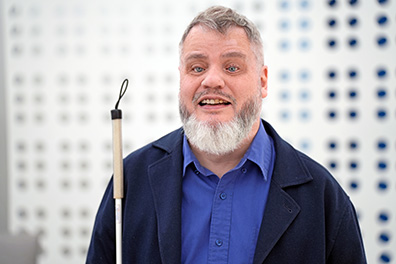
by Chris Danielsen
 I am trying something a little different starting with this issue of the Braille Monitor, and I am eager to know what you think about it. Instead of affixing an editor’s note to every article in this issue, I am placing an overview of the issue here at the front. I am hopeful that it will be a useful guide to the reader as to what to expect, and, where appropriate, to tie the issue together thematically for both myself and our readers. Going forward, I personally hope that writing this introduction will help me do a better job of planning each issue, and hopefully you will find reading it equally useful. But however you feel about it, please let me know by sending an email to [email protected] or calling 410-659-9314, extension 2330. That invitation goes for any other feedback you have about the magazine as well, and of course for your own article submissions.
These pages are often devoted to discussions of what we describe as “Federation philosophy.” An excellent contribution to this genre of article appeared in our January 2026 issue. It was entitled “The Myth of the SuperBlind” and was written by Cricket X. Bidleman. In the article, Cricket posited that putting certain blind people (often leaders) on stage, literally or figuratively, both exert undue pressure on them to seem invulnerable and unintentionally sends the message that there is a certain type of blind person that every Federationist is expected to be or to become. The article generated both enthusiastic and caustic responses on our social media and in feedback that I received personally. Therefore, it seems appropriate that we continue to discuss what our philosophy of blindness is and is not, and how experienced leaders and members can make it real for new or struggling members without placing a barrier in their path when we mean to make that path smoother.
Our first impulse, when confronted with people who say that they have experienced our movement as a group of blind people whose primary goal is to establish our superiority to other blind people, is to deny that any person who has even passing familiarity with our movement could possibly think such a thing. But while some social media posts tell us that they find the Federation affirming and supportive, others say the opposite, and they cannot always be dismissed as the grumblings of the usual suspects who have never bothered to learn much about us. Indeed, I was personally recently surprised that someone whom I had known for several years publicly left our movement on their social media page, claiming that they had always found it cult-like and toxic.
To further the ongoing discussion, this issue includes both a classic speech of our movement and some responses to it. When I was a student at the Louisiana Center for the Blind in the summer of 1992, some of our teenage students came back from that year’s national convention in Charlotte, North Carolina, with a question: Why was then-President Emeritus Dr. Kenneth Jernigan seen walking with a sighted guide during much of the convention rather than simply traveling with his white cane, as these teenage students were learning to do? I remember well how this discussion played out in one of our seminars, and I remember that Joanne Wilson, the center director, encouraged the young people to write to Dr. Jernigan and ask him directly. They did, and the result was not only a thoughtful letter in reply but his 1993 Convention address “The Nature of Independence.”
We are reprinting that address in this issue, along with reflections upon it that were part of a recent episode of our Nation’s Blind Podcast and an article submitted by one of the participants in the 2025-2026 cohort of the Kenneth Jernigan Leadership in Service Program. We hope to include even more reflections on this topic in future issues, including yours; please see above for how to get them to us. I will close my own reflections on this seminal speech and what it seeks to address with this quotation from it: “We absolutely must not become so rigid and dogmatic about the means and precise details of achieving independence that we make ourselves and everybody else around us miserable. Down that road lies bigotry, as well as the loss of any real independence or true normality.”
Speaking of the Kenneth Jernigan Leadership in Service Program, two other members of the current cohort have submitted reflections that are, among other things, appropriate for the May celebration of Mother’s Day, so we’ve included those as well.
Technology is always a popular topic in these pages. In this issue, Jonathan Mosen, the Federation’s Executive Director for Accessibility Excellence, presents a comparison of two multiline Braille displays that are now on the market, one of which, the Monarch, the Federation had an important role in creating. This is in direct response to questions that our Center for Excellence in Nonvisual Accessibility has received, so we hope Jonathan’s thoughtful and thorough article helps readers choose the right Braille device for their specific needs.
Don’t worry, we did not forget that another national convention is approaching in July. Norma Crosby, president of our Texas affiliate, which is of course hosting our planned gathering in that state’s weird and wonderful capital city of Austin, has compiled some things you will want to know about said city. Donald Porterfield, president of our Arizona affiliate and chair of the Resolutions Committee, provides tips and reminders for those who are preparing proposed policies for our convention to adopt. And of course, there’s the Convention Bulletin, updated with all the latest information we can provide as the big event approaches.
We’ve rounded out the issue with the latest news from our movement and the blind community, including an update on developments at LightHouse for the Blind and Visually Impaired of San Francisco, another victory for blind students of higher education, and information from Rachel Held, one of our outreach staff, on how chapters can participate in this year’s Coast to Coast Movement Challenge.
Happy reading, and please do share that feedback! As I have said before, this magazine truly reflects our movement only to the extent that all of the voices in our movement are part of it.