Resolution Reminders
by Donald Porterfield
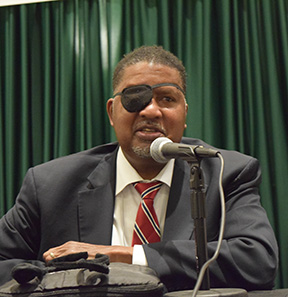 From the Editor: Donald Porterfield is a member of the board of directors of the National Federation of the Blind and president of the Arizona affiliate. He is also an attorney who works as a prosecutor in Pima County, Arizona, and his legal skills no doubt serve him well in his role as chairperson of the National Federation of the Blind Resolutions Committee. Here is what he has to say about the writing and submitting of resolutions, which will very soon need to be composed and sent to him:
Do you want to make a difference in the lives of blind people today and in the future? Do you think we should change a government policy, take a stand concerning an agency for the blind, or create new regulations? If you do, consider writing a resolution. Here are a few reminders to help you, as well as some questions to think about when writing a resolution. First, the questions:
- Has a resolution already been written on your subject? If so, are you really adding something new?
- Is the resolution necessary, or would a letter from the national President accomplish your goal? For example, a letter from the President commending an organization might be a better alternative than a resolution.
- Did you do your research to ensure the accuracy of the resolution?
- If the subject of the resolution would be of interest to a division, did you discuss your resolution with the division president?
Please be mindful of our deadlines. To ensure that your resolution will be considered by the committee, please send it to President Riccobono or to me by June 4, 2026, one month before the committee meeting. Since things are always busy leading up to the convention, we appreciate you sending them earlier if you can. If you send a resolution to me by email and do not receive a response acknowledging your email in two or three days, please call me at 520-850-2180 or send it again. If you miss the deadline, you must get three members of the committee to sponsor your resolution and then get it to me before the meeting begins. I will be pleased to accept resolutions by email at [email protected].
All resolutions will be placed on the NFB website shortly before the committee meets at convention on the afternoon of July 4. This procedure will give the membership a chance to look over the resolutions before the meeting and advocate with the committee members to support or defeat the resolutions.
Guidelines for Resolution Writing
A resolution is one very long sentence divided into two parts. In the first part, a case is made that certain events have taken place or certain conditions exist that require action. The events are described in short statements that begin with the word WHEREAS. These statements should clearly set forth the reason a resolution is being written, without being so detailed that they make the reader wish the resolution had never happened. The second part of a resolution explains what will or should be done based on the argument laid out in the first section. Resolves are used to say what the NFB will try to persuade others to do. These, too, should be brief and to the point: long enough that they are not ambiguous and concise enough that they avoid repeating what has already been said.
You should begin by determining what your RESOLVED clauses are, that is, how many there should be and what their basic thrust is. You will know how many by the number of entities we need to address or the number of problems we need to fix. After you decide specifically how you want the problem fixed, determine the smallest number of concepts you need to explain to a person unfamiliar with the problem to convince them that there is a problem. The best resolutions can be picked up by a person unfamiliar with the issue and hold that person’s attention (in other words, they are as short as possible) while still actually explaining the problem and the solution or solutions. This method, deciding the ending first and then crafting the arguments to reach it, will result in the simplest and clearest resolution. Then, when you actually write the formal resolution, you can focus on the writing and the style, having already done the planning part.
Here are the punctuation and layout rules for writing resolutions:
- Each argument begins with the word WHEREAS, all caps. BE IT RESOLVED and BE IT FURTHER RESOLVED, which introduce the RESOLVED sections, are also written in all caps. Note that WHEREAS is followed by a comma, but the two versions of BE IT RESOLVED are not.
- Each WHEREAS before the final one ends with a semicolon and the word “and.” This is true of the word “RESOLVED” as well.
- The final WHEREAS ends with a colon, the words “Now, therefore,” and a hard return. Please note that “Now” is capitalized.
- The final RESOLVED ends with a period. This reflects the fact that the entire resolution is a single sentence. Sometimes one is taxed to refrain from writing sentences within WHEREAS clauses, but inserting a complete sentence is not playing the game fairly.
- A blank line separates the elements of the resolution.
- In the beginning of the first RESOLVED, surround the year and the state with commas. The formula looks like this: “BE IT RESOLVED that the National Federation of the Blind in convention assembled this eighth day of July, 2000, in the city of Atlanta, Georgia,” note also that the c in city is not capitalized.
Remember that the resolves are couched in the subjunctive mood, which is rarely used in English. This means that the third person verbs look singular instead of plural, with the s removed: “the organization urge,” “the NFB condemn and deplore,” etc. This is because the subjunctive mood is invoked by words like suggest, wish, demand, request. Compare the following two sentences:
She visits her cousin every week.
I suggest that she visit her cousin every week.
The second sentence is in the subjunctive mood because of the verb “suggest,” so the correct verb form is “visit” instead of “visits.” It is the same with resolutions.
The rather strained form of the resolution makes it sound unnatural and formal. Do not attempt to add to this effect by indulging in jargon and verbosity. Even though resolutions are frequently long, brevity is a virtue. Each argument should be made concisely but clearly. Jargon never helps this process. Substituting “utilize” for the short, vigorous word “use” and referring to people as “persons” or “individuals” are good examples of counterproductive inflation of the pomposity quotient. On the other hand, because resolutions are formal statements of a policy position, you should avoid slang or informal words like “exams” instead of “examinations” or “quotes” for “quotations.” Verb forms like “hunker down” or “get going” are also a bit too casual for use in resolutions.
You will remember that the NFB is on record as opposing people-first language, except as it happens for some reason to sound euphonious. We are also on record as opposing the use of the terms “visually impaired” or “visual impairment” in favor of “low vision” (hyphenated when used as an adjective) if any distinction needs to be made between totally blind people and those with some eyesight. In other words, “blind people” is perfectly acceptable, or, if there is a good reason to make the distinction, “blind and low-vision people.”
Capitalization should be consistent. Do not capitalize words for emphasis. Quotation marks should not be used for this purpose either. “Federal” is not capitalized unless it is part of an actual title or is the first word of a sentence. Since WHEREAS clauses begin with capital letters, “federal” is almost never capitalized in resolutions. “Congress,” on the other hand, is, as are “House of Representatives” and “Senate.” Names of departments and organizations are capitalized, but terms like “departments of education” or “vocational rehabilitation agencies” are generic and should not be.
Resolutions often pile up nouns as adjectives. When this happens, the terms should be hyphenated: access-program producers.
Congressional bill numbers are written H.R. 0000 or S. 0000.
Resolutions are an important part of the work of the national convention. The Braille Monitor is a good sounding board for new ideas and new policies. Consider writing an article about your new idea or policy so that the conversation can begin, and you will be ready to write your resolution for 2027. However, the most immediate task is to start working on the resolutions for 2026. Resolutions guide our organization. Put your thinking cap on and get your fingers typing. Let’s make sure we have a great set of resolutions for the 2026 Convention! The job of the membership is to make sure the committee has resolutions to consider. I look forward to receiving yours!