When the Pain Is Real, but the Reason Is Invisible
by Kaleigh Brendle
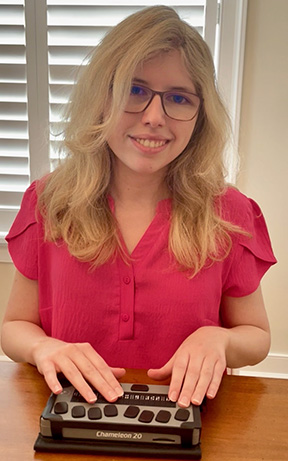 On a scale of one to ten, how do you rate your pain? That might appear to be a very straightforward question. You take the amount of pain you’re experiencing and compare it to episodes of pain you’ve encountered in the past. But what if you experience intense pain all the time? How do you quantify the pain you’re experiencing in one given moment when pain has become your normal? When I’m asked that question now, I usually laugh it off and discuss my high pain tolerance, without explaining why I’ve had to develop such a high tolerance in the first place.
I’m twenty-three years old. I’ll be attending UC Berkeley Law School this fall. I’ve been involved with the Federation since I was seventeen, after the College Board revoked Braille as an accommodation for all blind Advanced Placement students and the Federation advocated for its immediate restoration. I learned from leaders like Tim Elder, Pam Allen, and President Mark Riccobono and cultivated my blindness philosophy through candid discussions with students who had found the organization years earlier.
I knew that I had another disability. As I pursued my undergraduate degree at Villanova University and held leadership positions in both the state and national student divisions, it sat comfortably in the background. It would pop up occasionally, but I could easily manage it with the appropriate academic accommodations and personal boundaries. My disability is called Hypermobile Ehlers Danlos Syndrome, which is typically characterized by overly flexible joints. People sometimes think of us as the ones who can execute really cool party tricks and excel in gymnastics, but that extra flexibility can lead to joint pain and frequent dislocations.
I didn’t fully realize how much my Ehlers Danlos Syndrome would affect my life until I began my pursuit of training at the Louisiana Center for the Blind (LCB). For the first time, I was the odd one out in a blindness space. I watched my peers of all ages progress through their classes with ease, while I ended up at the urgent care clinic so frequently that the receptionists all knew my name. I would barely be able to stand after my hours of preparing meals in the kitchen. I would come very close to fainting when performing travel routes on hot days. At night, I would experience intense temperature fluctuations, either feeling as though I was burning up with fever or so cold that I’d end up sleeping under multiple blankets in my heaviest winter coat.
The pain was the worst part. Every night I would lie perfectly still and feel it in my ankles, my knees, my hips, my wrists, my elbows, my shoulders, and my neck, hoping that sleep would grant me respite. I had the honor of developing my blindness skills under the direction of incredibly skilled instructors, but I was also learning what a life with Ehlers Danlos Syndrome meant.
But how could I prove it? I had one letter from a physical therapist stating that I had Ehlers Danlos, but that was it. The specialists I needed notes from were all completely swamped, if they were taking patients at all. We as Federationists contend that the world was not built with us in mind. The same is true for those with disabilities like Ehlers. When someone sees my cane, they immediately gather that I cannot drive. By contrast, some perceive the limitations created by chronic conditions as personal choices rather than concrete facts. When I say that I cannot walk a mile in heat or sit at a desk for long periods of time, that doesn’t mean I’m simply choosing not to because I don’t feel like it. It means I can’t or I’ll pass out or be in such pain that I’ll lose a night of sleep. Those fears are based on experiences of having had to ignore those boundaries and fighting through the subsequent repercussions.
All of a sudden, I was navigating two starkly different worlds. At LCB, my access technology instructor regularly incorporated stretch breaks into his lessons. Meanwhile, I was having to articulate to the Law School Admission Council (LSAC) why I “deserved” the accommodation of stretching during the LSAT. At LCB, my woodshop instructor would give me alternate assignments if I was in a significant amount of pain, assignments that would still allow me to learn through the Structured Discovery approach. On the other hand, the LSAC nearly made me sit for the LSAT with a concussion and the associated pain that my additional disability creates when my body experiences trauma.
In my experience, people tend to approach chronic health-related matters transactionally rather than empathetically. The focus becomes either your ability to prove what you are alleging you live through, the subtle guilt trips that come with having to refuse a task or outing, or the inquiry of whether it’s all really as bad as you make it out to be. Statements like, “Well, you’ll have to figure this out when you have kids” neglect to acknowledge that I will likely parent differently than someone else. “Figure it out” won’t mean performing tasks that will put me at risk of injury. “Figuring it out” means finding alternative ways of doing something. It also might mean asking for help. People have balked when I’ve made that comment, but there is nothing wrong with asking for help when your disability necessitates it. Able people ask for help all the time. Reaching out when we truly cannot do something should never be something a disabled person is shamed for.
I have been shamed for asking for help by people of all ages. I have been mocked for my disability by other disabled people. I have cried that I’m hitting my limit and been met with an emphatic and unflinching expectation that I push harder. In so many spaces I’ve been in, no paper trail means you’re on your own.
My multiple disabled friends in and out of the Federation have been the biggest blessing. We support each other during the flare-ups and the difficult days. We share strategies for how we navigate the symptoms of our conditions. We listen, we empathize, we encourage, and we stand together.
For those who do not possess disabilities that cause chronic pain and other similar tribulations, I ask this of you: do not project your misconceptions in the advice you give. If you sprained your wrist once, that is not the same as having aggressive tendinitis. If your mom’s cousin’s friend has the same condition as the person you’re speaking with, that doesn’t mean that it manifests in the exact same way. If you are comfortable with and proud of your disability, understand that the person you’re speaking with may not be in the same stage of their journey. Finally, and most importantly, no means no. If someone is telling you that doing something will cause them pain or has attempted to do something and it is now causing them pain, their lived experience needs to take precedence in that moment. If you are concerned about the possibility of them faking a condition, ask yourself how you would feel if someone accused you of faking yours.
To anyone reading this who has a disability like mine, you don’t have to be proud today. You can cry. You can be angry. You can be nervous about what comes next. Just know that there will come a day when you’ve discovered strategies, therapies, supplements, or supports that make it easier. You will find people who believe you, who listen, and who won’t walk away when a flare-up strikes. I feel very lucky that I’ve found many people like that through the Federation, and I’m grateful for them every day. I won’t say that one day everything is going to be perfect. But one day, it will be better. We stand with you until that day comes and will be here to celebrate when it’s here.