The Super-Braillers and Me
by Will Hendrick
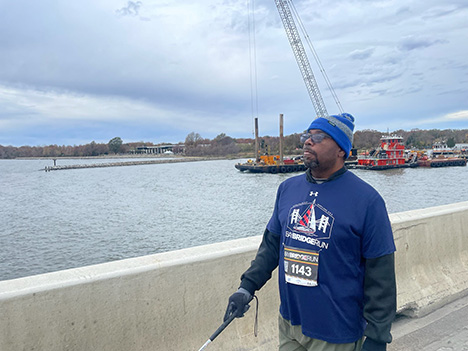 From the Editor: Will Hendrick serves on the board of the Greater Baltimore Chapter of the National Federation of the Blind of Maryland. I serve as president of that chapter. Will wrote this article in response to the “Myth of the SuperBlind” episode of the Nation’s Blind Podcast, which we excerpted in last month’s issue of this magazine. Here is what he shares:
Hello friends! Thank you for another great episode. When I participated in my first vocational rehab, unfortunately, some of the blindness professionals that assisted me gave me bad impressions of the National Federation of the Blind—professionals that helped me quite a bit, I might add, which is why I was inclined to listen to their opinions. I remember one comment in particular: “Those Federationists!” My opinion at the time was that if the professionals that get paid to inform me about the existence of the Federation don’t think it is all it is cracked up to be, then I don’t think I want to get too close. But I will still go, learn, and see what the organization has to offer. These blindness professionals were blind, I might also add. But nine years later, I am happy to say I am glad that I made up my own mind and gave the Federation a chance.
It took me years of participation in the National Federation of the Blind before I got to know people I clicked with or experienced actual friendship. That is mostly because I am picky! I don’t want to be close friends with just anyone or just because someone is blind. Blindness doesn’t mean someone is a good person. After making the effort to observe and participate, relationships have developed that I am proud to have. And I believe I am a better person for having them.
My “super-blind” experience was when I first tried to participate in Dinner and a Play at the Maryland State Convention about five years ago. Each year at the state convention, a cast of Braille readers performs a play while the audience enjoys dinner. The cast is not always the same and is recruited each year, but the group always goes by the name of The Braille Is Beautiful Players. I received an email stating participants were needed for the play and that experience did not matter. I had recently been discharged from my Braille class at the Workforce and Technology Center in Baltimore. I knew I needed to practice to maintain my skills, but I wanted to practice in a fun way. So, I responded to the email stating that I wanted to be in the play. So far, so good. But I did not receive my copy of the script until the day before the first rehearsal. I was unable to practice on my own with such short notice, but the email had said experience did not matter.
At the first rehearsal, on Zoom, I experienced how amazing blind people can be. The play we were performing was extremely long. In fact, it took us about an hour to read it through one time. Therefore, the cast was anxious to begin. These seemingly professional Braille readers took off like racehorses, SWOOSH! My part was ten pages into the play, so I did not have anything to read for several minutes. When the cast reached my segment of the play, I had no idea where they were. I was so embarrassed! I felt like I was letting the cast down. I certainly did not think I was an experienced Braille reader and knew I needed more practice, but my teacher had discharged me, so I must know something, I thought. Full of shame and embarrassment, I asked the cast to skip me and said that I would try to do better at the next practice.
In between rehearsals, I tried to practice, but our play was about Louis Braille, so some of the words and names were French. I could barely read English words, let alone French ones. At the next rehearsal, again the “Super-Braillers” took off. I tried to follow along, but after several page turns of the play, I lost my place. When it was my turn to read, again I was lost and asked the cast to skip me. It was looking bad. I wanted to be a part of the cast but felt that if experience truly did not matter, some kind of consideration should have been taken for a novice like I was at the time. The other cast members were laughing and bantering with one another, and I felt alone. The director, Debbie Brown, and another cast member, Sharon Maneki, called me individually to offer me help, but I was in my feelings by then and too proud to ask for assistance.
With only two rehearsals left, I realized I had to go to plan B. I stopped trying to practice the whole play and just focused on my lines. I only had two. Therefore, I memorized my lines and the lines immediately before them as a cue. At the third rehearsal, I was able to perform with the cast. By the fourth rehearsal, my solution had worked and I had no problems performing.
On the evening of the performance, when the cast sat together for the first time, I was hoping to get to know someone. Maybe that would have happened if I had chosen to have dinner with the cast, but I did not have a room at the hotel. I commuted from home to save my money. When I arrived for the play, most everyone had a seat already and was familiar with the person they were sitting next to. The person I sat next to when I performed did not say one word to me at the play. This was clearly not an intentional snub, but as I said, I was hoping to get to know someone and I thought more people would appreciate the courage it took for me to get on the microphone and perform with more experienced Braille readers. I did not feel the love.
As the saying goes, perception is reality. I think most of this was in my head and I was just in my feelings because I was embarrassed. I am now proud to call the person I sat next to at the play five years ago one of my closest friends. Her name is Melissa Riccobono, and she is, among other things, the co-host of the Nation’s Blind Podcast.