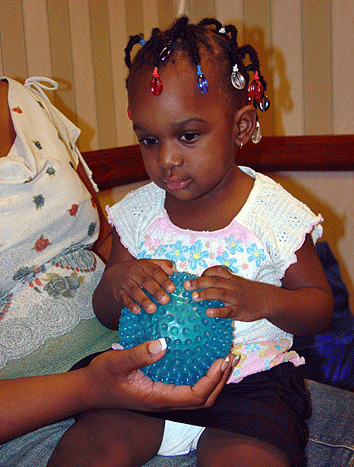
The toddler is intrigued by the tactile quality of her “bumpy” textured ball.
The purpose of this chapter is to demonstrate that students with low vision must be encouraged to explore the world not only with their eyesight, but also through their sense of touch. Touch will not only enhance their vision, but also will improve their ability to learn. Pairing vision with touch will give the student more information and a fuller view of the object under examination. Instead of running the risk of gaining only partial or inaccurate information through the exclusive use of the impaired visual sense, add in the tactile for additional, reliable information and details. Michael Anagnos the second director of the Perkins School for the Blind, explains: “Tactual observation is of inestimable value. This mode of instruction bridges over the chasm from the known to the unknown; from the concrete to the abstract; and lays a solid foundation for the mind to work upon.” (Peaco, 2000, p. 325)
|
The toddler is intrigued by the tactile quality of her “bumpy” textured ball. |
The French philosopher, Denis Diderot, offers the following evaluation of the senses: “I found that of the senses, the eye is the most superficial; the ear the most arrogant; smell the most voluptuous; taste the most superstitious and fickle; and touch the most profound and philosophical.” (Peaco, 2000, p. 315)
If this evaluation is valid, the development of tactual skills should be part of every child’s education. Common sense dictates that if a student has limited vision, he should develop greater use of the other senses to compensate for that poor vision. This chapter will also examine some useful tactile skills that low vision students should have and how they can be developed.
The following excerpt is adapted with permission from Willoughby and Duffy (1989, pp. 66-67).
Allison: Allison, a third grader in rural Iowa, could not describe how corn grows on the plant. “But she sees corn all the time,” protested her mother. However, Allison never had walked right up to the corn plants, touched them, and examined how the ears grew. She had not been lifted up to see how high the stalk grew. She had seen only a green mass.
Tiffany: “Mom?” asked Tiffany one day as they sped along the highway. “How come there aren’t ever any cars on our side of the road?” Her surprised mother suddenly realized that Tiffany could not see cars ahead or behind. She could only see and hear them as they went by and those cars were all on the other side of the road.
Mark: Mark had quite a bit of sight. He also was very mobile and examined things well by touch. Yet at age eight he did not know what the downspout on the corner of the house was for. He knew it only as a “pipe” of unknown purpose. He had never been close to it during a rainstorm.
These three examples show how easy it is to make wrong assumptions about partial sight. The child, never having seen well, really believes that he “can see it.” Adults with good vision find it very hard to imagine imperfect sight.
Even with the best attitudes and freedom to explore, a child with low vision as well as a child with no vision is likely to have some gaps in his/her experiences. Parents and teachers should look around continually for learning opportunities.
When showing an object, encourage the student to feel it as well as look with his or her eyes. Help the student and others to realize that it is really okay to examine objects by touch. Too often students are inhibited from learning because of self-consciousness about touching. Remember that it can also be embarrassing for a student to discover what he does not know. Be sensitive, tactful, and careful about where and when you deal with misconceptions and gaps in knowledge.
Food for Thought: The misunderstandings described above occurred because of the students’ limited vision. Since tactile skills provide additional information, they are a useful way of enhancing vision. Touch is a useful method to eliminate gaps in understanding.
By Barbara Cheadle
Editor’s Note: This Parent Perspective from the president emerita of the National Organization of Parents of Blind Children illustrates how touch enhances vision. Reprinted with permission from Future Reflections, Winter 2012, vol. 31, no. 1.
Was this a bruise on the apple? Frowning, I slipped off my glasses and brought the apple up close to my eye. Just then, I heard a soft chuckle and the teasing, deep voice of my adult son, Chaz: “Use your hands, Mom. Use your hands.”
When parents are raising a child, they can never be sure—at the time—that what they say and do is really getting through. It’s only years later, as those children strike out on their own as young adults, that parents find out how much of their efforts and how many of their lessons really got through. This was one of those wonderful, joyous moments of vindication that parent’s dream of; right there in my kitchen, while making a special family meal with the help of my partially sighted, legally blind son, Chaz.
You see, “Use your hands, Chaz; use your hands,” was our gentle mantra during much of Chaz’s early years. Our goal was never to discourage him from using his impaired (but often useful) vision, but to encourage him to use and trust his unimpaired (and almost always useful) sense of touch. We wanted our son to grow up feeling no restrictions in pursuing any interest or any career based upon his limited vision. We wanted him to be at ease with himself; unafraid of losing more vision, confident that whatever came his way he could handle it. We had learned from our partially sighted friends in the National Federation of the Blind that he needed to really believe that “It’s ok to be blind.” He also needed academic tactile skills—such as Braille. But we also learned from our observations of people at the NFB convention and other NFB events that our partially sighted son needed to trust his tactile sense and use it every day for true independence and competency. We had observed partially sighted adults clumsily and inefficiently trying to use their vision for tasks that their totally blind friends accomplished smoothly and independently—such as finding a keyhole and unlocking a door—and we wanted our son to have the best of both: to use his vision when it was efficient and useful, and his sense of touch when it was most efficient and useful.
My husband’s first career as an auto mechanic had already taught him the value of using touch, long before we had a blind son. Many are the times when a mechanic cannot get in to look at a piece or part that needs to be worked on, he or she must often do work solely by touch. So, it was easy for him to teach Chaz to use tools by touch, and to stop and listen for dropped objects to locate them by sound. Did he need a straight edge screwdriver, or a Phillips head to get a screw out? He didn’t need to get his face up there to see the screw at the top of the window, he could feel it and tell what it was, and then, using touch, unscrew it and take it out. If he had tried to do such tasks with his face right up on it, he would be clumsy, often fail, and could have concluded that he didn’t have enough vision to do most handyman types of tasks.
In the household, I observed and asked my blind friends about how they accomplished cooking, cleaning, and other chores by touch and sound. We practiced pouring liquids using touch to determine the fullness of a glass; we used touch to make a smooth bed, to pick out the best fruit, to check if the dishes were clean, peel a potato, and the list goes on. We talked about why it was not safe to put one’s nose down on the stove burner to adjust the flame—by passing his hand quickly above the surface and listening, he could feel and hear to make the adjustments he needed.
Chaz also learned nonvisual techniques directly through observing and modeling himself on the blind and partially sighted friends who were in and out of our house, and whom he saw regularly at NFB chapter meetings and other events. They also helped him accept nonvisual techniques and the use of touch and sound as normal and natural ways of doing things that one wanted to do.
 |
An adult Chaz Cheadle confidently uses tactile skills in combination with his vision as he fixes his sister’s bicycle. |
What I did not know then, but know now, was that what we were trying to accomplish was to make “touch” such a natural part of his personality and his way of being and doing, that he would not even have to think about it. And it worked.
After the, “Use your hands, Mom, use your hands,” incident in the kitchen, I’ve had several conversations with my son about how he uses touch throughout his everyday life to maintain his independence and do the things he wants to do. It wasn’t easy at first for him to analyze it because, well, he hadn’t thought much about it—he just does what he wants to do, and doesn’t usually engage in any kind of internal dialog about whether or not he’ll use his vision or touch or both for a particular task. For example, he is fond of cooking and once was employed for three months as a ship’s cook on a sailing ship that provided educational programs for school children along the Hudson River. He told me how his shipmates were astonished when they realized, while watching him cook, that he wasn’t looking at his hands or what he was doing. He was chopping, mixing, stirring, draining hot pasta, and all the other tasks purely by touch and sound while he talked with his watching shipmates.
Chaz does have useful partial vision, and he uses it effectively and extensively in many ways, especially with computers and print. For this, he does get his face close to the work, but it has not been a problem in his work as a computer information specialist. On the other hand, neither does he regret learning Braille. He uses it from time to time when he has to give a speech or a presentation, and he taught a close friend Braille so she could write letters to her beloved blind uncle.
There are some tasks that he is still working out alternative nonvisual methods for. He and his wife bought a 35-foot sailing boat, which they also live on—it is their home. He has repaired the engine, built new cabinets for it, and refinished the wood trim, without any problems. Of course, raising, lowering, and tying off the sails is no problem—that’s very tactile. But he is still learning, he said, how to navigate and steer using sound and touch and is developing his techniques and testing them out. But he loves the sea, even though the glare requires him to further reduce the amount of useable vision by wearing sunglasses most of the time he is out on deck. That’s another thing. Chaz has a central cataract, and he does not see well in bright sunlight or when there is glare. He sees best in twilight-type conditions. But, because he has incorporated touch and using touch as part of his natural way of doing things, he does not avoid glare conditions or otherwise restrict his activities to conditions that are optimal for his vision. Instead, he follows his interests wherever they take him.
Let us examine some specific activities to increase tactile skills for students. All students with low vision should have goals for the development of tactile skills in their education programs. Such goals will not only implement the spirit of IDEA (Individuals with Disabilities Education Act), but also will help the student develop a multi-sensory approach to learning. IDEA reads in part:
“The IEP Team shall, in the case of a child who is blind or visually impaired, provide for instruction in Braille and the use of Braille unless the IEP Team determines, after an evaluation of the child’s reading and writing skills, needs, and appropriate reading and writing media (including an evaluation of the child’s future needs for instruction in Braille or the use of Braille), that instruction in Braille or the use of Braille is not appropriate for the child.” (IDEA, 2004)
By Dr. Ruby Ryles
 |
Board puzzles, such as the one this low vision toddler is playing with, is an
example of a common toy that encourages the development of tactile skills. |
Reprinted with permission from “Pre-Reading Activities for Blind Preschoolers,” Future Reflections, vol. 13, no. 3.
Sometimes blind and visually impaired children come to preschool or kindergarten with less than average strength in their hands and fingers. This is the age that pre-reading and reading and writing activities should formally begin for children. Even if your child is not a future tactile reader, it is wise to spend time playing with him or her to develop arm, hand, and finger strength. Below is a partial list of activities you and your child might enjoy while doing just this. As you play you will find other activities that use these muscles. The goal is for your child to do the activity independently. But above all, have fun!
Arm and Hand Strength:
Weight-bearing activities such as:
Grip and Finger Strength:
These sample IEP goals and objectives are guidelines that you can tailor to the needs of the student and to the requirements of your local school system.
Goal: The student will use tactile techniques to complete daily living activities.
 |
Using touch allows this preschooler to hold her head in
a normal position while she practices pouring into a cup. |
Objectives:
Goal: The student will use his hands to gather information.
Objectives:
Goal: The student will demonstrate his ability to orient tactually on a Braille page.
Objectives:
Goal: The student will use tactile skills to identify room locations.
Objectives:
By Dr. Geerat Vermeij
Reprinted with permission from the Braille Monitor, October 2004.
A few years ago I was sitting in David Hillis's office at the University of Texas at Austin. Hillis, a preeminent evolutionary biologist and MacArthur Fellow, was telling me about his research on a small Asian clam that was accidentally introduced by people to North America during the late 1930's. Today this quite ordinary-looking little clam is found in lakes and streams throughout the United States. Researchers once thought that all the Asian clams in North America belonged to a single kind or species; but when Hillis began to analyze the DNA sequences of the clams, he discerned two genetically distinct species.
Hillis leaned forward in his chair. "I wonder if you can tell the difference between these species from the shells," he said.
"Let's have a look," I said, always ready for a challenge. Hillis handed me six specimens, each a little less than an inch long. There were, of course, no labels; it was up to me to decide how to divide these six shells into categories.
I set about my task. First came a quick reconnaissance: I took each shell in my hands, manipulated it with my fingers, and put it down, all in less than a second. Much previous experience with Asian clams and with thousands of other clams allowed me to conclude that, yes, these shells belong to the genus Corbicula: ovate shape, coarse and somewhat irregular growth lines, right hinge characteristics, somewhat eroded beak without well-developed lunule or escutcheon. But all these shells sure looked alike, so a more thorough examination was called for.
The pads of my index fingers traced the outlines of the shells, probed the growth lines for their sharpness and spacing, noted how deeply cupped the valves were, and gathered a dozen other details. With my nails I observed the precise shape of the growth lines—were the lines sharp or flattened, reflected or erect, widely separated or close together, and so on. I repeated these observations, all quite unconsciously, with each shell. I picked up the valves again and again, comparing, contrasting, forming hypotheses in my mind, and putting them to the test with additional observations. I had to decide which features were meaningless variations and which might denote characteristics that distinguish one species from another. I had done this exercise hundreds of times previously, for careful observation of form, life habits, and other aspects of shell-bearing animals lay at the empirical core of my scientific work.
After a minute or two of this directed exploration, I had divided the shells into two groups of three each. The differences were awfully subtle, but I thought they might indeed indicate two distinct species.
I announced my conclusions. My colleague was impressed. "Right on the money," he declared. The distinction I had perceived through careful tactile observation of the shells precisely matched the distinction Hillis had discerned from the DNA that he had extracted previously from the tissues of the clams whose shells he had given me to examine.
I tell this story, not to pat myself on the back, but to make an important point about exploring objects by touch. Quite simply, many blind people could extract far more information from the objects they touch if they developed and perfected techniques and skills for the most effective use of the hand—that exquisite and sensitive organ of touch that we humans have inherited and evolutionarily modified from our primate ancestors.
I was confronted with this larger issue when I was privileged to take part in the National Federation of the Blind's summer science camp for a dozen blind middle-school students. Mark Riccobono of the NFB and school teacher Robin House had invited me to talk about how to do science, how to think in a scientific frame of mind, and how blind people can be scientists. I would not just tell them about my research on shells but would have everyone examine shells so that we could then talk about how to ask scientific questions of these wonderful objects. I would also tell them about the larger scientific questions I have tried to tackle in my own career, questions about how evolution works, about evolution as fundamentally an economic process, and about the role that enemies play in the many directions evolution has taken over the course of the history of life.
We gathered at the Naturalist Center, a first-rate educational museum just outside Leesburg, Virginia. Thousands of specimens from the Smithsonian Institution are available for visitors to handle in a spacious setting where curiosity and free inquiry are the order of the day. I had arrived early to pull out some shells to demonstrate to the students and their enthusiastic adult entourage. Once everyone was settled and I had made some preliminary remarks about myself, about the etiquette of handling specimens, and about science and the blind, each participant was given a shell to examine.
As always happens when I am working with a collection, I was terribly pumped up to see such wonderful objects, even if they were all quite familiar to me. I never tire of looking at shells because I always expect to observe something new. On this occasion I was certainly not disappointed. Picking up a large Triton's trumpet (Charonia tritonis), I happened to notice some small tubercles near the front end of the shell that formed a continuation of a row of sharp teeth along the shell's outer lip. I have frequently handled specimens of this striking species, but somehow this interesting feature had escaped my notice.
But this exercise wasn't for me; it was for the children. I invited everyone to offer a description of the unfamiliar object in his or her hand. What could each person tell me about what he or she had observed?
It became clear that most of the students had spent at most a few seconds of unsystematic exploration and then put the shell down. The verbal descriptions offered were so rudimentary that I felt unable to proceed to the level of thinking about these objects in a scientific way. The point of departure for honing the scientific state of mind is to observe carefully and to be puzzled by the observations that make no sense. If we can articulate what does not make sense, we are well on the road to translating the puzzle in the form of a scientific question. Once we have reached this point, we can proceed to the more standard scientific stages of proposing a hypothesis, testing the hypothesis against alternative explanations, and placing all our findings together with those of others in a coherent theory that will explain, not just the things we know, but many things we don't know yet.
I came away from this encounter with the strong conviction that society—parents, teachers, the blind, and all the rest of us—have largely and dismally failed to teach the skills of exploration. Our hands are powerful sensory tools, capable of discerning fine details, integrating those details into a whole representation, and making sense of the things we touch; but if we don't know how to use our hands in this way, our ability to extract information from the objects we touch is severely compromised. Tactile exploration has been part of my life for so long that I had in many ways taken it for granted. Insofar as I had thought about the matter at all, I held that learning about objects with the fingers came naturally, whatever that might mean. But I have come to believe this is wrong. Tactile exploration is a skill that must be taught and honed.
How does one do this? Although I have no experience teaching blind people, I have thought about how the hand works as a sense organ. The broad outline of the technique I describe briefly below comes from an idealized dissection of how I use my hands, fingers, and associated tools to gain a coherent concept of the things I touch.
Let's think about those Asian clams again. I began with a cursory examination. The hand as a whole—or, if the object is small, the tips of several fingers—scans the object for general shape, weight, and texture. This gives us a general idea of an object, a tactile image we can then use to place the finer details we are about to uncover. The nearly random touching of the first stage is replaced by a much more systematic exploration, mainly using the tips of the index fingers. I may trace the object's contours, noting every detail—angles, roundness, texture, protrusions, openings, and any other peculiarity.
My fingers trace specific paths, informed by the object's overall form and by my hypothesis of the object's orientation. With completely unfamiliar objects, it is helpful to be oriented: where is the front, the back, the left, and the right? If I have handled more or less similar objects before, this orientation, achieved almost instantaneously during the first phase of exploration, comes quite naturally. The pads of the fingers are sensitive but are rather large. If we want still finer details, we need finer instruments. I use the ends of the nails, especially those of the thumb and index finger, to characterize and count small features. If I need to examine the features inside openings too small or narrow to insert a finger, I employ a stiff pin or needle. Vibrations from the pin as I slowly pass the shaft of the pin along the surface of interest will tell me the number, location, size, and shape of the ribs, bumps, and other protrusions I encounter.
The entire examination may last anywhere from a few seconds to a few minutes, but by the time I am finished, I have a detailed, coherent, and I hope accurate representation of the object in my mind's fingers. Further examination would surely yield still more information, as I illustrated above with the Triton's trumpet, but completeness characterizes all scientific efforts.
The key features of this process of tactile exploration are, I believe, accurate initial orientation and systematic (as opposed to random) touching and tracing. As exploration proceeds, we go from the large scale—overall shape, size, and weight; temperature; thickness; and the like—to a finer scale.
This recipe applies equally to tactile illustrations. We must begin by acquiring an overall sense of shape and size, which we do by using the whole hand and as many fingers as the illustration will accommodate. Once this stage is completed, we can begin to trace individual features, note the position of particular items, and observe how features are arranged relative to each other and to the whole.
Years ago, in a letter to the scientific journal Nature, a Canadian research group reported a study of the way blind subjects should read maps. The authors had their blind subjects first trace outlines. According to their data, it took thirty seconds or longer for the average blind subject to trace a given outline. In a comment published later that year in Nature, I pointed out that it would be very difficult to gain an accurate representation of the map if it took half a minute or more to complete the initial exploration. Integration, the key to gaining a representation of illustrations and objects observed by touch, is hard to achieve over time intervals as long as this. No sighted person would ever read a map by first following a country's borders by eye; he or she would quickly scan the map, acquire a general orientation and a sense for its large-scale features, and then concentrate on the details.
The principles that apply to touch apply to the other senses as well. It takes experience and some practice to gain a full appreciation of a piece of music or a bird's song we have heard, a painting we have seen, or even of the foods we taste and smell. Our senses have enormous potential to inform us about the world and to enrich our lives; but we must learn how to use our senses to best effect, how to observe, or to become more aware of our surroundings. This is as true for the sighted as it is for the blind, but for the blind there is the additional obstacle that we lack sight, one of the most integrative of the senses, the one that permits a nearly instantaneous, large-scale, and often distant orientation.
I no longer remember how or whether I really learned to observe, but I do know that my parents and brother were twenty-four-hour tour guides, describing everything and anything wherever we went. More important still, they showed me every imaginable thing—plants, insects, mushrooms, doorways, window frames, walls, brickwork on old Dutch buildings, rocks, models of buildings—the list is endless. In doing so, they stimulated my already substantial curiosity. Yet I wanted more; I hungered to become acquainted with my surroundings, to make sense of them—in short, to understand the world in a scientific frame of mind. I wanted to be aware, not only of the pleasures of my surroundings, but of its dangers and pitfalls.
I could not observe everything first-hand, of course, so I began to read. I read and read and read and read some more, and I still read voraciously. And in order to read and to retrieve all that information, I had to have superior Braille skills. What do superior Braille skills amount to? Rapid and accurate Braille reading, like rapid and accurate print reading, means quick recognition and processing of pattern, attention to detail, and engaging the mind as the fingers or eyes briskly move line by line across the page. There is, I am convinced, a direct connection between learning how to gather information from objects and learning how to read quickly and accurately. This is true for everyone, not just the sighted and not just the blind.
Nothing would help blind children more than being taught the techniques and pleasures of exploration—touch, sound, taste, smell, and whatever vision remains. It is hard to be curious about things if we do not know what those things are like. It is hard to avoid dangers if we are unable to interpret the cues our senses provide about our surroundings. It is hard to gain a sense of aesthetics if we feel, listen, taste, or smell carelessly and casually. And it is hard to get a job if we lack the skills to gain and process information by effective reading and effective use and interpretation of our senses.
We must make exploration a habit, a good habit, a pleasant and rewarding habit. We must educate parents, teachers, and the blind themselves how to observe with the mind engaged. This is not rocket science; in fact, it requires no technology at all other than the biological technology we have inherited from our evolutionary ancestors. How can anything be more important?
To gather full information, a low vision student must develop a multi-sensory approach to learning that includes both visual and tactile skills.
To function efficiently, all students with limited vision should have goals for developing tactile skills.
The development of tactile skills should begin from a very young age and be continued throughout the child’s education.