Future Reflections
Summer/Fall
2005
(back)
(contents) (next)
Independent Travel at the Swimming Pool or at the Beach
Editor�s Note: Engaging independently in sports
or recreational activities is an appropriate and achievable goal for all blind
kids. However, I am often baffled when I see kids being escorted by a sighted
guide to and from such activities. I don�t get it: wouldn�t the freedom and
joy of the sport be even further enhanced if blind kids also had the skills
and confidence to walk to and from, or in and around, the sport environment
by themselves? The following chapter from Doris Willoughby�s and Sharon Monthei�s
book, Modular Instruction for Independent Travel for Student Who Are Blind
or Visually Impaired: Preschool Through High School, addresses that very
question. So, if you are getting all psyched about signing your kid up for swimming
lessons this summer, don�t forget that true independence includes learning how
to travel and move about in the locker room, the showers, the snack stand, the
picnic area, and poolside as much as it does independently swimming in the pool!
Here are the practical steps you can take to make that possible:
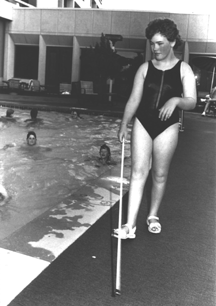 |
Terry Van Ettinger uses the cane to become familiar
with a hotel pool area before taking a plunge.
|
Module 85: Swimming Pool and Beach
Objective: The student will detect step-downs and drop-offs with the cane, and
proceed appropriately.
Objective: The student will walk on varied surfaces, including
sand, pebbles, and grassy hills.
Objective: When planning to engage in a sport, the student will
use the cane to a point as close as practical, and then stow it appropriately
during the activity.
Age of Student: Preschool and up (This Module is presented as
for the intermediate grades.)
Primary Skill Emphasis:
� Varied terrain
� Detecting step-downs or drop-offs
� Boundaries
� Landmarks
� Stowing cane
� Purchase or transaction
Additional Skill Emphasis:
� Emergency procedures
� Barefoot walking
� Sound direction and meaning
� Interpreting odors
� Air currents and echoes
� Weather and temperature
� Examining things tactually
� In a crowd or a line
� Hills and inclines
� Open space
� Meeting the public
� Careers
See Also (Other Modules):
- Other Outdoor Locations modules Apartment House or Condominium
- Back yard (Overall)
- Walking Across Open Space
- Unexpected Drop-Off or Step-Down
Remarks: It may or may not be practical to get into the pool
during a lesson. But it is easy to practice the associated skills around the
pool, and to discuss actual swimming.
Caution: A teacher who is not a qualified swimming instructor
should never take a student into the water (even shallow water) without a lifeguard
present. Also, a teacher should not go alone with a student where help could
not be found quickly if the
student fell in.
In all activities below, a young or inexperienced student should
be accompanied closely at all times.
Activities:
Example 1: Public Swimming Pool
(This description assumes the pool is with a large apartment complex. The general
approach is the same for a beach, river, or public pool.)
- Practice approaching the pool from various directions and
recognizing immediately when the cane finds the edge. Include practice in
approaching from various angles (with the pool not always straight in front
of the student). This is important because the student may reach the pool
unexpectedly. (See Cautions, above.)
- �How does the pool smell? What sounds do you hear? Bend
down and put your hand in the water. How does it feel?�
- Practice going to and from the pool, from the student�s
own apartment and from other appropriate areas.
- Find an unoccupied deck chair and sit down. Set the cane
down as usual. Note that in a pool area, anything (floor, chairs, etc.) may
be wet. That will not hurt the cane. If a person does not want to get clothing
wet, he needs to check tactually before sitting.
- At poolside, people often sit down without chairs. [Blind
children may believe that this is never done.] Sit down on a towel or directly
on the deck or ground. Again, consider whether clothing will get wet or dirty.
- Examine lifesaving equipment--ropes, floats, etc.--that
may be thrown to a swimmer in trouble. Note that a blind person can throw
a float to someone in trouble, or (with proper training) perform a rescue
by swimming.
- Study the rules and procedures of the pool.
- The student should become familiar with the changing room.
He should walk around and examine the location of the showers, benches, baskets,
footbath, toilets, sinks, etc., with explanation being given as necessary.
If the teacher is the opposite sex from the student, a friend or family member
may be asked to help. Or, an experienced student can simply go in by himself
and look around.
- The cane should be taken into the dressing room. It should
be used inside, unless the room is very small and familiar. The cane can be
set down (or leaned against the wall) beside the shower, under a bench, etc.
Is a shower required before swimming?
- Where is clothing placed? Is there a key or token for retrieving
one�s own basket?
- Walk with the cane while barefoot. Again practice approaching
the pool itself from various directions and recognizing when the cane finds
the edge.
- Analyze landmarks for orientation while swimming. Examples
include loudspeakers, dressing rooms, whirlpool, ropes, buoys, water input,
diving board, etc. Usually some such landmarks are noticeable by sound, feel,
or odor while the person is in the pool. Also, a person may get out of the
pool and then walk around to determine location.
- Particularly note the deep end of the pool vs. the shallow
end. If there is a rope delineating the shallow area, reach down and touch
it.
- Discuss where to place the cane while actually swimming.
Select an identifiable spot close to the pool--for example, at the edge of
the grass, in the corner nearest one�s own apartment. If it is necessary to
walk a short distance without the cane, this should be done cautiously and
not quickly.
- Discuss where to leave wallet and keys. Mention wearing
a key on a bracelet, or pinning it to the suit.
- If possible and appropriate, bring bathing suits and actually
go swimming or wading. Alternatively, the teacher may orient the student to
the pool and offer suggestions to the family and the swimming teacher.
Example 2: Swimming Classes at School
- If there is a pool in the school building, the student should
become familiar with it immediately as part of general orientation. He should
know the pool�s location in the building and be able to detect the drop-off
reliably.
- Until he is actually anticipating a swimming class, examining
the locker rooms or other detail may not be important.
- If classes go to a pool somewhere else, it is helpful to
explore that area in advance.
- Offer suggestions to the swimming instructor.
Example 3: The Beach
- Practice walking on varied terrain--grass, rocks, and sand.
Find the water�s edge, noting that it is not a clear-cut drop-off. At the
ocean, discuss tides. Walk barefoot in appropriate places.
- The student must understand that the body of water is very
large. Except in a very narrow river or lake, a person cannot �swim to the
other side.
- How is the safe-swimming area delineated? An experienced
blind swimmer can find rope barriers, and can learn to estimate distance if
intermittent buoys mark boundaries. In a crowded area, others� voices help
in orientation.
Reference(s):
David Walker. �Hook, Line, and Golf Balls.� National Federation
of the Blind.
Editor�s Note: Published by the National Federation
of the Blind, Modular Instruction is available for $20 plus $9 shipping
and handling. Readers may place a credit card order with the NFB Materials Center
by fax at (410) 685-5653 or by phone at (410) 659-9314. Checks made payable
to the NFB may be mailed with a request for Modular Instruction for Independent
Travel for Students Who are Blind or Visually Impaired: Preschool Through High
School (order number LSA01P) to NFB Materials Center, 1800 Johnson Street,
Baltimore, Maryland 21230. This information applies to print orders within the
continental USA only. For information about alternative formats or the cost
for shipping to Alaska, Hawaii, USA territories, and to other countries, please
contact the NFB Materials Center by mail, phone, fax, or by email at <[email protected]>.
(back)
(contents) (next)