Future Reflections Winter/Spring 2000, Vol. 19 No. 1
My
Introduction to Sleepshades and Independence
Reprinted from the February, 1998 edition of News and Views of Blind Arizonians, a publication of the NFB of Arizona.
Tom O�Brien, News and Views Editor: Craig Eckhardt of Glendale had the opportunity last summer to attend and participate in the Colorado Center for the Blind�s summer program for high school students. At our Arizona State Convention last September, Craig reported to the membership on his experiences. Following are excerpts from Craig�s remarks:
I would like to begin by telling you a little bit
about myself. I am fifteen years old, and I am a sophomore at Moon Valley High
School in Phoenix. I am partially blind.
Until last summer, I was confused, restricted in my
thinking and in my activities, and without direction or plans as to what I was
going to do with my life. I had not yet been introduced to the National
Federation of the Blind.
At the end of May, when the school year was coming to
a close, I was anxiously dreading summer. I really had no plans except to stay
up until 3 a.m. every night and watch TV. Actually, what I really wanted to do
was to find a job. But no one was hiring and, besides, I was too young to get
regular employment.
Then, one day as I was pondering my dilemma, I
received a packet in the mail from my uncle. It was information about some
place called the Colorado Center for the Blind in Denver. Apparently, my
parents had told my uncle about my problem of what to do for the summer. He
knew about the Colorado program for blind high school students, so he sent me
the information.
As we studied the information, I learned that it
wasn�t like a summer camp. It was more like a school for the blind and
partially blind. Immediately upon hearing that awful word, �school,� my
interest faded. I thought I had had enough of school for the year already.
I was about to give up on the Denver idea when I
suddenly saw it, the word, �JOB!� A summer job was what I really wanted! After
I saw �job,� I became interested all over again. Finally, it looked like I
would have the chance to earn some extra cash.
It was at this time that I met up with the National
Federation of the Blind. Since I was not a client of vocational rehabilitation
services, I had to find some other way to pay for the tuition to attend the
Colorado Center school. My mother contacted Jim Omvig and Bruce Gardner, blind
leaders of the NFB of Arizona, and, somehow, they took care of it.
On June 7, I flew to Denver to begin my training and
job. I didn�t know what to expect,
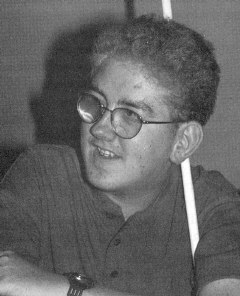
Craig Eckhardt
but I was excited. When I arrived at the Denver
airport, my counselor, who would also be my roommate for the next two months,
met me. Because of the small number of participants, I thought that the place
would be small. To my surprise, however, we pulled up to the Cherry Creek Club
Apartment Complex. And what a complex it was. It consisted of 1,400 public
apartments, two pools, a hot tub, and it was all laid out in the middle of
Denver.
Later that day, I attended a little get-together with
the other students and staff. During that meeting our group discussed several
rules, including curfew. A couple of days after that I became familiar with my
surroundings, including the complex, a couple of markets close by, and the bus
route to the Center.
My first day of classes was interesting. Quickly I was
introduced to Braille, cane travel, and what I first thought would be my mortal
enemy�blindfolds, also called �SLEEPSHADES!� I didn�t really have a problem
with sleepshades, except that I hated them. Every time I had cane travel and
had to put those things on, I became so afraid. However, after a time, I became
used to the shades. I still didn�t like them, but I learned to handle it.
Of course we did other activities, too, like rock
climbing (under sleepshades), traveling to the mall on the bus (under
sleepshades), and buying groceries (under sleepshades). I asked why sleepshades
were so stressed in this program. I was told that it is important for those of
us with some remaining vision to learn to use that sight efficiently, and not
to try to over-use it when it wasn�t helpful. Also, if you learned to rely on
your other senses and on blind techniques, you wouldn�t be so afraid and would
become more independent.
Independent. Now that was a word that made me ponder.
I was not even familiar with the word. But all through the program I noticed
how independence was displayed and discussed. My life had always revolved
around set schedules, and everything was always laid out for me. Basically, you
could say that I had been restrained from independent life, and I hadn�t even
known it.
As I learned about independence, things went well. I
even got the chance to go to New Orleans to the 1997 convention of the National
Federation of the Blind. The convention was overwhelming. Every day I was so
busy going to seminars, visiting the exhibit hall, and generally having a good
time, that I can say I literally never got out of the hotel. But that was OK
since everything at that convention was unforgettable and inspiring.
After our group got back from the convention it was
time to start our jobs. I was honored to work at a federal center cafeteria.
The job was fun and interesting, as I had expected. But I soon learned an amazing
thing�the job wasn�t my biggest interest as I had thought that it would be. I
realized that the job was but a small part of everything I was doing in the
program. Yes, everything�Braille class, cane travel, rock climbing, the NFB
convention, and the job�they were just parts of one program.
All the parts seemed to somehow connect around one
focus, around one meaning. I�ve thought about this meaning for a long time. I
finally concluded that all the activities and all the events had to focus
around the idea of independence. Finally, it all made sense. And, because of
this, other things in my life started to make sense, too. I wasn�t nearly as
hesitant and confused as I had been when I started the program. Suddenly, I
found out that doors and opportunities were opening up for me. I discovered it
then, and I know it now�I have choices. I don�t have to be limited or held back
just because I am partially blind. I am an individual, and I have individual
needs. Thanks to the National Federation of the Blind, I now realize this. And
let me tell you that just knowing and understanding this gives me a great
feeling. This knowledge is very important to me; and I am thankful to the NFB
that I have gained it.
I would like to thank all of you for letting me speak
today, and for helping me to experience some of the best months of my life. The
NFB has helped me to feel confident and to get my first real taste of
INDEPENDENCE�it�s great!
From the
Editor: The Colorado Center for the Blind is one of three
rehabilitation training centers for the blind operated by the National
Federation of the Blind. During the summer months, all three centers offer
special programs for blind children and youth. They are truly outstanding
programs, the best in the country.
Another excellent transition summer program for youth,
WINGS, is offered by Blind Industries and Services of Maryland (BISM). BISM, a
private agency, has a long-standing cooperative relationship with the NFB in
Maryland. All of these programs emphasize the use of competent blind
instructors and counselors as mentors, a can-do attitude, job experiences for
older youth, blindness skills, and blindness technology.
Program directors will discuss fees and funding with
you, but here are a few suggestions about possible funding sources: (1) For
older youth age 16 and up, investigate rehabilitation funding under transition
services. (2) Explore with your school district the possibility of using the
program to fulfill extended school year services (see article elsewhere in this
issue). (3) If your school district has failed to provide a significant amount
of services from your child�s current or past IEP, you could ask them to fund a
summer program to fulfill their compensatory education services obligation. (4)
Check with your local or state NFB and Parents of Blind Children Division
affiliates about possible scholarships. If none are available, perhaps your
interest, need, and willingness to help can spark interest in getting such a
scholarship fund established. (5) Seek assistance from local clubs and
organizations.
For applications and more information about the
programs, contact the following:
Blindness: Learning in New
Dimensions (BLIND, Inc.)
Joyce Scanlan, Director
100 East 22nd Street, South
Minneapolis, Minnesota 55404-2514
(800) 587-9558; (612) 872-0100;
fax: (612) 872-9358;
<www.blindinc.org>
Colorado Center for the Blind
Dan Wenzel, Children�s
Program Director
1830 South Acoma Street
Denver, Colorado 80223-3606
(800) 401-4632; (303) 778-1130;
(303) 778-1598; <www.ccb�denver.org>
Louisiana Center for the Blind
Pam Dubel, Children�s Program Director
101 South Trenton
Ruston, Louisiana 71270-4431
(800) 234-4166; (318) 251-2891;
fax: (318) 251-0109
<www.lcb�ruston.com>
WINGS:
Summer Youth Transition Program
Blind Industries and Services
of Maryland (BISM)
Rosemary Lerdahl, Rehabilitation
Department Director
2901 Strickland Street
Baltimore, Maryland 21223
(410) 233-4567;
e-mail: [email protected]