Future Reflections Winter/Spring 2000, Vol. 19 No. 1
Therapeutic
Horseback Riding for the Blind
Editor�s Note: Ms. Ritter is a Certified Therapeutic Riding Instructor and the Educational Consultant at Sebastian Riding Associates, Collegeville, Pennsylvania.
When people think of appropriate physical activities
for blind and visually impaired children, horseback riding is usually not one
that comes to mind. Riders typically function through their visual sense to
steer and cue their horse. Imagine a child with low or no vision controlling a
1,000 to 1,300� pound animal. They must move through space on the back of this
large horse without the aid of a cane or the feel of solid ground beneath their
feet. However, at Sebastian Riding Associates, we have found horseback riding
to be a wonderful activity for visually impaired children. A blind rider does
not have an over dependence on vision, and can therefore move into the feeling
and tactile aspects of riding more quickly. A goal for all riders is to advance
to an ability to operate through touch and feel.
Sebastian�s is a nonprofit therapeutic riding facility
serving over 100 riders with a large variety of disabilities (including
combinations of disabilities), such as Cerebral Palsy, William�s Syndrome,
partial paralysis, developmental delays, mental retardation, and blindness. Our
riders find physical and cognitive benefits while enjoying the freedom of
horseback riding. For individuals with these and other disabilities, the
fluidity of riding offers them an experience that is otherwise unattainable.
Beyond the freedom and self‑confidence that is
gained by riding, visually impaired children reap tremendous physical benefits,
as well. Posture is often affected when a child is blind or has low vision.
Some children tend to carry their head tilted upward, stretching their neck
muscles, and throwing their shoulders back. Conversely, some children tilt
their head downward causing their shoulders and chest to slump forward and cave
in. These �blind postures� affect more than muscle and bone development.
Posture translates into body language for the seeing world. A visually impaired
child cannot pick up on the subtle cues of how others carry themselves. They
must be taught how it feels to stand tall with square shoulders and head up and
forward. An individual�s posture significantly impacts balance when horseback
riding. Likewise, riding can significantly impact one�s posture, and therefore
balance, in a very positive way. �Weaving� is one of many exercises that helps
the child improve balance and posture. This exercise is done by having an
experienced aid lead the horse in a zigzag pattern with unannounced stops. If a
child is new to horseback riding, has other medical conditions, or extremely
low tone, two side‑walkers will be used. The support given by side‑walkers
provides safety, but riders must use their muscles to maintain a comfortable
balance. In order to be balanced, the rider must sit up tall, allowing the
pelvic area to follow the motion of the horse. Trunk muscles become strong, the
head comes up, shoulders become square, and riders become increasingly aware of
their body in space.
Riding a horse approximates a normal walking gait in
the pelvic, trunk, and upper body area of a person. This is very helpful for
blind children who shuffle their feet or tend to walk in a circle because of a
dominant leg. Orientation and mobility specialists work with visually impaired
children to lengthen their stride, hold their head up, and shift their center
of gravity to lessen the shuffling, flat footed walking pattern characteristic
of some blind children. While riding does not replace the exercises needed to
walk straight with a comfortable heel down motion, it does support the
strength, flexibility, and body awareness to facilitate the learning. In a
normal human gait, the pelvic area and shoulder girdle move in counter
rotation. A horse�s walking gait facilitates this same counter rotation in the
human rider. The rider�s body responds as if long, heel down, strides are
taken.
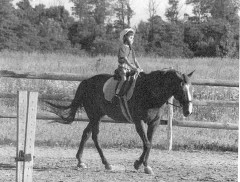
Andrew Love finds benefit
and��� pleasure from horseback riding.
Horseback riding also offers many opportunities for
the visually impaired to learn navigation skills. Grooming a horse involves
large and fine motor movements. At Sebastian�s, the horse is cross‑tied
in the barn. Riders must choose the appropriate grooming tools in the proper
sequence and use them on each side and section of the horse. The hands‑on
interaction with the horse teaches the child about the size and conformation of
this large animal. It also requires focus and the ability to navigate in a busy
and unique setting. When grooming is completed, the saddle and bridle are put
on the horse. Buckling straps and attaching the therapy lead and lead rope
require fine motor skills. Blind and visually impaired children can participate
in each of these activities with the ultimate goal of performing these tasks
independently. Blind riders lead their horses out of the barn and into the
arena or riding ring. Riders follow verbal cues from the instructor and take
cues from footing and sounds to determine when they and their horses have
arrived at their destination.
Mapping is a navigational skill that can be done prior
to, and during, a ride. A three‑dimensional map is used to replicate the
riding area. The rider tactilely explores the arena through this tool. This
three‑dimensional map gives the rider an understanding of his riding
environment. While on the horse, the rider can determine the long and short
sides of the arena from the distance traveled, the sounds of the spectator
area, the whinnies from the barn, etc. Visually impaired riders stop, start,
and steer their horse to sounds and verbal cues. These cues include direction
from the riding instructor, music from a tape recorder, and noise‑making instruments.
The games and activities included in the riding experience are practically
limitless and lead to a fun and educationally relevant sport for the blind
child.
Visually impaired children also gain muscle strength,
balance, body awareness, confidence and self‑esteem through horseback
riding. Therapeutic riding facilities are becoming more available as families
experience the remarkable benefits. Some facilities are small with only one or
two horses. Others are very well-established with top of the line equipment and
many, many horses. However, most are somewhere in‑between, and almost all
depend heavily on volunteers and donations. These programs are filled with
volunteers, instructors, and horses who give of themselves because of a love
for the special riders they serve. If you are considering a program for your
visually impaired child, here are some questions you need to answer: How is
your child�s mobility? Is your child a fearful child? How is your child�s
balance? Is your child�s attention span and focus developed enough to
participate in the riding experience?
When choosing a riding program, speak to the program
director and the instructors. Does the program have other visually impaired
riders? Some programs, such as Sebastian Riding Associates, have a week long
camp designed specifically for visually impaired riders.
Are the instructors certified by your state
handicapped riding association or by the North American Handicapped Riders�
Association? How are the horses trained? While there is no such thing as a
totally �bomb proof� horse, a therapeutic horse should be calm, gentle, and
extremely tolerant.
When you visit the facility, is it a safe environment?
Are the walkways clear of tack and grooming equipment, but is that equipment
readily available to the riders? You will want your child to have a safe
environment that encourages exploration and eventually independence. Horseback
riding is not an activity that is usually associated with blind and visually
impaired individuals, but perhaps it should be. You can call NARHA (North
American Riding for the Handicapped Association) for a list of Therapeutic
Riding facilities near you, call (800) 369‑7433.