Future Reflections Winter/Spring 2000, Vol. 19 No. 1
Why
Does It Take So Long?
Reprinted from the NBA Bulletin, Winter, 1996/97, published by the National Braille Association (NBA).
Editor�s Note: The problem of Braille illiteracy is not only about getting Braille instruction for kids, it�s also about getting Braille materials accurately transcribed in a timely fashion. This requires advance planning, adequate funding, and the selection of conscientious, qualified transcribers and proofreaders. Betsy Burnham, the author of the article below, is one of those conscientious transcribers who cares deeply about the Braille product that goes out to the students she serves through the Maryland Instructional Resource Center. She hopes her article will help educate school personnel about the importance of ordering Braille textbooks and materials early. Here is what she says:
In September of this year I was talking with Gloria
Buntrock, a past president of NBA, regarding her group�s proofreading policy. I
do not remember the exact conversation or what precipitated Gloria saying (and
I paraphrase), �When you are transcribing a book you should think of yourself
as a publisher.� Those words hit home and triggered many other thoughts for
days to come.
Two or three days after this conversation I was feeling
particularly overwhelmed and frustrated over an accounting book our group had
received two weeks before. The school was calling wondering where the book was,
the student needed the book. I began to think, what are we doing wrong, are we
really taking too much time to Braille this book? We have a scanner and
MegaDots after all! (I say that facetiously.) Then Gloria�s words, as I
recalled them, came back to me. �You are a publisher.�
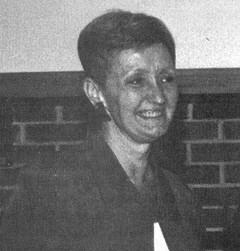
Betsy Burnham
The thought occurred to me, �I wonder how long it took
the publishers of this accounting book to have it ready for print
distribution?� As the print publisher designs the book, decisions must be made
as to how this information will be visually displayed not only to get the
information to the student but to enhance the student�s learning of that
information. Graphic artists, education specialists, typesetters, and many
other specialists are involved in these decisions, which result in bold,
colored, and italicized print, graphics, size of font and placement of pictures
and, oh yes, those wonderful marginal notes. It is indeed a very long tedious
process for print publishers and this long process is accepted and expected by
the consumer. For this article I phoned the publishing company of the
particular accounting book I was working on and asked the approximate time the
publication of an accounting book takes. The person with whom I was speaking
said from receipt of a manuscript to the final proof they plan on an absolute minimum
of two years prior to sending the book for printing.
The decision as to which textbook school systems
choose for their students is based not only on the information contained in a
book, but also if the information is presented in a manner that will ensure and
enhance the learning of the subject.
I realized that as a transcriber I indeed am a
publisher, and the way I format or display the print copy in Braille must also
�enhance the learning� of that material for the Braille reader. There is
clearly a difference between what will enhance learning for a print reader and
what will enhance learning for the Braille reader. I must be very concerned
about how and where I place this material on the Braille page. Where do I put
those marginal notes so they don�t interrupt the flow of the text? Which
diagrams should be put into tactile diagrams, which should be described, which
should be omitted? Will it be necessary for me to distinguish between bold and
italicized print? How will the table or chart be used? Will it be read across
or up and down? My decisions can and do make the material either clear and
understandable or more confusing than ever.
Luckily, I have the Code of Braille Textbook Formats and Techniques, 1977; my handouts
from NBA workshops; and fellow transcribers to assist me in making those
decisions. But it does and should take time.
I want the books I transcribe to enhance learning, not
just give the information, or worse yet, make learning that text more difficult
because I didn�t format the text correctly or think about the student for whom
I was transcribing the book. Therefore, I will continue to read what I am
transcribing, think about how that information will be used, and format it
properly.
The next time someone asks me why does it take so
long, I will take a deep breath, count to three, and ask myself how long do I
think it took to produce the print version; then say very nicely, �I am doing
the best that I can. And oh, by the way, I have a copy of an article from the NBA Bulletin I�d like you to read.�
Hopefully, when those requesting the books stop to
think about how long it took to publish the print text, they will begin to
understand the function and job of a transcriber and grant them the same
understanding and courtesy that they give the print publisher.