Future Reflections Summer 2000, Vol. 19 No. 2
Fueling the Fire
by Barbara Walker
Editor�s Note: The following article first appeared in Issue 4, 1999, of News and Views of Blind Nebraskans, the publication of the NFB of Nebraska. Not long thereafter it was reprinted in the May, 2000, issue of the Braille Monitor, the monthly magazine of the NFB. It was originally a speech delivered at the meeting of the Nebraska student division during the 1999 state convention. Barbara Walker is a long-time leader of the National Federation of the Blind whose insights about blindness� have inspired many over the years.� This is what she said:
When President Clark called me
a couple of weeks ago to ask if I would speak at the Student Division Luncheon
today, I hesitated, as I nearly always do when asked to do something
conspicuous. But when I suddenly realized she was handing me a chance to
fulfill a pledge I had made to myself at our National Convention this past
summer, the only viable answer I could give was, �Yes. And thank you for the
opportunity.�
I hope each of you�for we are
all sometimes students, whether or not we�re currently attending a school of
formal education; and we are all sometimes teachers, whether or not we hold an
academic degree�will be willing to help me keep my promise.
 |
|
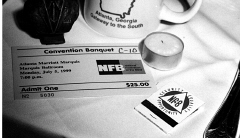
The
matchbook and candle from the 1999 NFB Banquet.
|
As
I made sure my ticket was in my purse in preparation for the banquet of the
National Federation of the Blind in Atlanta, I wondered if it would be the
high point of the convention for me this year. Since the time I began attending
National Conventions in 1975, I had thrilled many times to the magical spirit
of the banquet. But this one, my twenty-fourth (I missed the convention in
1981 due to the birth of my daughter, Marsha), wouldn�t be the same. Dr. Jernigan,
who had been the catalyst of the vibrant Federation spirit for more years
than I have attended conventions, wouldn�t be making sure his ticket was on
his person tonight. And he never would again. He was dead.
I sat down on my bed and let
myself cry. Then I remembered how, ten years ago at banquet time in Denver,
less than three weeks after my beloved husband Jim had died, I couldn�t imagine
walking into the banquet without him. But I did. And I was glad I had. I would
go this time too, beginning by summoning the advice our first First Lady, Mrs.
Hazel tenBroek, widow of our Founder, Dr. Jacobus tenBroek, had passed along to
me nine years ago when I was struggling to keep my composure.
I had been on my way back to
my room after the 1990 Fiftieth Anniversary Banquet in Dallas. A close friend
had just said to me, �I thought this banquet was just perfect. Didn�t you?�
 |
|
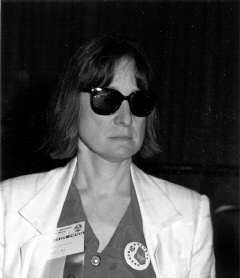
Barbara
Walker
|
�It was great,� I sincerely
replied, fighting back tears. �But perfect?� my inner self said, �Certainly
not.�
One of the living ingredients
of anything approaching perfection for me was tangibly missing. True, it had
been a year since Jim had died. And my friend, who had also known Jim well, had
learned to experience life without feeling the constant void of his physical
absence. I, at that time, still hadn�t.
As my friend and I parted and
I reached the hall outside the ballroom, Mrs. tenBroek, who had undoubtedly
heard our conversation and empathized with me, said that her husband, who had
been dead for over twenty years by then, had shared with her something she
continued to find useful when dealing with hard times: �Sometimes, the only
thing to do is to keep putting one foot in front of the other.�
It got me to my room that
night and to many places since then. It would also get me to the 1999 banquet
hall.
Soon I was there�one of the
over two thousand present at our largest banquet ever. As I sat down, those on
either side of me urged me to look inside my mug. (Since 1974 everyone
attending our banquets has received a complimentary mug with the Federation
logo and something specific to the Convention site on it.) Usually there is
nothing inside. This year was different. Della Johnston handed me one item�a
replica of the bust of Dr. Jernigan, which had been unveiled at the Memorial
Service the previous day. I was interrupted from my exploration of this
treasure by another of my tablemates. �Keep looking. There�s more.�
I knew there was. I had
already found something that disturbed me�a book of matches.
�I noticed,� I said, trying
not to sound upset. But I was remembering the time, at the school for the
blind, when we were all asked to light a match and, from that, a candle, in
order to pass some class. To my relief, we had used wooden matches. When my
turn came, I braced myself, stuffed down my fear, and performed the task
flawlessly. I hadn�t willingly done it since.
And book matches? Those were
too dangerous for blind people. That�s what I had been told until I met the
National Federation of the Blind. And then, although I learned that it wasn�t
really unsafe for blind people to use them, I, well, I just preferred not to. I
mean, why do that when there are obviously superior ways of getting the job
done?
�Did you find the candle?�
someone asked.
�Yes,� I said, too quickly,
and with an edge in my voice which I hoped hadn�t revealed the emotion I was
trying to conceal.
�Are you concerned about
lighting a match?� Jeff Altman asked. �If so, I can show you this nifty way I
learned where you can�t burn yourself.�
�Concerned,� he had said.
Afraid was more like it. He probably knew that, but �concerned� did sound
kinder and less confrontational. Of course he knew. He hadn�t even paused
between the initial question and the offered assistance. Figuring that whatever
we were going to do with the candles would be a tribute to Dr. Jernigan and
knowing that I wouldn�t want to look back on the event not having tried to
participate, I accepted his offer.
Inviting me to put my hands on
his if I wanted to, he explained that you fold the cover of the matchbook back
so that the front cover touches the striking bar. After taking a match out, you
place the head between the covers, far enough in that it will rub across the
bar, but not in so far that you can�t hold onto its other end. Holding the
covers firmly together with your thumb and forefinger anchoring the head, you
grasp the protruding end of the match between the thumb and forefinger of your
dominant hand and pull the match out. He mentioned in passing that it�s important
to keep track of where things are so that you don�t bring the lit match into
contact with the exposed heads of those remaining in the open book.
On my first attempt I was
gripping the match head so tightly that my other hand slipped off of the stick.
My second try released the smell of sulphur, but no spark. I had loosened my
hold too much. With Jeff�s calm encouragement, I tried again. The match sizzled
victoriously. Before my fear could cry �exception,� I lit another and another.
And there it was�the magical Federation spirit�mentor and student sparking a
flame, putting out fear.
Although Dr. Jernigan hadn�t
directly taught me this technique, nor did he teach it to Jeff, he had nurtured
our Federation family in such a way that we knew that, when it�s done with love
and respect, as one who knows teaches one who doesn�t, both become stronger.
As I was thanking Jeff for
helping me, President Floyd informed me that I was supposed to be at a
different table. Flushed and apologetic, but also excited about the prospect of
sharing my newest joy in learning, I went as directed. Sitting now between
Aloma Bouma and Ardyce Earl, I proudly demonstrated the new skill Jeff had
taught me.
Shortly thereafter we honored
Dr. Jernigan by lighting our candles. When mine almost immediately went out,
I triumphantly lit it again, reveling in the spirit of all who had made this fearlessly exuberant moment possible for me.
And later, as President Maurer
was reaching the crescendo of another stellar banquet address, he put into words
the glow I continued to feel from the candle-lighting tribute we had paid to
Dr. Jernigan and, in my mind, to all of those, especially Jim, who had
physically gone from our midst, but whose spirit and love were among us still:
�The spirit they kindled,� Dr. Maurer said, �can never be extinguished, because
we will fan the flame. We will add fuel to the fire. And we, the members of the
movement, will cause a great conflagration.�
Those weren�t just fancy words
to me. They were the expression of a very intimate moment we in that room had
shared. I made a personal vow to take both the spirit and the experience with
me and to pass them on to others.
I intend, very soon, to make
good on that promise. But first, I want to give you, again in Dr. Maurer�s
words, the reason I hope you�ll accept not only the spirit of my offer but also
the physical act of carrying it out, whatever your current level of confidence
may be.
Dr. Maurer said: �We are the
blind of more than a single generation and of every segment of society and of
every part of the nation. We have the capacity to think and the mental
discipline to reach conclusions that will alter the future for us all. We
possess the confidence to bring those conclusions to reality. Nobody else can
do it for us. We must do this for ourselves, and we will. Our future is bright
with promise, because it belongs to us. And there is no force on earth that can
stop us.�
I said earlier that I had not
willingly lit matches, even wooden ones, since that time in Nebraska City when I
did what it took to get out of that class. How had I managed that, especially
having directed an Orientation Center for the Blind for a number of years and
having also been a parent?
A few times, when duty called,
I made myself do it. But mostly I gave others the privilege. Between the time
when Jim was alive to light candles for such things as birthdays and Advent and
the time when I thought the children were old enough to do it themselves, we
pretended the little lights in the chandelier above the dining room table were
candles. (Both Marsha and John had said they looked like candles when they were
dimmed.) I also discovered the existence of the torch lighter, something I
continue to find useful.
In all of these instances I
don�t think my choices were necessarily bad or even detrimental to others.
But inside I always knew I was hedging. And it was, as so often it is for me, the National Federation of the Blind that not only called my bluff but also gave me the chance to grow beyond my fear.
Please don�t get me wrong. I
haven�t become a book match lover. I still would choose, when given options,
another method of lighting a candle. But I no longer feel like fleeing the
premises if something needs to be lit and book matches are the ready source of
a spark.
I encourage you to participate
in lighting a match and a candle today whether or not it frightens you. If it
doesn�t, you may be the one, like Jeff was for me, who releases someone else
from fear. If it does, I hope you�ll have the courage to let someone help you.
Please join me now in doing
the kind of thing I believe Dr. Maurer meant when he talked in Atlanta about
fueling the fire and fanning the flame. Let�s add some sparks to that great
conflagration!