Future Reflections Special Issue: A Celebration of Braille
(back) (contents) (next)
St. Lucy Day School Creates a Braille-Rich Environment
 Editor’s Note: After I read the delightfully informative piece from Sister Elaine about “Braille: What It Is and What It Is Not,” I had the inspiration to ask her to include a bulleted list of how St. Lucy supports Braille for its students. Established in 1955, St. Lucy Day School for Children with Visual Impairments is a Roman Catholic school for blind children in Philadelphia. The list below, I’m told, is just a sampling of the many ways that Braille is embedded throughout the school’s programs. It might be instructive for you--our readers--to use this list and conduct your own ‘compare and contrast’ analysis of how your state school for the blind and visually impaired ranks in supporting Braille literacy. Here’s how St. Lucy supports Braille:
From Sister Elaine: St. Lucy Day School for Children with Visual Impairments supports Braille literacy on every level ranging from theoretical to practical, academic to recreational, and required to inspirational.
- Principal Sister M. Margaret Fleming was the NFB’s 2007 national Distinguished Educator of Blind Children award winner. The title of her award speech demonstrated much about why she was selected for that prestigious award: “Braille Readers Always Ignite Learning and Living for Everyone.” Sister Meg has also served on the American Foundation for the Blind committee that published a brochure entitled Braille Literacy Issues for Blind Persons, Families, Professionals, and Producers of Braille. Her leadership clearly fans the fire of our passion for Braille Literacy.
- Each class is taught by a certified instructor well practiced in methods of teaching Braille. Braille instruction, Braille reading, and Braille writing are an every-day, all-day classroom experience.
- Students’ work and decorations displayed in the school halls are in both print and Braille.
- Preschool-age children are taught Braille readiness skills. In kindergarten our students begin learning contracted Braille. Once the student demonstrates efficient Braille reading skills (usually by third grade) they are mainstreamed into the regular parish school for subjects such as Religion, Science, and Social Studies.
- Students are provided with Braille textbooks. Books not available in Braille are transcribed, embossed, and bound by our school volunteers on site.
- In addition to textbooks, all other learning materials (such as worksheets, tests, and project descriptions) are transcribed in most cases within a day of the request.
- Tactile diagrams and models with Braille labels are produced at the school upon teacher request.
- Our students receive a Braille copy of song lyrics whenever we celebrate Liturgy or have choir performances. Scripts for school plays are also embossed in Braille so everyone is literally ‘on the same page’ during practice.
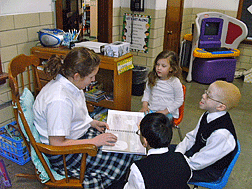 A third of the books in our elementary school library are Braille. Of the 1,959 volumes of Braille books, 1,610 have been added since the year 2000. Of these recent additions to the library, 261 volumes have a recent copyright of 2000 or more. For the younger children we have 309 Twin Vision® (print-Braille) books. This enables parent and child to share the reading experience and paves the way to a love of reading Braille.
- The students at St. Lucy Day School for Children with Visual Impairments have participated in the NFB Braille Readers are Leaders contest for over ten years now. This is the busiest library time of the year with no limit to the number of books signed out for the week. It is no surprise that some of our students have won prizes in this national contest.
- From time to time our older students share reading time with the younger students. These students model good Braille reading skills while their younger partners enjoy stories handpicked for him or her.
- Our school continues to acquire the latest technology (software and hardware) available for learning, writing, and producing Braille. Each student who learns Braille is provided with a BrailleNote and a laptop computer with Open Book and Duxbury software installed. All computers are networked to a Braille embosser.
- We still use the Perkins Brailler (also called a Brailler or Braille writer) as well as slate and stylus. Perkins Braillers are kept in good repair by Sister Elaine George on site and Richard Heigh in New Jersey--(609) 601-0557.
- Each year parents and teachers (from the parish school) have the opportunity to attend a Braille class taught by Sister M. Margaret Fleming.
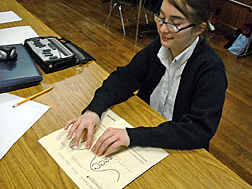 Upon request our staff gives workshops at various schools, clubs, conferences, and events explaining the Braille code to all ages from preschool to senior citizens.
- The students in grades five through eight at St. Lucy Day School for Children with Visual Impairments design and produce large print/Braille greeting cards. Customers and those who receive the cards are delighted to feel the Braille code.
- Thanks to the Pennsylvania affiliate of the NFB, our students celebrate annually Louis Braille’s birthday with a retelling of his life and the development of the Braille code. The day is filled with Braille activities and games. Even the refreshments incorporate the Braille code.
- We have a closet full of rainy-day-recess board-and-card games that are labeled with Braille.
- Students’ art collages make use of recycled Braille pages.
- Visitors to our school receive a small card with the Bible quote “We walk by faith and not by sight” embossed in Braille.
This is not an exhaustive list of our support for Braille literacy, but I think it demonstrates on which side of the issue we stand.
(back) (contents) (next)