Future Reflections Fall 2014 CAREERS
Special Little People
by Brandy Wojcik
From the Editor: Those of us who are blind often must deal with questions about our competence to handle the activities of everyday life. Such questioning is especially intense when it comes to our ability to care for young children and keep them safe. Brandy Wojcik has been taking care of children since she was a child herself, and childcare has become her life's work. In this article she describes the roots of her interest in caring for children and explains how she works as a home childcare provider.
It's a summer evening after I have spent the day teaching, playing with, and caring for six children in my home. The first child arrived at 6:15 A.M., and the last one left at 6 P.M. Our day was spent playing outside, taking a trip on the bus to my chiropractic appointment, painting, and enjoying a new sensory activity, as well as dealing with all the usual diaper changes and feedings. For me it was an ordinary day.
Early Opportunities
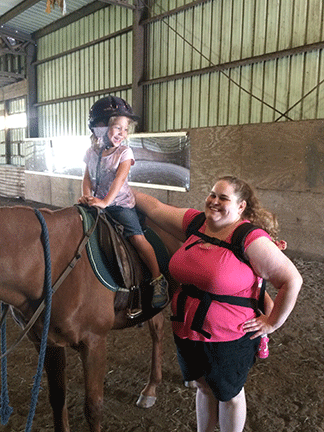 I like to say that my career as a childcare provider was launched before I turned four. One day my preschool teacher brought her infant son to our class to let us see what a new baby looks like and to show him off to her fellow teachers. As my mother was due to have my little sister pretty soon, the teacher took extra time with me. While I sat on the floor by the classroom window, she laid her three-week-old baby in my lap. There he relaxed as I marveled at how tiny he was. The teacher even let me feed him his bottle. I think I was the happiest three-year-old on the planet! I've loved and cared for young children ever since.
I was very fortunate as I was growing up. Every day of my life, my mother and teachers expected me to do what other kids my age were doing. My mother didn't make excuses for me because I was blind. She didn't care how I got the job done, but she was determined I was going to succeed.
My mother often tells the story of when I was six months old and an early intervention teacher came to our home. The teacher told my mother, "You need to have normal expectations for your daughter, or you will have to take care of her forever." My mother had no intention of taking care of me forever! She was an amazing mother until I was eleven. She remarried when I was twelve and started the second part of her family. At that point, after being mainstreamed through elementary school, I took up residence at the state school for the blind.
At home I had been a normal kid who was expected to do chores and participate in school activities. I cooked, played hard, and volunteered at the local childcare center. I was a child growing into an adult who did what all my peers did.
That momentum continued when I attended the school for the blind. My teachers, resident instructors, and Scout leader took me under their wings. During the school year I took half of my classes at the local public high school, only taking the blindness-related classes on the school for the blind campus. I ran track, mentored elementary students, and sang in the choir. I acted in plays and served on the student council at both schools.
Work and Learning
I went home on occasional weekends, as well as holiday breaks and summer vacations. At home I cooked, cleaned, hung out with the neighborhood teens at the local pool, and read a ton. When my mother worked, I took care of my younger siblings. I often went to enrichment camps.
One day my mother said, "You aren't going to just hang at the pool and hide in your room reading all summer." We put an ad in the neighborhood newsletter, and I began to babysit. Neighbors in my mom's social circle saw me caring for my younger siblings and hired me to babysit for their children. They told their friends about me, and before long I had a large clientele.
People sometimes ask me, "Weren't they afraid to trust you with their children? Were they worried because you're blind?" Actually, my blindness never seemed to bother them. I think they saw that I was competent in my skills. I could prepare food in any kitchen, and I could clean up in any house. I dressed like the other teens in the neighborhood, and I was well-groomed. I could get around in the neighborhood with no problem, and I had passed CPR training. I brought my Braille notetaker to take down emergency phone numbers. When I arrived at an unfamiliar home for the first time, I asked for a quick tour so I could get oriented.
Of course, when someone had a question, I explained how I would know what was happening around me. Usually the person would laugh and say, "Why didn't I think of that?"
Through middle and high school I volunteered at a local childcare center. I babysat for many children, including a few of my teachers' kids. During the summer between my junior and senior years in high school, I got my first paid job in a childcare center. For as long as I could remember I had said that I wanted to be a teacher, and this job confirmed it. As I learned to implement lesson and care plans for infants and toddlers, I was in my element and loving it.
Professional Training
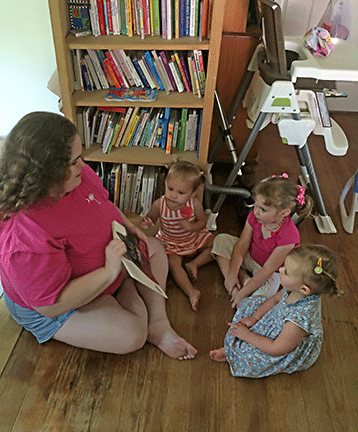 I was accepted to the University of Texas, where I earned a degree in elementary education. I had minors in music and special education, with a focus on reading instruction. Due to dialysis, two kidney transplants, and severe gastroparesis that resulted in surgically implanted feeding tubes, it took me seven years to complete my degree. Nevertheless, in my academic courses and in my student teaching, I did everything the other students did. I accessed the material using text-to-speech software. I labeled things in Braille and took tests electronically. I never had anyone take notes for me, and I didn't get extra time to take tests due to my blindness. When I left school I wanted to be able to say that nothing special was done for me as I pursued my degree.
Throughout college I worked in two childcare centers in their infant rooms. I loved every minute of it, but when my student teaching began, my schedule no longer allowed me to work the hours of a center. Instead, I began to nanny and babysit for friends in the evenings. Also I became a top selling and recruiting leader in a home-based business with Discovery Toys. I often taught child development and business building seminars to other Discovery Toys consultants and parents. Each time I taught a seminar, I learned more about children and how they learn.
When I graduated from college, I realized that my health made it hard for me to put in the fourteen-hour days, inside and outside the classroom, required of an elementary school teacher. I also realized that I preferred to teach the youngest children, from infancy through kindergarten. I began to work as a nanny full-time. At the end of a nanny job I decided I would like to work from home, and opened my first childcare business from my apartment. Within two weeks I had two little girls. After two months I had three children full-time and two part-time.
I loved what I was doing, but I knew I wasn't going to go far in my little apartment. I'll save the long story for another time. The upshot is that I moved to Michigan, where I run my childcare business from my rented house.
Questions and Requirements
I operated in my home in Michigan for nearly two years as an unlicensed childcare provider. I've wanted to become a foster parent for many, many years, and I began the process of becoming approved. In order to claim my income and prove that I am financially stable, I had to become licensed as a childcare provider.
Obtaining my license should have been no problem. I had submitted all my paperwork and was waiting for the computer to generate my certificate. Then someone unknown to me turned me in as an unlicensed provider, claiming that because I am blind I might not be able to provide proper supervision to children. Days before my license was to arrive in the mail, I heard a knock on the door.
It was one of the state's licensors for childcare providers. She just showed up unannounced. I had to agree to close down until I had my license. Furthermore, the licensor decided that, as a blind person, I might not be able to supervise the children in my care. She launched a full-scale investigation of my abilities as a blind caregiver.
Naturally I tried to educate her. I gave her the NFB's pamphlet, Parenting without Sight. The foster care agency assured her that I was doing my job as well as any other provider. Nothing seemed to work. At that point I reached out to my friends, my previous employers, parents of children currently in my care, and leaders in the NFB. Collectively we sent the licensor over thirty recommendations via email and even more by voicemail. In the end she admitted that she was overwhelmed but appreciative. Six weeks after the unannounced visit, I held my childcare license in my hand.
I sighed with relief, but I still faced one more hurdle--my ninety-day review. All childcare family homes have this announced visit. The licensor comes to review whether your paperwork and home are meeting standards.
When my visit occurred, the licensor brought her supervisor along. They grilled me for two hours while I was busy caring for two toddlers. As they left at last, they said, "You are licensed for the next three years. You will only hear from us if someone has a complaint."
I'm now operating at full capacity. Full-time I have four children ages two and under, and I have one four-year-old part-time. My sixth space is reserved for my foster child when he or she arrives.
Braille and More Braille
People often ask me, "What do you do with the children and how do you do it?" Actually, I do very little different from any other childcare provider. Our day looks much like the days of the other care providers I converse with through various family home childcare support groups online. The biggest exception is Braille. My house is plastered with Braille. The crayons, paints, and markers are all Brailled. My paper trays are labeled so I know what color paper is on each particular tray. Puzzle pieces are labeled to tell me what they are (a fish, a lobster, a crab). Shaped puzzles are labeled with their colors, as are blocks, pegs on our peg board, and other toys. In this way I can identify whatever color or object a child is looking at. My household appliances also have Braille labels so I can cook independently.
I have hundreds of Braille and print/Braille children's books. In most cases I hand Brailled the text onto clear plastic sheets and added the Braille to the print pages. I also purchase already Brailled books from Seedlings Braille Books for Children and the Beulah Reimer Legacy.
To teach children to color within the lines, I have pictures with glue lines traced over the print lines so we can work on this together. Older children also are mentors, coloring and playing with the younger ones. Younger children often want to do what the big kids do, so this is a very useful tool for advancing visual skills such as drawing and writing. I also use letter tracing applications on my iPad. When children are ready to begin formal reading instruction, I have Brailled many learning tools such as letter and word tiles, games, flash cards, and early readers.
For music and movement I have people show me the motions for unfamiliar action songs. I also use a music and movement series called Dancing Beats. Children can watch the DVD and copy the actions. Music is a huge part of our day!
I provide many sensory activities for the children. Currently we have Rainbow Rice and Alphabet Pasta in our sensory table, and there is another tub of water, beads, and boats. I strongly believe that busy children are happy children. Children who are busy and happy tend to be well behaved. They don't have time to find trouble.
Safety First!
How do I manage to keep so many small children safe? Basically, I do what any provider does--I keep a safe, clean home. If the children can reach something, they can have it. By the time they can reach things they can't have, they know and understand the rules about toys and other things higher up. I have locks on the front and back doors so children can't let themselves out. I also have a gate to block off one room. If I need a child to be contained for some reason, I can be assured he or she is safe while my attention is with the others.
From an early age I teach the children to answer when I call them. When they are around nine months old, we begin to play call and response games. By the time they are a year old, the children come when I call them. I teach them through a lot of play and praise. It is extremely important, as we spend several hours a day outside playing, and we take frequent trips into the community. All of my children wear Squeaky Shoes or bells or carry a shaker in their pockets so I can locate them when we are outside. Nevertheless, it is very important that they also come when I call.
For meals, each child has a regular seat at the table. With this arrangement, I don't have to worry about who is where. If a child gets up, I know who is gone. When I hand out food, I know who is getting the plate. This is especially important, as some of the children in my care have severe food allergies.
All children need to become independent, and I teach them to be as independent as possible. They learn that this is our school at home and we need to care for it. If something isn't right, they should tell me or fix it themselves. For example, all of the older children put random, abandoned Sippy Cups, teethers, and pacifiers on the counter for me to clean them. When children finish eating, they take their dishes to the sink. By three they are washing their hands independently.
We have a place for everything. Children begin learning to help clean up toys at about a year and a half. We put on a playlist of songs about cleaning up, and we all clean up the mess together. They love having a part in the work that needs to be done. Because I've taught them to clean up after themselves, I rarely have to crawl around a giant mess of toys searching for missing pieces.
Paperwork, Paperwork
My least favorite part of being a licensed childcare provider is the huge amount of paperwork. I have a few tricks that help me keep it under control. I type in all of the forms that I can store in the computer. Each time I need a form, it is ready to go. I'm required to keep an attendance record. I have it posted, and parents sign in and out each day. At the end of the week I file the record in a folder for attendance. We are required to keep emergency cards with us at all times. The cards are too small for me to Braille all the information on them, so I type all the information in the Notes section of the parent's contact in my cell phone. Each child has a labeled folder where I keep all of his or her documents. Back in high school I had a wonderful team of teachers who insisted that I label all print papers with Braille at the bottom. I may have complained back then, but the habit has saved me time and time again. Labeling papers is automatic now.
For the things that I can't manage to do independently, I have hired a reader and driver. I hired her by advertising on a local garage sale group on Facebook. I put her through an extensive interview process and required driving record and background checks. I needed to know that she could perform the responsibilities of the job with ease, and that she was a safe driver who could be trusted with my special little people. She helps me with a wide variety of tasks that range from helping me Braille books and prepare art projects to driving me to doctor's appointments and stores that are out of town. When I have foster children in care, she will drive my child to parent visits and drive us to the child's appointments.
Final Thoughts
When I'm not busy with my childcare business, I'm active in my community. I sing in my church's choir, teach Sunday school, attend local concerts in the park, take walks in the neighborhood, spend time at our local knitting shop learning to knit, tend my small vegetable and flower gardens, and enjoy going out to eat with friends.
Childcare and foster care licensing require continuing education. To complete these requirements, I attend local conferences, read books and write reviews, watch DVDs, and attend webinars. I enjoy helping others when they have questions. It is rare that a few days go by without someone calling or emailing me, looking for advice about their child. I love helping blind people who are interested in the childcare field know the work is possible for them. I would be happy to help anyone who has questions.
For now I'm content to care for the five children in my childcare, and I eagerly await my first foster placement. However, someday I wish to run my own play-based childcare center.
It is impossible to share all the components of my journey to my successful childcare career. It has been full of successes and failures. I look forward to many more years of caring for children and mentoring others.
Media Share
