American Action Fund for Blind Children and Adults
Future Reflections Special Issue: Science, Technology, Engineering, and Mathematics (STEM) CAREERS AND PASSIONS
The Cutting Edge: Holding Our Own in the Age of Information
by Ameenah A. Ghoston
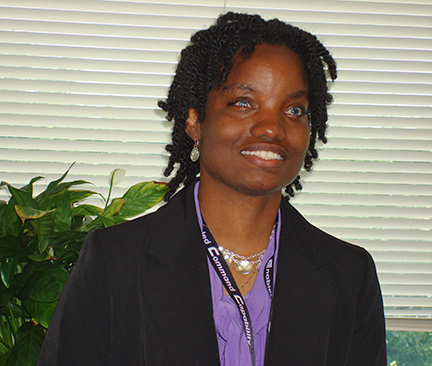
From the Editor: Since 2005, Ameenah Ghoston has worked for the Defense Information Systems Agency (DISA), where she facilitates collaboration among stakeholders in software development processes. In 2010, she was certified as a federal Chief Information Officer (CIO) by the National Defense University Information Resources Management College. The CIO prepares leaders and agency personnel for leading within and across federal and organizational boundaries. Prior to joining federal service, she worked at the National Federation of the Blind Jernigan Institute International Braille and Technology Center, where she tested and evaluated assistive technology devices for use by blind persons. She led efforts to organize the first ever Goals for Achieving Math Accessibility Summit, a forum for math educators, companies developing math accessibility solutions, and blind professionals working in STEM fields. She attributes her success to her NFB mentors and the confidence she gained by attending the adjustment to blindness program at the Louisiana Center for the Blind in 2003.
 Before a farmer can plant a field, he or she must cultivate and prepare the soil. This process requires tools, fertilizer, and most importantly, hard labor. Just as a farmer cultivates the land, students must take advantage of opportunities that will prepare them for employment, cultivating them throughout their school years.
I have had many cultivating opportunities that have led me to pursue the field of information technology (IT) with an emphasis on helping people connect with one another. Information technology concerns cellphones, computers, and the internet--all the networks and devices that have drastically changed how we connect with one another and with the world around us.
My early interest in IT was cultivated by my desire to connect with a guy--my stepfather. In 1984, when I was eight, we connected for the first time by playing a game of bowling together on an IBM computer. That IBM computer now sits in the basement with a collection of other tech relics, but in 1984 it was considered top of the line, and it stood prominently on my stepfather's desk. I remember sneaking to touch it and wondering how it worked. How did it play a bowling game, anyway?
I attended a resource room for blind students in the Chicago public school system. When I was in fifth grade, my classmates and I were given a computer course. We were introduced to the Apple II-E computer and a programming language called BASIC. Our instructor taught us the essentials of the program, and we programmed our first computer game. This class also introduced me to a screen access program and synthesized speech.
Ironically, though we were learning about the computer, my classmates and I still used the manual typewriter to produce our homework assignments for the classes in which we were mainstreamed. We also used the Perkins Brailler and slate and stylus for taking notes and handling assignments, which we turned in to our resource teacher for translation. Needless to say, it was frustrating to navigate among these assorted technologies. However, the experience taught me to rely on multiple devices. I learned to determine which solution would work best for me in a given situation.
While my dad and I connected through our mutual interest in computers, my mother and I connected through literature. We spent hours reading together--that is, I read Braille books to her aloud. When we were not reading, she had me define words and use them in sentences. I used my slate and stylus to produce these assignments because I thought the Braillewriter was noisy and hard to carry. When I entered high school in 1992, I continued to use a slate and stylus, though I was exposed to much of the technology I use today in my career as an IT professional.
During my sophomore year in high school, my teacher of the visually impaired enrolled me in a research study sponsored by Northern Illinois University (NIU). Through this study I was provided with a Braille 'n Speak notetaker, a Blazie Braille printer, a laptop with Windows 3.1, and a screen reader. The primary purpose of the study was to expose blind and low-vision students to the internet and to evaluate the impact of the internet in an academic setting.
In many respects, this study was my first hands-on experience with hardware and software, and it helped me understand how the various technologies connected. Most importantly, I learned to integrate my new arsenal of technology into everyday life. When we connected to the internet and learned to send email, I began to see the full significance of what I was experiencing. I realized that I wanted my career to center around access to information.
Granted, the amount of information available on the internet was nothing like what we have today. At the time, however, going online provided me with greater access to information than I had ever known before. I had an immense appetite for learning, and I was starved for reading matter. Few of my family members were college educated, but they placed high value on literacy and learning. I had access to Braille and recorded books through the National Library Service for the Blind and Physically Handicapped (NLS), but I was frustrated because I could not go to the library and browse like my peers and relatives. The internet was truly a game changer. For the first time ever, I felt that I had a competitive edge. I was on the cutting edge of technology, ahead of my sighted peers in learning about the new online world.
In 1994 the internet was still a relatively new phenomenon, and students rarely had their own computers. However, the story was very different in my household. At that time my stepfather headed a major project to connect all of the computers at the agency where he worked to other networks. My mother was learning to use a computer for her work as a university administrator. You might say that I had a front-row seat, witnessing the transformation of our society as it went online. I saw how the PC and the internet could change how people learn and work. This understanding gave me hope and a zeal to be part of the future of IT.
However, my hope was quickly dashed. I came face to face with reality when I confronted the challenges of studying math and science, subjects that are essential in every STEM career field. In college I became so discouraged by my difficulties accessing material that I gave up on my dream of earning a BS in computer science. In 2002 I earned a BA in history with a computer science minor from the University of Illinois at Urbana-Champaign.
Nevertheless, I did not give up entirely on a career in STEM. I simply found an alternative path. During college, I worked part-time at the National Center for Super Computing Applications (NCSA). Its primary mission is to harness the power of computers for data modeling and simulation of science and engineering. It was definitely one of the places to be if you wanted to be on the cutting edge in the world of computing. One aspect of its mission was educational outreach and technology for the K-12 environment. I worked on grant proposals to get funding in order to bring these educational opportunities to local schools.
Because I had both computer programming and writing skills, it was not unusual for me to edit grant proposals one day, develop websites in support of our educational programs the next day, and on another day generate user accounts for participants to access data visualization tools. In that environment my combination of skills was quite rare. Most of my student coworkers were averse to writing anything in actual words. However, my combination of skills also made me unsure about life after college, about what I should do and where I should go. It was my stepfather who encouraged me to work for the Department of Defense, and I have been there since 2005.
One of the problems I had to solve in my job was how to access diagrams. With my supervisor's support I devoted work time to talking with experts in tactile graphics, comparing the cost and function of various tactile graphics solutions. I settled on the Emprint embosser, which is a dual tactile graphics and inkprint printer. I also obtained IVEO software and an accompanying touchpad. Both technologies are manufactured by ViewPlus Technologies. I can explore a diagram through Braille and speech, and I can collaborate on diagrams with sighted colleagues. I have also created and given presentations that have process diagrams in them.
Once a supervisor asked me to develop and give a presentation on the project I was working on. I was so shocked by the request that I blurted out, "Why me?" "Because I assigned you as the lead," he responded. I was shocked because PowerPoint is a visual aid for giving presentations, and I was unsure how I would use it as a blind person. I worked with several people to ensure that the presentation was visually appealing, and I gave it using a laptop and a Braille display. To present the diagram I arranged for one of my teammates to assist me, partly because he was more knowledgeable than I in that particular area. When it came time for questions, I answered them to the best of my ability. One of my coworkers pointed out that I had presented to some of the most difficult personalities in our group and congratulated me for holding my own.
That is what I desire for the upcoming generation of blind STEM professionals to do: to be able to hold their own. Technology is becoming virtual, wearable, robotic, and mobile--and all of it is interconnected. Blind people need to be at the forefront, ensuring that all of this technology is usable for and by the blind. Ensuring that blind people are involved begins when parents and teachers actively seek the involvement of blind children. I had access to cool and interesting technologies. Above all, the adults in my life, people whom I respected, communicated critical messages. "We believe that you can do it," they told me. "We believe in you so much that we are going to prepare you for the future."
Media Share
