American Action Fund for Blind Children and Adults
Future Reflections Convention 2016 NOPBC CONFERENCE
Advocating for Myself
by Kayleigh Joiner
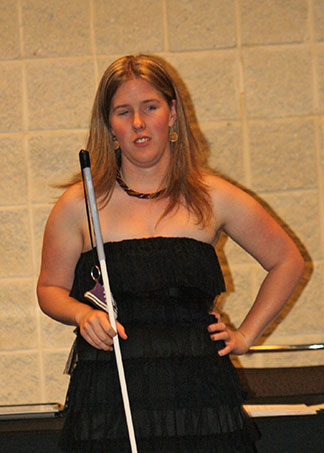 Introduction by Kim Cunningham: The person we're going to hear from next is the reason I'm here today. I'd like to introduce my daughter, Kayleigh Joiner.
Thank you for the opportunity to speak to the best parents of blind children organization in this country!
My childhood education revolved around the use of my residual vision. My TVI deemed me a visual learner. I used large-print textbooks and magnifying devices starting in the third grade all the way through high school. For this reason I spent countless hours every evening doing homework, homework, and more homework. No one ever dreamed of teaching me Braille to help speed things up.
Doing all my work visually was very fatiguing. My neck hurt and my eyes ached. I was given books on CD, but that didn't help me work much faster. No one listened to our concerns.
In seventh grade I decided I was done with the pain and strain of reading visually. I determined that I would teach myself Braille. While my mother began a five-year battle with the school district for Braille instruction, I signed up for distance learning courses on Braille from the Hadley Institute for the Blind and Visually Impaired. [Applause] I worked hard, and I was able to complete my schoolwork on top of taking courses at Hadley. When I informed my TVI that I was teaching myself Braille, she criticized me, saying, "Why would you want to do that? We can always teach you later on!" This was my first step in learning that I am my own advocate and that only I know what works for me.
The week following my high school graduation, I moved to Ruston, Louisiana, where I had six months of intensive sleepshade training at the Louisiana Center for the Blind (LCB). [Applause] By graduation I had doubled my Braille reading speed, I was able to cook a meal for forty people, and I had traveled out of town independently. I also learned to use human readers to gain access to printed information. This training prepared me to be successful in college and beyond.
While I was in college I utilized my travel skills and newfound confidence when meeting friends for dinner off campus. In taking tests or doing research, I enlisted human readers, whom I directed to access the necessary information.
During my junior and senior years, I spread my wings even further and moved off campus into my own apartment. This was a perfect time to put to use the cooking and cleaning skills I had acquired at LCB.
College can be an exciting and challenging time for all students. During my freshman year I started to have a problem with my teeth. Home was three hours away. I had to use the skills I had learned at LCB to find a dentist and a driver who could take me there. I had to transition from having these things done for me to doing them myself.
While I was at college, the weather gave me some good opportunities to test my travel skills. Many times I had to travel to class in the rain, holding an umbrella in one hand and my long white cane in the other. I also had the opportunity to travel in snow. (And let me just say, this Texan isn't used to that!) I was able to venture out in the cold to get some boots at the mall.
I have always wanted to be a teacher. I recall playing school outside with my next-door neighbor for hours on end. I want to have a positive impact on future generations of children and give them the skills they will need for their future. I enjoy working with young children and love their natural curiosity and joy for learning. That is why I decided to major in elementary education.
I graduated in December 2015 with a degree in elementary education, early childhood through sixth grade. In the fall of 2014, as part of my degree program, I spent two hours a day, four days a week, in an elementary classroom teaching small group reading. One of our assignments involved writing a paper on the growth of the students in our small group. We had to perform assessments on our students to gather the necessary data. In order to perform these assessments, I Brailled out the protocol sheet and added Braille to the sight-word cards so I could determine whether the students were reading the words correctly. I also made copies of the students' guided reading materials so I could follow along as they read and provide them with strategies they could use to help them figure out difficult words. By having many tools in my toolbox to choose from when accomplishing a task, I can be just as effective as a sighted teacher.
I joined the Federation in 2007 when I attended my first NFB national convention in Atlanta. That year I was also a participant in the NFB's STEM program, Youth Slam. Fast forward to 2009, and I was elected to the board of my state student division. In 2011 I became a mentor for participants at Youth Slam.
As you can tell, I have transitioned from being a receiver in the NFB to someone who is now giving back to future generations. I strongly encourage you and your children to get involved with the NFB. The Federation can provide opportunities for networking with other blind students and parents of blind children, along with blind mentors who can serve as role models for you and your children. Through my involvement with the NFB I have learned that I can live the life I want. You and your children can, too. Thank you.
Media Share
