American Action Fund for Blind Children and Adults
Future Reflections Winter 2019 EARLY CHILDHOOD
Mama Bears Unite!
by Alison Clougherty
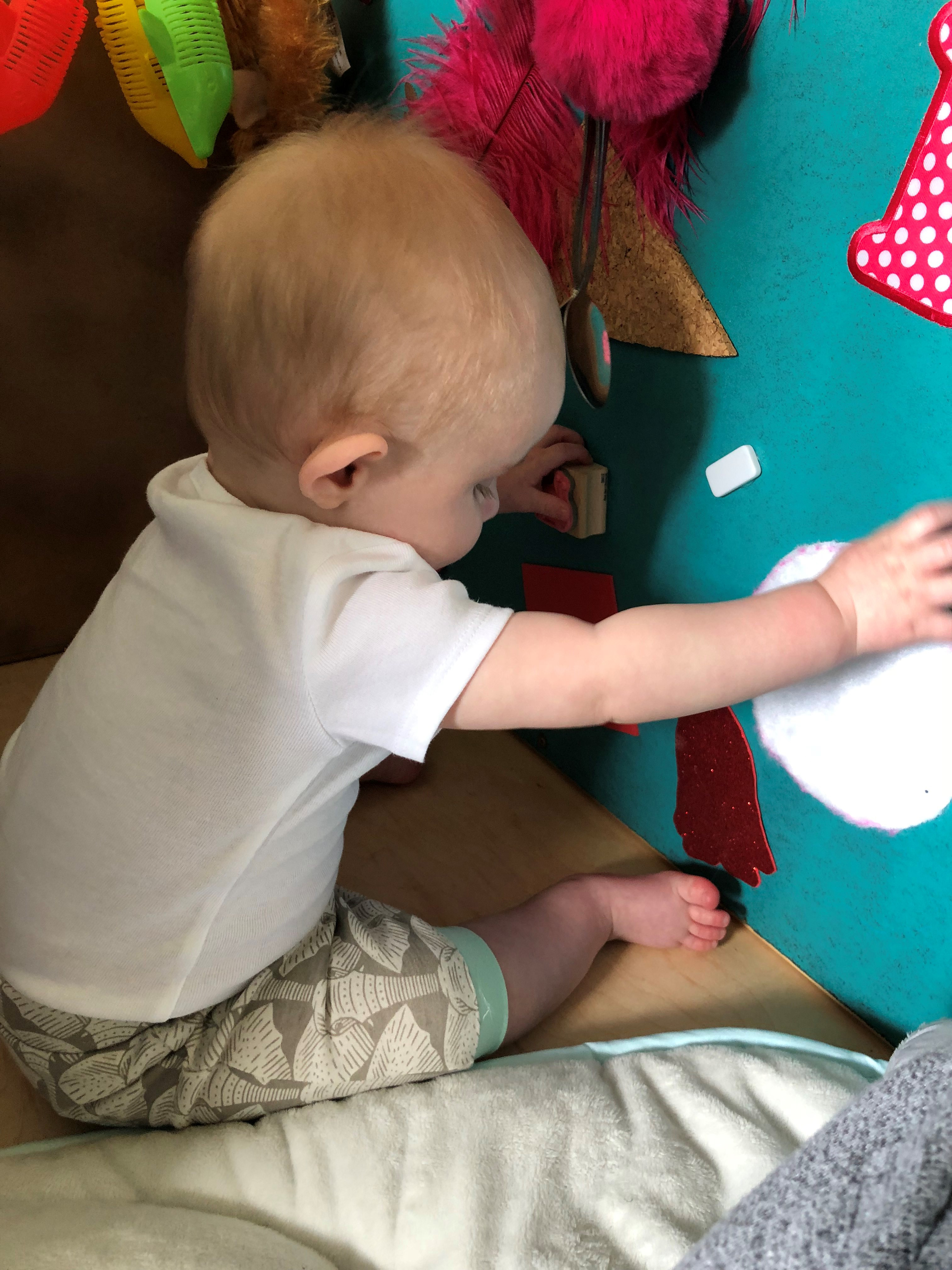 From the Editor: Alison Clougherty is the mother of a blind son, Finn, who is sixteen months old as this magazine goes to press. This article originally appeared on her blog, Seeing Things in a Different Way, in which she writes about her parenting journey. You can follow her posts at https://seeingthingsinadifferentway.wordpress.com/about-us.
By the time Finn was eight months old, we'd really come a long way since those early days after his birth. Doctor's appointments were less frequent. The surgeries were behind us. My husband, Patrick, and I were on the same page. We were immersed in the everyday job of parenting our son.
As I imagine most new mothers do, I was spending any free time I had immersing myself in books on "how to get your baby to sleep through the night," "how to raise a kind human," "how to make your own baby food" (a short-lived phase), and "how the hell to get your baby to sleep through the night?!?!" among others.
On top of the usual parenting books, I was also reading anything I could find about how to raise a blind child. As rare as our situation is, the amount of literature published on the topic is scarce to say the least. I did find one book that was extremely old and extremely technical, but I took what I could get. The first few chapters were a biology lesson on how the eyes work and communicate with the brain. Helpful information, I suppose, but I was well past any interest in the mechanics of it all—just tell me what my son needs already!
It turned out that a lot of what Finn needed was no different from what any other infant needs, with a few modifications. We learned to talk to him A LOT! For example, I never just swoop in and pick him up without saying first, "Mama's going to pick you up." I say this to avoid startling him. Any time I carry him throughout the house I describe where we're going, how we're getting there, the directions we're taking. I'm sure a lot of parents do this, too, but for Finn it has to be pretty constant and consistent, as he depends on these descriptions to learn about his environment.
But when I came upon the chapter in this book entitled "Early Intervention," a lightbulb went off. I studied early childhood education alongside psychology as an undergrad in college. I even went on to get a master's degree in education policy. None of this do I use directly in my job in event marketing, which has sometimes led me to look back and wonder if I have let my education go to waste. Now I think perhaps the education path I chose wasn't meant for my professional career at all; perhaps it was meant to give me a solid foundation for my career in parenting Finn.
All of that is to say that the concept of early intervention was not new to me. I knew the basics—that any children born with disabilities or delays are entitled to free government services to help them achieve and succeed to the best of their abilities. I knew this right was protected by the Individuals with Disabilities Act (IDEA). Yet not until I read that chapter did it really dawn on me that we needed to apply for services for Finn. I'm not sure why it took so long—I had accepted Finn's blindness for sure, but perhaps I was still in a bit of denial that I was, in fact, a special needs mom. And though I had basic knowledge of what early intervention entailed, I really had no knowledge of what services a blind child would need or qualify for. From what I remember of my course studies, blindness was not one of the typically identified "disabilities" on the list.
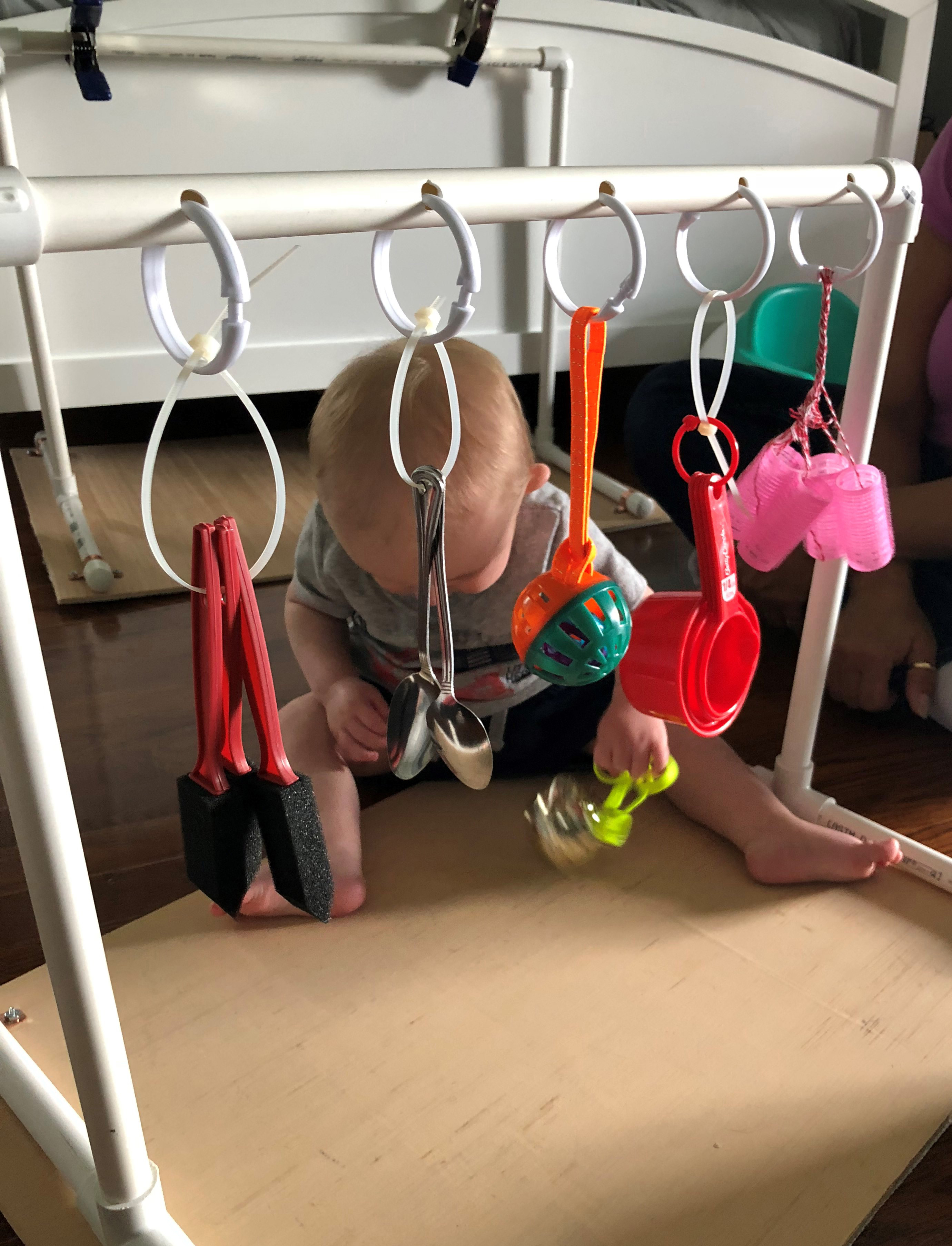 Luckily this book laid it all out there for me. The two most important services Finn would need would be a TVI (teacher of the visually impaired) and an O&M (orientation and mobility specialist). A TVI provides tools and education specifically for those with visual impairment or blindness. An O&M instructor teaches those with visual impairment to move safely and independently throughout their environment—for example, how to properly use a long white cane. I'd never heard either of these terms before, or if I had it was many years ago in school, and it didn't sink in. If only I'd known then that I'd have a blind son fifteen years later, I'd have listened a bit more closely!
After reading up on early intervention, I was a bit dismayed that no one—none of the doctors we'd seen—had yet suggested to us that we should apply for these services. Luckily, I read this book, and luckily I had the base background education that I did, or we might have gone many months or even years longer without getting Finn the services he needed. From there I asked our pediatrician, our retinal surgeon, and Miss H [a blind adult in the area], their thoughts about Finn's needs. They all agreed that we needed to apply for services through the state as soon as possible, though none seemed particularly familiar with what the services would be or the process of obtaining them. We were on our own.
I found the Tennessee Early Intervention Services (TEIS) phone number online and called them three times before receiving a call back. When I finally got someone on the phone, I was asked a slew of questions regarding Finn's medical history. From there, we had to have all of his records transferred to the TEIS offices to prove need. Once they established that there was in fact a need for services, we'd be assigned a case coordinator. This process took about a month. I told the lady on the phone that my son was completely blind. I'd sent her all of his medical records proving this fact. Yet, a month passed before they confirmed all of this to be true.
We were assigned a coordinator. We'll call her Miss C. Our first meeting with Miss C. was pretty simple—she came to the house, met Finn, had us fill out some paperwork, and let us know that we'd been preliminarily approved for services pending one other medical record they needed. I was annoyed, but things seemed to be moving along. Miss C. let us know that we'd then be assigned a developmental therapist, and we would soon know how many days a month they would allow us to see him/her. I started to ask a few questions that went something like this:
"The developmental therapist—what is "his/her role?" "What is "his/her background in vision impairment?" "Would we also be given a TVI and an O&M?"
This is where things went south for Miss C. and me—we'll call me Mama Bear. Miss C. told me that the developmental therapist (DT) is meant to ensure that Finn achieves his developmental milestones, but that he/she would have no background in visual impairment. She said she knew of one DT with a background in O&M, but that she was assigned to another county. She went on to say that TEIS had no TVI or O&M on staff in my county, so those services would not be available for Finn.
I'm sorry, WHAT?!?!?!
My follow-up questions went a bit like this: "You're telling me that my blind child is approved for services, but none of those services are specific to visual impairment?" "You're telling me that there are no TVIs or O&Ms in the state of Tennessee available to help him?" "You're telling me he's only been approved to see a developmental therapist, even though he thus far has shown no signs of developmental delays?" Her first answer was "Yes." Her second answer was "Well, there are TVIs and O&Ms, but not on our staff, so you're welcome to obtain those services privately and pay for them on your own." Her last answer, "Yes."
As you can imagine, I had some follow-up questions: "What about parents of children like Finn who can't afford to pay for services on their own?" "What about those who don't have the means to take their child to said services? Are they just left to fall through the cracks?" Her answers were again, "Yes," and my response was a simple, "Unacceptable."
Things got pretty tense with Miss C. I don't think she was prepared for me to break out the book I'd just read, or for me to reference the IDEA (Individuals with Disabilities Education Act). I was armed with knowledge, and I wasn't taking no for an answer.
Miss C. did agree to do what she could to get me the one DT in the area with an O&M background, even though she was not currently an actively practicing O&M. I took a deep breath and held it together until she left. I was angry. I was in full-fledged mom advocacy mode. As confident as I'd been while Miss C. was in my living room, as soon as she left I was deflated and afraid—afraid that there was nothing I could do to get my son the services he needed.
Though I knew enough about the IDEA as a whole, I didn't know much about Tennessee's interpretation of that law. I did as much research as I could online, but that only took me so far. I started researching TVIs and O&Ms in the area to see what kind of information I could gather. I then came across a TVI training program at Vanderbilt University. I emailed the head of the department, explained my situation, and asked if there were any TVIs on staff who might know more about the early intervention system. Candidly, my husband and I have the means and were willing to pay for services privately if necessary, but I wasn't about to come out and say this in my email. I knew for all the other mothers in my situation out there who don't have the means, this just wasn't right.
The person I emailed at Vanderbilt immediately responded and gave me another contact there whom she said had extensive experience in the field. She followed up a day later with two other contacts. Just when you get discouraged by one person's seeming unwillingness to help, you turn around to find another who goes above and beyond!
I reached out to all three contacts. The first one to respond, we'll call her Miss D., was a certified vision teacher and O&M instructor, as well as an early interventionist. Bingo! She could not have been more helpful or sympathetic. She explained to me that having specific vision services for Finn was an absolute necessity, and that services needed to start sooner rather than later. Furthermore, and as I'd suspected, it was the state's responsibility to provide these services. She offered to come to our house, do an evaluation of Finn at no charge, and meet with him weekly until we could get services from the state. She didn't want him to fall through the cracks for even a minute. People are so wonderful sometimes!!
Miss D. came to do her evaluation the next week, and she put together a full report that spelled out Finn's developmental status and needs. A lot of children with visual impairments have delays related to development. Thus far, Finn had exhibited no other issues—he'd hit every milestone "on time." That's not to say he didn't need a DT—he was only eight months old at this point, and who knew if his development would continue on this path. But the DT was more of a preventive need for Finn than an immediate one.
The need for a vision teacher, someone who could ensure he had the proper tools to learn without visual input, was a true, immediate need for our son. Miss D. gave us the name of the head of TEIS for a neighboring county—she told us that she knew of a similar situation that had happened years prior, and that this man had secured a private vision teacher to be paid for by the state of Tennessee for a little boy, also blind. Miss D. told me to send her report to him and give him the background. She also agreed to call him herself and let him know I'd be reaching out.
I heard back from him immediately. He said he'd be sending all of his paperwork from the family he'd worked with years back to my coordinator and her boss, his counterpart for my county, as evidence of a precedent and an example of what needed to be done. Within days of his email, we were approved for a vision teacher to come meet with Finn once a week! We were also approved for the DT with an O&M background to come two to four times a month. Hallelujah! The persistence and help of others had prevailed!
We started the process of applying for services in May. Finn was approved for a vision teacher and began seeing her in late July. It took three months of phone calls, waiting, emails, and most of all, people who cared, to help us get there.
What I learned from all of this was that my most important job as Finn's mother is going to be working as his advocate. Being his Mama Bear. At the same time, I'll be working as an advocate for all other mothers in my shoes, just as that mother in Tennessee had done years before me. I'm sure she had to go through an even harder battle to get her son a vision teacher, with no precedent yet set. I think of other mothers out there starting on this journey; mothers who don't have any background knowledge about early intervention and have never heard of the IDEA; who may not have access to or know where to find the books I've read; who may take no for an answer, simply because they don't have the knowledge, time, or energy to put up a fight that they may view as a losing battle.
As a side note, I don't want to bash TEIS or even my original coordinator (we have since moved counties and have been assigned a new coordinator; I think Miss C. and I were both happy about that, since we never fully recovered from that initial first impression). For all the stress it caused me for those few months, TEIS has provided really wonderful specialists who work with my son every week in the comfort of our own home. He is now in his seventh month of service, and it has truly been invaluable. Though they are here for Finn, they are really here to teach Patrick and me how to equip him with the tools he needs to succeed. I've learned so much! Early intervention is an amazing service any special needs parent should take advantage of—just don't be afraid to fight for what you think and know your child needs, despite what you may be told. The more precedents we can set, the better for those who come after us. Most of all, know that there are people out there who can help and who are eager to help. Including me!
Media Share
