American Action Fund for Blind Children and Adults
Future Reflections Special Issue on Tactile Fluency A LETTER FROM THE EDITOR
The Gift of Touch
by Deborah Kent Stein
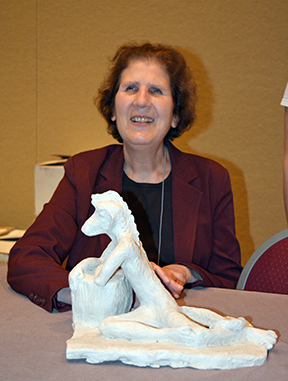 Growing up as a blind child, I was blessed with parents who understood that I would gather most of my knowledge about the world around me through touch. Nearly every day Mom took me on walks in our suburban neighborhood, showing me telephone poles, mailboxes, fire hydrants, and the toadstools that popped up in the grass after a rain. I remember her hoisting me high to touch the icicles that hung above the front door, and Dad showing me the bags of peat moss he was spreading on the garden. I even remember Dad lifting me up to examine the bald head of a family friend at a party, to everyone's vast amusement.
My parents modeled the concept of tactile access, and our neighbors and relatives followed their lead. My uncle brought me a lizard, racing in circles at the bottom of a metal wastebasket. A neighbor up the street showed me the body of a mourning dove that had crashed into her picture window. Through all these opportunities to examine and explore, I built a vast storehouse of tactile memories, mental images that have served me throughout my life. I also learned to use my hands efficiently for gathering information. Although the term was unfamiliar in those days, I gained a high degree of tactile fluency.
The critical importance of touch in the lives of blind children might seem intuitive, but many barriers, literal and figurative, can prevent our blind children from learning to explore with their hands. Our society places a host of prohibitions against touching things, and "Don't touch!" is one of the first rules that sighted children learn. "Don't touch that! It's fragile.” “That's sharp; it will hurt you.” “That isn't yours; leave it alone!” “Don't touch!" Raised in this touch-phobic atmosphere, parents of blind children may feel uncomfortable about letting their kids have a hands-on view of the world. People may stare and frown. But then again, others will understand, smile, and say, "And come over here! Check this out!” I believe that my parents understood that saying "Don't touch!" to a blind child is the same as saying, "Don't look!" to a child with eyesight.
Tactile fluency in its many facets is the theme of this issue of Future Reflections. Carol Castellano explains that tactile fluency can help blind children achieve independence. Ann Cunningham and Al Maneki write about introducing young blind children to pictures and drawing. Stacie Dubnow, Steve Landau, and Mike Coleman and Mike Rosen discuss technological innovations that give blind people greater access to graphics, and Lindsay Yazallino shares some of her adventures with tactile exploration and discovery.
With the advent of 3D printing and other new technologies, the field of tactile fluency has awakened the interest of scientists, educators, and the blind community. The articles in this issue of Future Reflections only graze the surface, but I hope they will lead readers to question assumptions and reach out for new possibilities.
Media Share
