American Action Fund for Blind Children and Adults
Future Reflections Special Issue on Tactile Fluency EARLY LEARNING
Tactile Fluency: Expanding the Concept
by Barbara Shalit
 From the Editor: Barbara Shalit became interested in drawing opportunities for blind students in the 1970s, when she read an article on the subject by John M. Kennedy of the University of Toronto. She worked for many years with the New Jersey Commission for the Blind, and she has served as the lead teacher for New Jersey's NFB BELL Academy.
In the past, training programs for teachers of the visually impaired (TVIs) described tactile fluency almost exclusively in terms of preparation for Braille reading. They focused on smooth hand and finger mechanics and, of course, on effective tracking—no scrubbing up and down a letter or contraction, no getting lost looking for the next line.
More recently, however, the definition of tactile fluency has expanded to embrace the comprehensive use of touch for an understanding of both 2- and 3-dimensional objects. Research shows that blind children have inherent abilities to understand raised-line drawings, and we are increasingly aware that students need to develop these abilities for success in the classroom and beyond. Tactile fluency has come to include not only the ability to read and write, but also the ability to interpret and create tactile graphics. We're not just talking about maps and geometry diagrams, either. Starting in pre-kindergarten we're introducing children to raised lines, simple drawings, and a variety of textures. We're encouraging children to express themselves through their own drawings on tactile-sensitive surfaces (not the dining room table!). In short, tactile fluency is now understood to be a necessary component in the self-expression of blind children and a basis for lifelong learning.
Parents and TVIs play a large role in developing tactile fluency in children. Generally TVIs have had limited room in their schedules for activities in this area, needing most of their time for Braille instruction, materials preparation, and consultations with classroom teachers. More time may be allocated for tactile fluency as it becomes incorporated into early-intervention activities and joins other goals in students' Individualized Education Plans (IEPs).
Building Background
I can't emphasize too strongly that direct experience with the world is the basis for a child's understanding of representations of real objects. Blind children need plenty of opportunities for hands-on exploration of the environment. They need to discover that a car is not simply a couch that carries them from place to place! They need to become thoroughly acquainted with trees and bushes, the corners of rooms, door locks and hinges, tricycle parts, the dog's leash or harness, the cat's condo, and live animals at the petting zoo. This real-life experience will become the foundation for the child's understanding of representations of these and other items as line drawings (most easily understood), possibly with varying textures.
Countless opportunities exist for the child to practice turning direct experience into tactile representation. You're limited only by your imagination, so go for it! Depending on the child's developmental age, the teacher or parent might make a raised-line drawing (RLD) of something very familiar, e.g., the child's bed, a clothing hanger, or a pair of socks. First encourage the child to explore the actual item with hands and fingers. Maybe the sock is striped or ridged. Use a texture for the stripes within the outline of the sock. Talk with the child about the different textures. The child or parent can use a pencil to poke a hole in the drawing of the sock where a toe might poke out. A finger can slip through the hole, and you have a wiggling toe! You're having fun and moving from the real object to its representation.
Has the child ever hugged a tree? Been placed on a tree branch? Ridden in a wagon before reading about one in a story? Does the child really know about the parts of a swing? Have you attached playing cards with clothespins to the spokes of bike wheels for an auditory cue? What's a spoke, anyway? Remember "The Bear Climbed Over the Mountain"? Make and trace a curved line, perhaps first with Wikki Stix, then with a raised-line drawing tool or crayon. Be the bear and track its journey over the hill. Sing the song. Take a toy car for a drive over the mountain, or let a doll climb it.
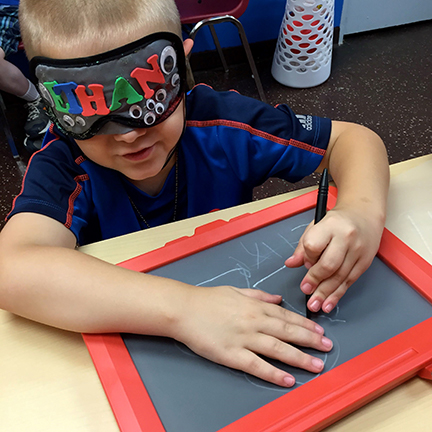
Research has shown that line drawings are the most readily understood representations in the early stages of developing tactile fluency. If you run out of ideas for illustrations to turn into RLDs, download and print free clip art (umbrella, dog, cake). On the paper's reverse side, use a drawing tool — a hard, sharp pen or pencil, or a tracing wheel — to trace the object, which will produce a raised-line drawing on the flip side. You can also use one of the drawing kits now available, such as the Sensational Blackboard or the inTACT Sketchpad. With these tools there is no need to draw on the reverse side of the page to produce a positive image.
If you have a Braillewriter, you can make a variety of pictures:
- Create a series of wavy lines (dots 3, 2, 1, 4, 5, and 6; repeat) or make short lines, long lines, or dashed lines, with a story to accompany the illustrations.
- Make up a story about a walk over a stream. A dashed line could represent stepping-stones through the water. Each time there's a space between the "stones," the protagonist gets to dip a foot into the water (the child can dip a finger into a cup of water).
As parents and TVIs read this article, they probably will recall other fun activities they've used successfully to develop tactile skills. The creativity is out there to be shared.
A number of raised-line activity books are available commercially or through organizations such as National Braille Press. Use simple mazes to practice tracing and direction-changing. Remember to use directional terminology such as top, bottom, corner, left, right, middle, beside, and between, even with very young children. Eventually (and why not now?) begin to use terms such as north, east, south, and west, especially when taking walks. It may not be the developmental time to delve into compasses and magnetic north, but when that time does come, the vocabulary will sound familiar. This background will prove advantageous during orientation and mobility training.
So far, this approach uses a top-down, adult-to-child, instructional method. It's critical for children to realize that they themselves can create images. They can draw and assemble by themselves, discovering the pleasure and meaning of their own creations. All humans, including children, have an innate drive for self-expression. An important part of tactile fluency includes making one's own art and illustrations. Maybe your child will develop a personal logo well in advance of learning his or her signature. It's conceivable that drawing skills will enable the blind student to hand in a worksheet with his or her own hand-drawn illustrations.
Approaching the Page
Let's skip ahead to fourth grade and a child's first exposure to a bar graph. Approach the page in a sequential, logical way. Initially, have the student get an overview of the page. Are there bumpy parts? Smooth parts? Where's the action, the information? Where is there no information? Using directional terms, have the child place the hands together in the "top middle" of the page and slide the hands down and around. If this approach is difficult, just moving one's hands over the page will help reveal where the content lies.
Next, have the child place the hands together at the top middle of the page and draw them apart and down along each side. Feel the empty margins. Oops, what's that? Oh, a page number. But where's the content information?
Back to the top, and line by line, left to right, encourage the child to explore the page, touching everything there is to touch. The child will come across the graph bars of different lengths to be compared. Then the child will encounter the y-axis and the x-axis and their noted measurements. Wouldn't it be fun if the bar graph related to the child's personal experience, such as who's the tallest family member? Who's next in height?
Homemade Early Drawing Kit
You can make a simple drawing kit by using a framed sheet of window screening. Place the drawing paper on top of the screen. Use thick crayons to draw and drag lines across the page; the crayon lines will leave little pieces of crayon wax on the paper in the shape of the lines. The lines are now tactile. Just drawing strokes and counting them is a simple, satisfying activity. Another activity, requiring a bit more dexterity, involves tracing within shape stencils. Once this skill has been mastered, the child can try drawing the shape freehand. The screen device is commercially available. Other, more sophisticated, devices allow drawn lines to be erased through physical pressure or with an electronic eraser.
Future Opportunities
As your child develops tactile fluency, he or she develops new neural pathways. As the child explores actual 3-dimensional objects, he or she learns to relate them to their 2-dimensional versions. Our goal is to help the child comprehend illustrations that grow more complicated with every school grade. Ultimately these young people will need to read maps and diagrams professionally or in higher education (a car mechanic's schematic, an organic chemist's diagram of a molecule).
In addition to understanding raised-line illustrations, perhaps with differing textures, blind students are likely to encounter 3D printed objects. These objects can be extremely useful, but careful tactile exploration is essential. Students need plenty of experience with thorough tactile exploration in order to benefit from the opportunities that 3D printing can provide. Such exploration, too, falls within the skills of tactile fluency and tactile literacy.
The timing is right for a basic, primary curriculum combining ready-made, raised-line drawings with opportunities for the child to create art and diagrams. This standardized foundation would support both teachers and parents in their efforts to expand the concept of tactile fluency. We have widened our thinking about what constitutes tactile fluency as we share ideas and have fun putting them into practice.
Media Share
