American Action Fund for Blind Children and Adults
Future Reflections Special Issue on Tactile Fluency PERSONAL PERSPECTIVES
From Pickles and Papyrus to Bats and Brains
by Lindsay Yazallino
From the Editor: Lindsay Yazallino is a tactile design specialist who works with others to create "hand-catching" experiences. She is also an air travel enthusiast who loves adventures, especially when they involve airports, sushi, and connecting with new and interesting people. In 2007 she was awarded a national scholarship from the National Federation of the Blind.
It was October 1995, I was in first grade, and I knew exactly what I wanted to be for Halloween. A pumpkin? A ghost? Boring! I decided to dress up as my favorite food—a dill pickle.
Fortunately for me, my family got totally onboard with my plan. My highly creative aunt and grandma set to work designing the perfect pickle outfit. Once it was finished, I tried it on and examined every detail with my fingertips. I admired the felt hat with a curved stem on top, the plastic Vlasic label across my chest, and the half-spherical pickle bumps glued onto my pickle-green felt suit. I loved experiencing my unique outfit through touch just as others enjoyed looking at the pint-sized pickle girl. As I marched with the rest of my classmates in my school's Halloween parade and heard the admiring reactions of the people around me, I couldn't have been happier to be—literally—in a pickle.
 My life has been enriched by tactile experiences—and pickles—ever since I can remember. From the time I was a totally blind baby, my parents and the other adults in my life encouraged me to explore the world through my four senses. Many of my earliest memories are vividly tactile. I loved to go fishing with my dad, and I can still picture with my mind's fingers the slimy skin, tiny teeth, and ridged tail and fins of a wriggling rainbow trout that would soon become our dinner. I used to collect seashells, and I marveled at their multi-textured surfaces and naturally smooth, polished interiors. Even the display rack by the drugstore check-out register, filled with packages of gum and mints, was a tactile treasure trove, and it did not escape my inquisitive finger pads. My parents would step back and let me discover my environment for myself, even when it would have been faster or easier for them to intervene. I am grateful that they gave me that gift, enabling me to develop such strong sensory awareness during those early years.
Of course, my tactile astuteness sometimes worked to my parents' disadvantage, as when I immediately figured out the contents of my birthday and Christmas packages by feeling them through the wrapping paper. But my mom can be crafty, and she found clever ways to disguise my gifts. Sometimes she wrapped them in extra-large boxes full of rattling popcorn kernels. So, to everyone reading this, especially parents, never underestimate a devious child with well-trained fingers!
In addition to seashells, I collected everything from bells to music boxes to—yes, I'll admit it—SpongeBob SquarePants characters! (Plankton and Squidward are still my favorites!) I found myself especially drawn to 3D replicas of actual objects, and I delighted in admiring their exquisite tactile resemblance to the real things.
I was incredibly fortunate to spend elementary school working with my exceptionally whimsical and creative TVI, Maggie Ritchie, who was as big a fan of tactile exploration as I was. She had an uncanny knack for finding the most hand-catching goodies to show me. During our years together she came to school with an anatomically correct skull model, a roll of papyrus from Egypt, and even a live rooster from her farm! She always used fun, tangible items to spark my often unconventional interests.
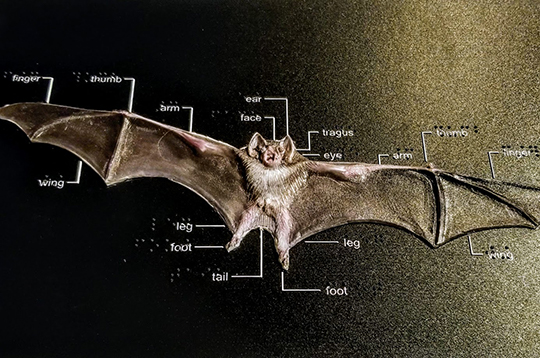
 If you had asked six-year-old me what my favorite animal was, my answer would not have been a dog or a cat, but a bat. I was intrigued by bats' remarkable abilities to fly silently through the night, hang upside down by their feet, and use echolocation to build pictures of their environments through sound. However, I had no idea what a bat looked like until Maggie brought in several plastic bat models, a bat necklace, and even a bat house—a wooden box where real bats could take up residence in one's backyard. After exploring the replicas, with their distinctively flexible, hand-like wings and large ears, I was convinced that bats were the coolest-looking animals ever, and I couldn't understand why most people find them so ugly. Little did I know that bats would fly back into my life more than two decades later. But I'll get back to that in a bit.
Even while I was playing with bats and skulls, I was also doing actual classwork. I began to learn Braille at age three, and I quickly became a voracious tactile reader. I learned math and science—my favorite subjects—through a combination of excellent teachers, the Nemeth Braille Code, and plenty of tactile graphics and 3D models. I also learned to interpret tactile maps proficiently, although I admit that geography was never my favorite subject.
Throughout middle and high school, I loaded up on advanced math and science courses, which meant that I needed tons of ever more complex tactile materials, including graphs, diagrams, and images. My TVI at the time, Kay Adamson, was up to the task, ensuring that I had everything I needed. She spent countless hours creating pages upon pages of calculus graphs and trigonometric figures, certainly not a task for the faint of heart! Despite the often Herculean effort required to produce them, nobody ever questioned my need for tactile course materials. We all understood that tactile graphics enabled me to capture in seconds concepts that would have taken far longer to convey through written or verbal descriptions—if they could be conveyed at all through mere words. I took it as a given that I could construct vivid mental pictures through touch, and that "visuals" are not just for the eyes.
Fast-forward to college. I was a student at Brown University, taking an introductory neuroscience course as part of my cognitive science concentration. To my delight, my professor brought in a few preserved human brains for the class to look at—and touch. Some of my classmates were totally grossed out, but of course I couldn't pass up the opportunity. I examined the tightly packed folds that make up the spongy yet firm cortical surface of a typical brain, as well as the noticeably altered texture and consistency of a brain affected by Alzheimer’s disease.
After graduation, with these vivid images still in my own brain, I spent several years as a cognitive neuroscience researcher. My colleagues and I investigated fascinating questions about the relationship between blindness, brain development, and cognition. I was thrilled to have the opportunity to work on scientific studies of Braille reading, touch perception, and many other nonvisual abilities that had always enriched my life. To top it all off, I had the opportunity to get my brain scanned for research, and I am now the proud owner of a 3D-printed model of my very own brain! I can hold my brain in my hand and still have one in my head at the same time!
Investigating tactile perception often meant that my hands spent more time typing on a computer keyboard than on touching anything new and interesting. Eventually I decided that it was time for me to return to the concrete, tangible world that I love. I realized that, in our sight-centric environment full of "DO NOT TOUCH!" signs, I wanted to help create more tactile experiences designed to enrich all our lives, not just the lives of blind people. Meanwhile, I met several new friends who were experts in 3D printing, and I was enamored with the possibility of transforming digital images into physical objects that I could hold in my hands.
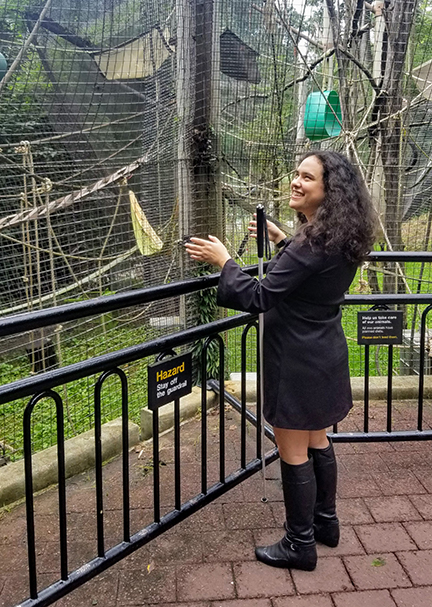
Nothing could have been more fortuitous than crossing paths with Steve Landau, who immediately impressed me with his ingenious ideas and his passion for tactile design. I was inspired by the creative ways in which his company, Touch Graphics, was cleverly using technology to transform tactile maps, images, and 3D models into interactive multisensory experiences. When Steve asked me to work with the Touch Graphics team to create touch-responsive museum exhibits and other public installations, I was excited to contribute my expertise. Most of these tactile objects are designed so that exploring them through touch triggers engaging audio and visual descriptions, and some even include fun sound effects. In a world where visual images usually take precedence over all else, I feel fortunate to have found like-minded colleagues who value excellent tactile design, and who appreciate my nitpicky attention to tactile detail. There is nothing quite like dreaming up ideas and achieving literally tangible results, which, to my delight, have included both brains and bats!
Speaking of bats, last year I attended a conference in Austin, Texas. Austin is home to the largest urban bat colony in North America, living under its famous Congress Avenue Bridge. My visit inspired me to begin working with a team of bat researchers back home in Boston. We spent several late nights watching bats in a local cemetery and listening to their calls, using a special acoustic detector. (I know—it's not exactly everyone's idea of a fun night out!) Naturally, the images from my childhood remained clear in my mind; still, I wanted to learn more about bat anatomy. As it turned out, I was in luck. I had just met Crispin Weinberg, an expert in biomedical 3D printing, and he graciously volunteered to print several exquisitely detailed bat skeletons for me.
Meanwhile, Halloween was drawing near, and I knew it was time for me to do the obvious. With the help of my Touch Graphics colleagues, I selected a wonderfully cozy, fuzzy bat costume, complete with furry ears and pointed fangs. I may not have been in a pickle this time, but going batty was just as much fun. And now, it's time for me to work on accomplishing my next goals, such as touching a real live bat, learning to use a 3D printer, and creating 3D embryology models. And, as I promote the world's tactile wonders, then maybe, just maybe, I can help to reduce its population of "DO NOT TOUCH!" signs!
Media Share
