American Action Fund for Blind Children and Adults
Future Reflections Fall 2019 FEATURE
Happy Birthday, Dear Seedlings!
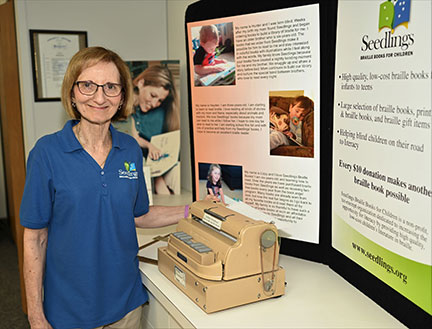 From the Editor: For blind children and their families, Seedlings Braille Books for Children is a beloved resource. For the past thirty-five years this small nonprofit company in Livonia, Michigan, has provided books for blind children and for blind parents to read aloud, whether their children are blind or sighted. Seedlings books are sold at affordable prices, and in many cases they are provided free of charge. In honor of Seedlings' thirty-fifth anniversary, this seems a good time to look back at how the company began and evolved over the past three-and-a-half decades.
"Everybody searches for a vocation they can be passionate about," reflects Seedlings founder Debra Bonde. When she was in her mid-twenties, Bonde was eager to find such a vocation, but she was hampered by her extreme shyness. Social work and the other helping professions appealed to her in many ways, but they were also scary. "They would require me to be out there talking to people," she says. "That just wasn't going to work for me."
Then she saw an ad for a class on Braille transcription. She had a friend who was a transcriber, and she thought the class might be interesting. Twenty people signed up for the class, and Debra Bonde was among them.
Bonde quickly discovered that many people are not cut out to do Braille transcription. "You have to be very detail oriented," she explains. "You have to pay very close attention all the time." Of the twenty people who took the class, Bonde was one of only two who finally were certified. She earned her Braille certification in 1979 by transcribing The Best Christmas Pageant Ever by Barbara Robinson.
Inspiration
While she was taking the class, Bonde met a woman whose daughter was blind. She was aghast to find out that the little girl had only two Braille books of her own. When she did some research she learned how few Braille books were available for children and how outrageously expensive they were.
"I came from a family of readers, and I was very moved to learn about this shortage of Braille books," Bonde remembers. "I firmly believed that kids should be surrounded by books from an early age." She decided to transcribe more children's books into Braille and to make them affordable.
Once she made that commitment, Debra Bonde got to work. Her father donated some needed supplies as well as the first binding machine. He was an engineer, and he managed to obtain the blueprint for a machine that added electronics to an old Perkins Brailler. He built the machine and connected it to an Apple IIe computer. With the help of this machine and a program called BrailleEdit, one of the earliest Braille translation programs, Debra Bonde transcribed and shipped her first titles in 1985.
Learning to use the Perkins-computer combo was no small achievement. Even after Bonde had mastered the quirks of the machine, it kept breaking down. It was only partially automatic, and she had to crank the paper in sheet by sheet, printing the books one copy at a time.
By this time the organization had acquired a name. Bonde and her crew chose Seedlings because Braille dots reminded Bonde of tiny seeds. Books from Seedlings could help blind children grow up to be literate adults.
In 1986 Bonde printed the first Seedlings catalog on an old stencil machine that belonged to her church. The catalog was only one page, and it listed twelve titles. That year Seedlings distributed 221 Braille books to eager young readers.
Growth and Expansion
Bonde knew that Seedlings had to reach a wider audience. She and her assistant, who was one of her close friends, obtained a directory of agencies serving the blind. They sent out as many fliers as they could manage. A major boost came from a Detroit newspaper that ran a regular column called Disabled in Detroit. The paper printed a story about Seedlings, and it was picked up by the wire services. Stories about Seedlings appeared in papers all over the country, and letters flooded in. Most came from families hungry to obtain Braille books for their children. Many arrived from people who offered their help.
It was clear that Seedlings needed to produce a broader range of Braille titles, but money was tight. One of Bonde's friends was active in a local Lions Club. She invited Bonde to speak to her chapter. Bonde still dreaded public speaking, but she knew this was a valuable opportunity. For the sake of Seedlings, she addressed the Lions Club. The Lions made a generous donation of a thousand dollars.
Seedlings had been operating out of Debra Bonde's basement, but they were quickly outgrowing the space. In 1990 Seedlings rented a room in a former high school in Livonia, Michigan. The space had once been the school's home economics room. It was a big, open area of about 1,000 square feet, with plenty of room for shelving. Bonde and her assistants knew that families were used to waiting months to receive Braille books, and they wanted that to change. They determined to keep a good supply of books on hand. When orders came in, they could be filled immediately.
In the early 1990s Seedlings had one part-time employee and several volunteers. Everyone worked to keep overhead as low as possible without sacrificing quality. "Everybody was very resourceful," Bonde says. "When anything went wrong, we'd kind of MacGyver things back together."
In 1997 the city decided to tear down the old high school, and Seedlings was forced to move to new headquarters. This time the company rented a large commercial space in Livonia. Even with the luxury of 1,500 square feet, they quickly ran out of room for books and equipment. Books were piled everywhere.
In the years that followed, Seedlings expanded still further. Twice it spread into neighboring spaces. The number of embossers grew, and so did the staff and the corps of volunteers. Recently Seedlings acquired the Braillo, the Cadillac of Braille printers. Manufactured in Norway and sold in the United States through American Thermoform, the Braillo is a very sturdy machine that produces interpoint Braille, or Braille transcribed on both sides of the page.
Embracing UEB
When Unified English Braille (UEB) was adopted as the Braille code for the English-speaking world in 2016, Seedlings focused on converting its collection to UEB. The process of converting titles into UEB from the old code is labor intensive, but the Seedlings staff felt it was crucial. "It seemed so important to give young readers books in the code they are learning at school," Bonde explains. They started with the books for younger readers, the children who are new Braille learners. For older readers they have begun by choosing the most popular titles.
Today the Seedlings catalog includes more than thirteen hundred titles, ranging from board books for toddlers to full-length novels for teens. Several books for young children are bilingual editions in English and Spanish.
Often people ask how Seedlings decides which books to produce in Braille. Selecting new titles is definitely a group effort. The staff and volunteers look at titles that are popular and books that have won awards. They also review suggestions from readers.
Although more and more titles are now available to blind readers electronically through services such as Bookshare and BARD, Seedlings has experienced no decrease in the demand for hardcopy books. In fact, the number of orders increases every year. "We especially see the need with early Braille readers," says Bonde. "As they work to master reading, they need real books that they can hold in their hands."
Reaching the Blind Community
In 2017 Seedlings reached the half-million mark; it had sold or given away five hundred thousand books since the days of the Brailler-computer! Altogether Seedlings has sent books to children and adults in seventy-five countries!
About half of the books that Seedlings distributes are donations to schools, programs, and individuals. Teachers of the visually impaired (TVIs) are eligible to receive four free Seedlings titles annually. For the past seven years, Seedlings has donated books to the NFB BELL Academies. This year Seedlings generously gave gift certificates to each of the children who entered the Nationwide Braille Readers Are Leaders contest, sponsored by the American Action Fund for Blind Children and Adults.
The Book Angel Program is a very special program that Seedlings has sponsored since 2002. Children from birth to age twenty-one who sign up for the program can receive three free Braille titles per year. Since it was established, the Angel Book Program has given fifty thousand books to blind readers.
When asked about future plans for Seedlings, Debra Bonde explains, "We'd like to increase the number of books we distribute by about 10 percent per year. And we want to continue giving away half of those books completely free of charge."
Seedlings has touched the lives of thousands of people, and many of them share their appreciation in heartfelt letters. "When I was first learning Braille at age five, I received some Seedlings Braille books," wrote John, a high school sophomore. "To this day I still have a few Seedlings books sitting on my shelf, my favorites being The Very Hungry Caterpillar and Goodnight Moon. Thank you, Seedlings, for helping children enjoy the greatness of reading!" A lawyer from Ottawa, Canada, explained, "Were it not for Seedlings, I would not have had books to read for pleasure as a child. Starting from around age five, my favorite Christmas gift was a stack of Seedlings books. I can remember the joy of perusing the Seedlings catalog every year with my mom and picking the books I wanted. Reading books myself permitted me to learn spelling, sentence structure, and the joy of literacy." Rosa, a blind grandmother, wrote, "I have been able to read to my son and granddaughter so many books from Seedlings as a blind parent and grandparent. My son's favorite was Green Eggs and Ham. My granddaughter's favorite is The Very Hungry Caterpillar. My granddaughter loves when I read books to her, and when we're together, she hunts for her favorite books and brings them to her Mima (that's what she calls me) and snuggles next to me to listen to me read to her as she follows along excitedly."
"We're very grateful for the support we receive from Braille readers," Debra Bonde says. "I love getting their feedback. I love what we do! Everybody needs more books!" When she started creating Braille books for children, Debra Bonde discovered her life's true vocation!
Happy thirty-fifth birthday to Seedlings!
Media Share
