American Action Fund for Blind Children and Adults
Future Reflections Fall 2019 PASSAGES
Paths and Transitions
by Mausam Mehta
From the Editor: This article is based on a presentation given by Mausam Mehta at the 2019 Midwest Student Seminar, "Owning Your Future," which was sponsored by the National Association of Blind Students (NABS). Mausam is a NABS board member, and she is active with the Virginia Association of Blind Students.
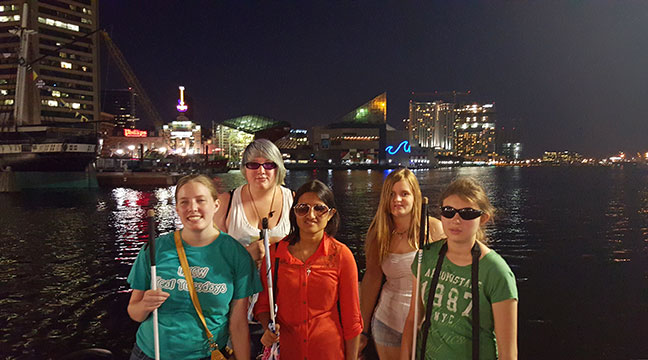
I'm a first-year student at the University of Virginia, and I'm going to tell you every single thing you need to know about college, so sit back—this will take a few hours. No, just kidding! Actually I want to talk to you about paths and transitions, how change and uncertainty ultimately bring clarity.
My passion for math has led me to a school brimming with spirit and launched me on a trajectory toward business school. As I speed to the end of my freshman year, I feel that I'm where I belong. But I scaled a mountain of doubt and uncertainty to get to this moment.
I have traditional Indian parents. When my friends were collecting Pokemon cards and watching Star Wars, I was doing multiplication tables. At the dinner table my dad would give my sister and me complicated math problems to solve to hone our mental math skills. He had the philosophy, "If you don't know the right answer, don't say anything." I'd like to think I've integrating that idea into all aspects of my life, but that would mean I'm always right—and even I can't pretend that's true!
Discussion around college became a focal point of my life early on. In second grade, as I labored over long division problems that took up entire Braille pages, I heard my parents shout their congratulations over a long-distance phone line to my cousin in India, who had just made it into the top med school. When I was in sixth grade I wrote my first research paper, a whopping two pages—in Braille, not print—on Helen Keller. I dedicated a page and a half of this novel to her success at Radcliffe College, despite the low expectations she faced. Her triumph helped fuel my efforts in school.
Fast forward to high school, sophomore year. I was rocking baggy jeans and a ponytail, and I preferred to spend my time rolling around on the goalball court at the nearby school for the deaf and blind. My favorite subject was Latin, not even a core subject, and I could rattle off Shakespeare's “Sonnet 23” faster than I could remember any of the elements on the periodic table. It was evident to me that something was changing.
In my school district we had the opportunity to apply to two-year programs that would take us out of our traditional schools for half a day to specialize in a particular area. During our junior and senior years we could spend our time concentrating in STEM fields or in the visual arts at the Governor's School, or we could obtain a certification in a trade at the technical center. The application processes for these programs were quite competitive. Many of us spent the latter half of our sophomore year obsessing over our grades and résumés, who we might get recommendation letters from, and which programs to apply to. My peers spoke confidently about the medical internships they would procure as their senior capstones at the "Gov School," or about all of the money they would make right out of high school with their welding certifications. (No joke! As welders they could make a lot of money!)
I had no such certainties. To be completely honest, I envied their confidence in the future. As I walked through the technical center on a class tour, I smelled grease from the auto body shop and heard the steady banging of hammers from the architecture block. I learned later that the students were building a house—a real house! —for a family who had lost their home in a terrible fire. What if I were part of all this, I thought as we continued on our way. Could I make a tangible difference in someone's life?
I kept those thoughts to myself. Later, when my parents asked me about the tour, I gave noncommittal answers and retreated to my schoolwork. I was really disconcerted by the direction of my thoughts. My interest in the technical programs did not line up with the fixed course I had planned.
My parents had raised me to work hard in school, to get good grades so I could go to a good college and find a well-paying job. That was what I wanted, right?
After lots of deliberation, I decided to apply to the Governor's School with a concentration in STEM. Although this was the choice everyone anticipated, my rationale for choosing this track had changed significantly. I had the privilege of being accepted into the program, and I resolved to make the most of this opportunity.
My time at the Governor's School was inarguably one of the most challenging academic pursuits of my life. I shed quite a few tears over partial derivatives, and I will always regard force diagrams with a healthy dose of dislike. Sometimes, as I hammered out the final sentences of a lab report at 3:00 a.m., those nagging thoughts would come back to me. How are partial derivatives going to help me make a tangible difference? I knew the knowledge I was gaining here was important, but was any of it actually practical?
In time I began to understand that my in-depth knowledge of STEM would open doors to many real-life applications. Maybe one day I could use my knowledge of calculus and physics to build an even better house for a family. Sometimes we doubt our choices to the extent that we don't really give them a chance to show us their merit.
I don't especially enjoy reminiscing about the college application process, so let's move on to something a little more exciting. Second semester of senior year, though stressful, is a time when unknowns become known. Two months after I submitted applications to eleven schools, I pored over my options and made endless lists of pros and cons. In the end I narrowed my choices down to two schools: one that my heart had been set on for years, and the other one that I never would have dreamed of attending. After touring both schools and spending hours comparing their academic programs, I settled on the second one. Sometimes we surprise ourselves!
The University of Virginia has sixteen thousand undergrads, it sprawls over more than two thousand acres, and it prides itself on its twisty, aesthetic paths that often lead nowhere. When I arrived on the campus in late August, I had no idea how many months I would spend wandering around lost. At first I was more worried about how the food in the dining hall would taste and whether I was going to get along with my roommate.
I can't begin to describe the roller coaster of emotions I experienced during the first week. I had several moments of truth that formed the foundation of my college experience. One of them came in the form of my first economics class.
On the first day of class I walked into the lecture hall at 8:54 a.m.; this was before I discovered the joys of sliding into class thirty seconds before it starts! I found a seat somewhere in the middle of the massive, echoing auditorium that held more students than my entire high school. As I listened to the clamor of people just starting to make friends, I felt isolated in a sea of strangers. I had expected this, I suppose, but nonetheless it was overwhelming.
A few weeks later, in early September, I sat at my desk in my empty dorm room, fighting a pervasive feeling of despair. College was supposed to be a fresh start, with new friends and new experiences. Instead, I felt I was already missing out on many opportunities. I was so lost in my thoughts that at first I didn't realize my phone was ringing. I answered without checking the caller ID and was surprised to find that it was our very own Syed Rizvi, a member of the NABS board. He asked me about my experiences so far, and after hearing my dejected answer, he launched into a monologue in typical Syed fashion. Our conversation would change my outlook on college into something far more positive.
"Mausam, you need to go out and make some friends," Syed told me, "and here's how you should do it." Needless to say, that was the beginning. I started spamming my hallmates into dinner with me. I interviewed for UVAs oldest organization, the esteemed Jefferson Society, and somehow I got in. I raised my hand an obnoxious amount in discussion classes, made friends with the dining hall workers, and fell down a few sets of stairs. I laughed a little and cried a lot during my first finals week, and I left for winter break feeling at least a little bit fulfilled.
I have to tell you it hasn't been easy. I came out of my first semester feeling that I had not met my academic standards. There were moments when I worried that maybe I wasn't cut out for this college thing after all, that all my doubts were becoming a reality. I felt that I wasn't working hard enough, but I didn't know if I could work any harder.
As I stand here now, halfway into my second semester, I'm not entirely free of those uncertainties. Sometimes when I'm sitting in my 9:00 a.m. class, running on three hours of sleep, I still question my decisions. But I remind myself that this experience is far bigger than I could ever imagine.
My dad is a small master of philosophies. He has always told me that when you're faced with a tricky problem, start with what you know. I know that I'm grateful to be part of a vibrant community of students and faculty that share an endless passion for education. College is about exploring, not limiting. I have so much to learn, but finally I feel I'm getting to where I need to be. Each of us takes a different route with unique challenges and victories. We may not always know whether we're heading in the right direction, and we will not always have the right answers. We certainly do not have it all figured out. In fact, I'm even thinking about switching my major—but that's a different conversation.
The college experience is one of a kind. Take the time to learn as much as you can, but don't forget to meet your daily quota of fun along the way. It's an exciting time, so carpe diem! Seize the day!
Media Share
