American Action Fund for Blind Children and Adults
Future Reflections Fall 2019 PROGRAMS
Regarding the Colorado Center for the Blind and My Experience
by Luc Gandarias
Reprinted from Braille Monitor, Volume 62, Number 6, June 2019
From the Editor: Luc Gandarias is a sixteen-year-old high school student from Washington State. He attended NFB STEM EQ in June, and he hopes to become an astrophysicist. This article is based on a presentation he gave at the 2019 convention of the NFB of Washington.
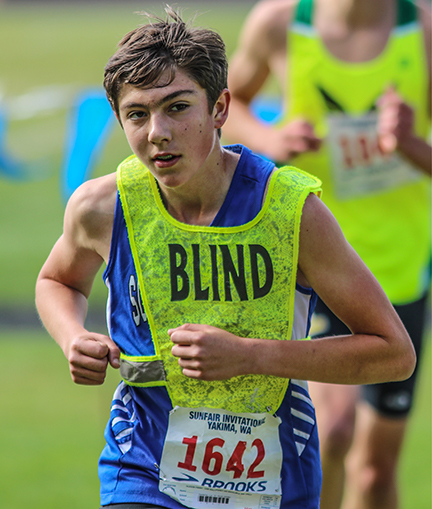 I am here to speak to you today about my summer at the Colorado Center for the Blind (CCB). Before I talk about the main points, it is important that I give some background. I first learned of the CCB while I was at the NFB national convention three years ago. My mother and I were returning to our hotel room after a lengthy general session to change and prepare for the banquet when she noticed the CCB table. Immediately she strode over to it with me in tow and began cheerfully firing questions at the CCB rep. I listened curiously until I heard that the summer program lasted eight weeks and took place all the way out in Colorado. At that point I tuned out the conversation.
Once her voracious appetite for answers was satisfied, my mother turned to me. "Excellent!" she said. "Guess where you're going after freshman year."
I was twelve at the time, just entering seventh grade. I was vehemently opposed to any program that impinged upon my summer pastimes of hanging out with my friends and playing Minecraft. Clearly I wasn't seeing the wisdom in going to such a program, though it would provide training in the skills I needed to realize my goals in the professional workplace.
As time wore on, I grew considerably warmer toward the idea of going to CCB. I talked with many of my closest Federation family members, who all thought that the Colorado Center was a perfect fit for me. They said the experience would give me a taste of what college life might be like.
Another factor that gave me the desire to attend the program was learning about the additional activities it offered, such as outdoor rock climbing, whitewater rafting, and a 5K run. These activities would all be done under sleepshades, and I was understandably underwhelmed by the idea. I didn't realize that once you're under sleepshades for eight hours a day anyway, it isn't a problem to put them on for recreational activities as well.
Eventually the time came for me to attend the program. My mother and I made the journey down to Littleton so I could get situated in my apartment. It was then that I met my counselor, a college student from Georgia named Justin Heard. He also served as president of the Georgia Association of Blind Students. I also met a fellow student named Brett Camen. I soon grew quite close to both of these people.
After a three-day period of rest while everyone got to know one another, the program came on hard and fast. The home management segment of the program held no real difficulties for me, since I have always been expected to cook and help out with the chores at home like any other kid. However, even during the first week, I saw enormous growth in other students at the program. Their counselors instructed them on how to complete basic cooking or cleaning tasks and then turned them loose to try it themselves. Several students came to CCB scared to open an oven. By the end of the program they were making entire meals unsupervised. That is the power of Structured Discovery!
Though the physical tasks of cooking and cleaning weren't difficult for me, living with three other people was. It was exceedingly hard to keep my possessions separate from those of the others. Several times I went on a mad rampage around the apartment, looking for one of my dress shirts that had inexplicably dematerialized from the hanger. To make matters even more convoluted, my counselor and I both wore the same size clothing, and we had pairs of khakis that were identical. This experience greatly improved my organizational skills, which desperately needed help anyway.
The class that challenged me the most and incited the most growth in my skills was travel. I was a competent cane user before coming to the program, and I had experience using sleepshades. However, my skills under sleepshades were mediocre at best. This changed very quickly. CCB mandated that all students were to have their sleepshades on from morning announcements until the bell at the end of the day. Initially this was quite difficult for me, and I was caught several times peeking, but I adapted reasonably quickly. After the second week I didn't mind not being able to use my sight, but I minded very much the sticky, itchy, uncomfortable nature of the sleepshades. After all, the temperature in Littleton was in the high 90s. However, I slowly grew accustomed to this, too.
The first few days of travel class were slow going. They mainly consisted of basic cane techniques, but we quickly progressed to lessons navigating intersections in the neighborhood surrounding the center. When I asked when we would work on traveling to specific locations, I was informed that they would start those lessons the following week.
Another week was too long for me to wait. I planned with one of my friends to go to the Microsoft store in Park Meadows on Thursday of the second week of the program. The store was fifty miles from the apartments, all the way on the other side of Denver, and the trip involved three train transfers and two buses. Actually, Michael and I had no real reason to go to this store. We didn't need to purchase anything, nor did we have the money. The trip was meant to challenge our problem-solving skills and to prove our abilities to the counselors so we could take other expeditions in the future. The travel instructors were quite willing to let me go on independent routes or to go with another student. They even permitted me to go to Wells Fargo to resolve an issue with my bank account during center hours—alone, of course.
Perhaps the most beloved part of each week at CCB was the Sunday shopping spree and cleaning extravaganza. Students would loudly complain to one another about how long shopping took and how much they didn't want to clean. I never found cleaning particularly grueling; in fact, it usually took me about a half hour to clean the apartment. However, I am in full agreement with the other students regarding the laborious task of shopping for the week. It was mind-numbing, and it took hours. The shopper's assistants were slow and rarely found the correct items. It took nearly two hours to locate everything on a twenty-five-item list and get checked out. At home I know the layout of all the local stores, and I can easily find almost anything. A shopping trip like the one I just described would take my family and me about twenty minutes total. In spite of this, I feel that it was beneficial for me to do this shopping on a regular basis. I may have a more efficient method for shopping in my area, but the experience at the center showed me what shopping will be like when I am in college or living on my own. In addition, creating a weekly budget to provide meals accommodating the various eating styles in my apartment was a challenge and a skill I needed to develop. I learned a lot about budget and compromise. Also, I learned how expensive my favorite summer meal of Greek pasta salad is to make when I'm not shopping at Trader Joe's.
The most highly anticipated and fun part of the program was the NFB national convention. All eighty-nine students from the three NFB training programs were flown to Florida to experience the magic of a national convention. Our trip was excellent. Naturally we were required to wear our sleepshades from eight in the morning until five in the evening, unless we were sitting in a meeting. This amounted to very little actual time wearing the shades, since meetings comprised most of the day. However, navigating around the hotel under shades was torture! The place was cavernous and echoing in one area, which was difficult to navigate, but not too bad. The lower hall was a different story altogether. It was carpeted and lined with tables that made shorelining impossible. The only way to navigate this hallway was to make an educated guess where the walls were and walk as straight as possible toward the escorts at the end of the hall. I got all kinds of mobility practice in a vast and unknown area. It was good experience for my fellow CCB students and for me.
General sessions were long, but they were never boring. I had had the good fortune to attend convention three times before this summer, so I knew what to expect. This was not the case for many of my peers, and they were overwhelmed by the sheer number of blind people in one place. Something I noticed among all students during the convention was the desire for involvement in this great organization. Even the students who were most depressed by their condition before coming to the convention were fired up by the NFB philosophy by the end. Interacting with people who share ideas, adventures, and prospects for the future was a new experience for many of us.
In this speech I can't contain all that I learned at CCB, but I would like to mention one thing before I close: I will never be a dishwasher! All along my plan has been to go to college and study to become a physicist, and now I am doubly convinced that this will be my path. At the end of the program, students were assigned to an internship at various local establishments. My job was to be a dishwasher at a local restaurant. On the first day, the supervisor told my friend and me that he hoped this internship made sure that we never worked in the restaurant industry! That set the tone for the rest of the week. On the upside, we got free food and beverages the entire time we worked there.
I also enjoyed the commute in the morning. It was rather long, since we worked in Golden. After the first two days we were deemed to have enough travel skills to find our own way, and we made the commute without supervision.
Eight weeks at CCB seemed daunting at the beginning of the summer, and I thought I would lose all my vacation. In the end, I am so happy I went to CCB and came to know the amazing friends that I met there. I have people I can call all across the country now. I have lifelong friends, and I got a glimpse of what skills I need beyond my regular school day. Thankfully, my NFB family and my first TVI, Denise Mackenstadt, set me on a good path. I only hope that attendance at CCB will be an option for more students from Washington State. This is not just a live-in program but a real-life program!
Media Share
