American Action Fund for Blind Children and Adults
Future Reflections Winter 2020 PERSPECTIVES
Growing Comfortable with the Uncomfortable
by Trisha Kulkarni
Reprinted from Braille Monitor, Volume 62, Number 3, March 2019
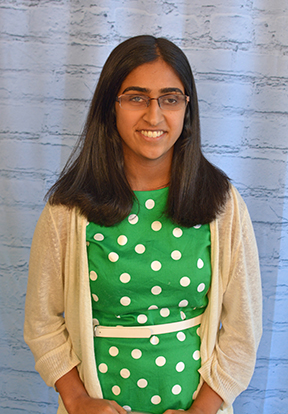 From the Editor: Facing our fears and moving forward can be one of the greatest challenges in life. For those of us who are blind, that challenge is heightened when the low expectations of others seem to confirm that we have plenty to be afraid of. Trisha Kulkarni has given serious thought to these issues. She told her story in a speech at the meeting of the National Association of Blind Students (NABS) during the 2018 NFB Washington Seminar.
I am so excited to have the opportunity to speak to you today and to share some of my story. For those of you who don't know me, my name is Trisha Kulkarni, and although I've been a longtime contributor and leader in my community, I'm a new member of the National Federation of the Blind.
I had the privilege of being part of the 2018 National Federation of the Blind scholarship class. Through my trip to the NFB convention in Orlando, Florida, I gained exposure to the incredible efforts of this organization. I encourage all of you to apply for a national scholarship, because that experience really did change my life.
It is quite a humbling experience to stand in front of you today, not only because of the long journey that brought me to this moment, but because of the novelty of my work with the NFB. Seven years ago I did not know a single blind person, and I was convinced that Braille was simply decorative artwork on signage. Now I've moved across the country independently with my guide dog, Liberty, to seize life's opportunities in a new and exciting place. Of course I have fallen, both literally and figuratively, in the pursuit of my dreams, but I have realized that pushing past the boundaries of what is comfortable is the only way to see how far your capabilities can stretch.
Today I want to share with you a series of experiences that have defined my character and purpose within and beyond the NFB. More importantly, I want to challenge each of you to embrace the power you have to create meaning in every aspect of your life. In order to fuel the NFB forward into a new generation of leaders and advocates, we need to continue growing as individuals. Only then will we best be able to break down the barriers of low expectations that stand between us and our dreams.
My first story begins at a time in life that most people like to forget: middle school. At the start of seventh grade, I not only had to deal with pimples and the onset of puberty, but I also had to face a new challenge. A few months earlier I faced a retinal detachment that left me completely blind and face-down in bed for months to recover from surgery. When it was finally time to return to school, I had no orientation and mobility training, no knowledge of Braille, and no access to assistive technology. I was still trying to learn how to get around my house, and it seemed impossible that I would ever be able to match my clothes again.
However, I still had my academic ambitions. I worked hard to reach my goals in the classroom. With lots of support I finished middle school with good grades and a determination to continue finding success.
When I got to high school, however, it was harder to ignore the barriers that stood between me and my sighted peers. People began to hint that I would create too much work for my teachers and loved ones if I continued on the advanced track in school. When I sat in meetings fighting for my right to take honors coursework, I was told that the reason my Braille materials were coming in months late was that I was an anomaly for wanting to pursue a rigorous course of study. The suggestion was that perhaps there was an easier way to graduation.
But I refused to lower my standards. I started taking honors classes, and I sought involvement in extracurricular activities. Despite the resistance I faced, I sought to find success in these endeavors and true independence. I came to realize that there are a lot of preconceived notions about students with disabilities. The expectation is to bring these students up to average, but to excel seems unnecessary. I was often called an overachiever, as if I was striving to accomplish more than I should.
If you have a goal, do not let other people's skepticism deter you from reaching it. Stay grounded in the values and missions that are important to you, and do not limit your scope. Sometimes you will find that your actions change minds better than words can.
Of course, changing expectations came with many hard nights. But in the end the sleepless nights and sacrificed lunch periods served a greater goal than just getting my high school diploma.
The idea of college started entering conversations when I was in tenth grade. At my competitive high school, it never seemed to leave. My sighted peers and I worried about which university would best fit our personalities and our academic interests. But I also had to think about my blindness. It wasn't going to deter me from reaching my dream schools, but I devoted many hours to orientation and mobility training, and I received my guide dog before my senior year of high school.
There was just one problem: I didn't know where I wanted to go to school. On a vacation to the west coast, I finally found Stanford. I fell in love with the people and the talent that occupied every aspect of the campus. But as I walked the paved sidewalks, listening to the tour guide describe the beautiful scenery and rich history, I couldn't help the doubt that crept into my mind. Stanford was thousands of miles away from home; it covered eighty-eight hundred acres and had the lowest admission rate in the country—it felt crazy to imagine that I could go there! After my parents fell asleep that night, I stayed up for hours. It was easily the hardest night of my life! It was the first time I felt like my blindness would deter me from reaching what I wanted most.
However, after listening to my motivation mix on Spotify and talking to my family, I began to fill out the Stanford application. Suddenly all the steps I had taken forward to reach that moment didn't seem like enough progress. I worried how I'd measure up. But December 8 came sooner than anyone could have expected. As I sat in my living room with my family, with my finger hovering over the "view status" button, my heart began to pound. I read the word "Congratulations!" and began to scream.
That night meant so much more to me than just getting into college. It was the first time I'd realized how much there is to lose by not going after what you want. I came so close to not applying because of my fear that I was not good enough. Do not let your fear of failure be bigger than your dreams. Only you have the power to determine your self-worth.
Today I am in my second quarter at Stanford University. My transition to college has not always been comfortable, as a broken tooth, countless nights of no sleep, and many days lost on that 8,800-acre campus can speak for. But I have learned so much about myself and my aspirations since moving to California last September. Being away for school has shown me that I can venture out and find my own way. I discovered a new outlet for my voice by writing for The Stanford Daily, and I have taken on leadership positions in my dorm government. I survived my first computer science class, and I have applied to get some of my research published. I have explored the social scene of college life, and I have spent many late nights talking with my friends and eating way too much junk food.
College has shown me that every day is an adventure. With every step you take outside your comfort zone, you learn more about yourself and what is important to you.
I am a Federationist, but I am also a sister, a daughter, a friend, a writer, a black belt in Taekwondo, a chocolate lover, a Harry Potter enthusiast, a social advocate, and a terrible dancer. My purpose in the NFB is not defined by my blindness, but by all the other intersections that I bring to the table.
As I leave you today, I want to encourage you to grow comfortable with the idea of the uncomfortable. Life will throw you many adversities and opportunities that you will not be able to control, but they will define your character and purpose more than you realize. If you do not let your fear of failure stand in the way of what you want, and if you do not limit your potential, the world will be a better place with your contributions.
Thank you so much for the opportunity to speak to you today. Go make your dreams a reality!
Media Share
