American Action Fund for Blind Children and Adults
Future Reflections Special Issue on Ethnic and Cultural Diversity BUILDING MOVEMENTS, COMMUNITIES, AND FAMILIES
Cambiando Vidas: How a Small Group of Friends Started a Movement
by Conchita Hernandez Legorreta
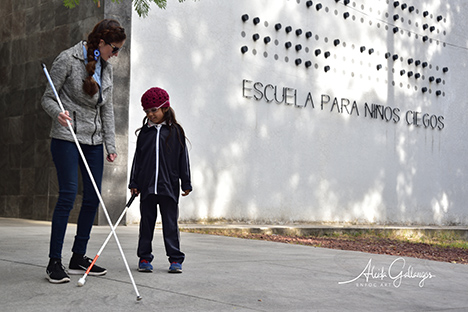 From the Editor: Conchita Hernandez Legorreta is a doctoral candidate in special education at George Washington University. She serves as statewide specialist in blind and low-vision services for the state of Maryland, and she chairs METAS, the organization she helped to found.
When I think of the single most important thing that has made a difference in my life, I would definitively say that it was encountering the National Federation of the Blind. I first learned about the NFB during my last year as an undergraduate in 2008. A blind college professor convinced me, much against my will, to attend the NFB national convention. At the convention I realized that I could do much more than I ever had imagined. I was excited by the possibilities and utterly angry that I had been kept from this information all of my life.
At the convention I learned how a small group of determined blind people started the NFB more than seventy years ago because they were not happy with their situation in society. Little did I know at the time that they would become my example to follow.
I was born in Mexico, and I moved to the United States with my family when I was five years old. My parents saw the difference that living in the United States made for children with disabilities. However, my family was undocumented, which meant that I could not access many services.
Although I received mediocre IEP services, my education was better than what I could have gotten in Mexico. I consider myself extremely fortunate to have found the NFB and obtained the tools I needed to live a full life. However, it does not sit right with me that other blind and low-vision individuals do not have the same opportunities. I have gone back to Mexico frequently, and the situation there in terms of disability is very different. In Mexico, 60 percent of people with disabilities are illiterate, and they have few economic and educational opportunities.
A Crucial Phone Call
One day as I sat at home planning the next DC NFB BELL Academy, my good friend Garrick Scott called me. Garrick has worked with youth with disabilities in various programs and projects. At the time he was president of the Georgia affiliate of the NFB.
Garrick explained that he had been asked by some traveling nurses if he could visit a school for the blind in Mexico. The nurses wanted the blind students to meet positive blind role models. Garrick thought it would be a good idea for me to go along, since I come from Mexico and speak Spanish. I convinced Garrick that we would not take a simple field trip to the school. Instead, we would plan a curriculum and a series of workshops for the students. Most importantly we would teach them a positive philosophy about blindness.
Soon after Garrick and I started planning our trip, Sachin Pavithran and Richie Flores joined forces with us. Sachin works on state and national policy in Utah. We used his expertise to set up meetings in Mexico with local government leaders. Richie has a master's degree in rehabilitation and works at UC/Berkeley, guiding students with disabilities. He is also involved with sports, so we started planning sports activities and gathering sports equipment to take to the students. What began as a small trip to show Mexican blind students a good role model soon turned into a full endeavor with a curriculum, supplies, and a team of top professionals.
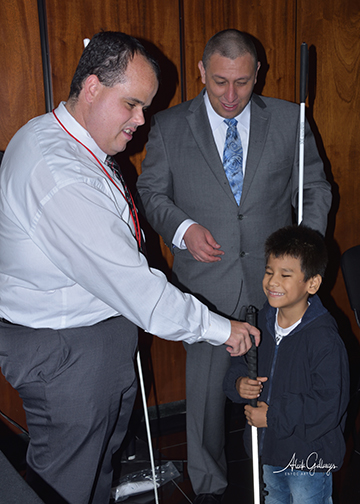 As people learned of our upcoming trip, we started getting donations of canes, Braille paper, and money. Our team realized this trip could not be an isolated event. We had to plan a sustainable program. We started having conversations with people in Mexico to get their input and guidance. METAS (Mentoring, Engaging, and Teaching all Students) was born out of this idea. Taking inspiration from the original twelve founders of the NFB, we also decided to change the reality for blind people. We officially became a nonprofit in 2016 and started letting people know we were on a mission to bring a little bit of the NFB to blind people in Mexico.
The amount of support we received was beyond anything we had hoped for! Individual blind people were our biggest supporters, giving us money and supplies. They felt, as we did, that we were the lucky blind people, truly living out the motto "Live the life you want." Now it was our turn to give back. The National Federation of the Blind of Texas quickly became one of our biggest supporters, donating canes for all of the students at the school. The NFB of Utah also strongly supported our work. People reached out to us from across the country to ask how they could help, and help they did!
Our First Trip to Guadalajara
Finally we arrived at the school in Guadalajara and started our workshops. All of our practice at NFB BELL Academies®, Youth Slams, student seminars, and state and national conventions paid off. This is what we had been training for! We worked with students and teachers from 8 a.m. until 3 p.m. for a full week. For many of the students it was the first time they ever had a cane in their hand. We played a game in which students took turns hitting a piñata while the other students practiced correct cane grip and motion.
One of the students we met was a five-year-old girl named Perla. She would walk around the school without a cane, but she loved to follow our every move. When we put a noise-making ball into her hands for the first time, she jumped with joy. She was enthralled with a ball that could make sounds. As we continued to visit the school over the years, we saw Perla grow up. We watched her become a confident young woman, holding a cane and walking with purpose.
During our first visit to the school, Richie and Sachin took two students on a mission to buy cake for our celebration. The students had never traveled independently before, and they certainly had not traveled accompanied by any blind adults. Not only were they excited about going to pick up the cake, but they were happy to be using their canes and navigating the streets with two blind role models.
Cambiando Vidas
Since that first visit to Mexico, we have taken three more trips to the school for the blind in Guadalajara. We also have found ways to work in the United States.
One of the conversations we started to have through METAS concerned the lack of training for Spanish-speaking families in the United States, especially those that might be undocumented. Unless someone has a green card, they are ineligible to receive rehabilitation services, denying them access to blindness-skills training. We reached out to the NFB of Texas and pitched them the idea of hosting a weekend workshop called Cambiando Vidas (Changing Lives) for Spanish-speaking individuals and their families. We wanted to open up the workshop to any blind or low-vision Spanish speaker, regardless of immigration status. We realized it would be important to include families. We wanted families to learn about our positive philosophy and to be engaged in learning.
Norma Crosby, the president of the NFB of Texas, loved our idea. We decided to host the workshop in McAllen, Texas. McAllen is a border town that is surrounded by border patrol. This means that if someone living in McAllen is undocumented, they cannot travel anywhere. They are prisoners in their own city.
When we opened up registration to the workshop, we decided our limit would be ten blind people and their families. By the time I went online to check how many people had registered, I discovered that we had seventeen blind people and their families, and we had to close registration. It was abundantly clear to us that this workshop was a needed service that no one else was providing.
During the Cambiando Vidas workshop, we held several classes. In the home management class Irma Pyka focused on organizational skills and cooking Latin food. Ana Marquez and Gabe Cazares taught Braille. Raúl Gallegos and Rolando Hernandez taught technology and the use of NFB-NEWSLINE®. Daniel Martinez taught orientation and mobility. Garrick Scott and I focused on working with families. All of us worked together to make the workshop a success!
Many of the participants in this initial workshop are still highly involved in the NFB of Texas. They have attended national convention and Washington Seminar. The NFB of Texas continues to host the Cambiando Vidas workshops, and it has conducted some workshops across the border in Mexico. We are very excited that this endeavor has continued, and we hope more affiliates will partner with us to bring this resource to their respective states.
METAS and the Holman Prize
In 2018 I had the great honor of winning one of the Holman prizes, enabling me to host a conference in Mexico. The Holman Prizes are given each year to blind people from around the world who have designed projects to help change what it means to be blind. METAS used the prize money to host our first national conference in Mexico. We hosted a three-day conference with workshops for blind people, parents, and professionals. The conference was free of charge, and we provided breakfast, lunch, and childcare to all participants. We had an amazing team that made the conference a huge success with more than three hundred participants from Mexico and Colombia.
Garrick Scott and Sachin Pavithran coordinated our logistics. Richie Flores coordinated sports activities and seminars. Daniel Martinez and Janna Stein provided information on teaching resources. Irma Pyka held workshops on independent living. Yadiel Sotomayor and Enrique Mejía gave orientation and mobility seminars and trainings. Norma Crosby, Glenn Crosby, and Debbie Stein led discussions on blindness philosophy. Carlos Serván gave information on what good rehabilitation can look like. Teresa Romeo and Jackeline Saba provided a parent perspective. Among our Mexican presenters was Hector Figueroa, who is a blind politician and charro (a type of Mexican cowboy).
Throughout the conference we urged participants to learn to advocate for themselves and their children, and we guided them toward the creation of an advocacy organization. They elected officers and have started doing work in Mexico. We encouraged parents to set higher expectations for their blind children, and we helped organize them to demand that schools do a better job of educating blind students. We are still in contact with many of the participants, and we continue to guide them forward.
METAS plans to continue holding programs and projects in Mexico and the United States. To quote a child I once worked with during the NFB BELL Academy, "I learned that being blind is a superpower!" I could not agree more. Our collective action is making a difference all over the world. It really does just take a small group of people to create a movement.
Media Share
