American Action Fund for Blind Children and Adults
Future Reflections Spring 2020 STEM
My Time at the NFB EQ 2019
by Maura Loberg
Reprinted from Braille Monitor, Volume 62, Number 6, June 2020
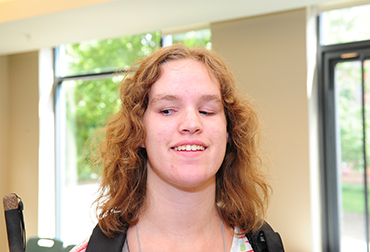 From the Editor: The National Federation of the Blind is deeply committed to helping blind students participate fully in the STEM fields (science, technology, engineering, and mathematics). Through a generous grant from the National Science Foundation (NSF), NFB EQ gives blind students hands-on experience in the field of engineering. In this article Maura Loberg recounts her experience at NFB EQ during the summer of 2019. Maura is pursuing a double major in psychology and English at Nebraska Wesleyan University, and she serves as president of the Nebraska Association of Blind Students. This article is based on a speech she delivered at the 2019 convention of the NFB of Nebraska.
The revolving door opens, and the sounds of airport traffic fill my ears. Dozens of people line up for the noisy TSA machines, while others amble to the food court to grab their morning coffee. The rush makes my aunt visibly nervous as we walk toward the empty ticket counter.
Before I have time to load my behemoth of a suitcase onto the conveyor belt, I hear familiar voices saying my name. I say a brief goodbye to my aunt before I head toward the comforting voices of a Nebraska friend's family. As we all check in together, we run across the other two friends heading to the program; by the time we head to the gate, we resemble a small tribe.
Even with such great company, however, I still don't expect much from the program. For context, I had been to many science programs for both blind and sighted youth. Many of them were full of cranky teenagers and scatterbrained instructors who rushed through experiments like wildfire. I assumed NFB EQ would be similar, but luckily I was mistaken.
My three friends and I flew into BWI (Baltimore-Washington International) after a long layover. We were met with anticipation and excitement by the NFB staff right when we landed at the gate. As soon as we got to the Jernigan Institute, I heard familiar voices, music, and the unmistakable swipe of canes. I ran into several old friends in the Harbor Room, and, after several slices of pizza and an unexpected conversation with an engineering professor, my hopes for the week were lifted.
NFB EQ was about re-imagining blindness in the STEM fields, taking on the unknown, and, well, building stuff. And build stuff we did!
On the first full day of NFB EQ we were told to build a rough model of the structure we hoped to showcase at the end of the week. We were given no major rules; we needed to put our creative juices to work. Needless to say, I had a lot of fun throwing around ideas (and pieces of cardboard). That experience set the tone for the days ahead.
Tuesday brought several tutorials on drawing with different dimensional views, cutting with handsaws, and using various measuring and organizational techniques. It amazed me that there truly were no tasks we couldn't do. We made raised-line drawings with Sensational Blackboards. Braille rulers and straight-edges were readily at hand. Handsaws were distributed without fear for the students' safety. With our alternative techniques and tools we were asked to start mapping out our structures. We knew that any kind of model we wanted to build for the exhibition was truly within our grasp.
Wednesday saw us take a tour of a post and beam facility, where we got up close and personal with a wooden bridge. We climbed on stepladders into the rafters of an adjacent building constructed nearly a century ago. This experience gave us an idea of how we could best support our structures. We also learned more than we thought possible about the load and calculation methods that engineers use in their everyday occupations. We were asked to put together towers in teams, and we had to see which ones would hold the most weight based on our calculations.
Thursday was a chaotic mess of events happening at once. We had to bear down and get our projects ready for the exhibition on Friday. Members Hall at the NFB Jernigan Institute bustled with noise. I could hear the scratch of pens drawing detailed plans from the top, front, and right views; the cutting and hot-gluing of balsa wood in extremely specific measurements; and the frantic whispers of the mathematical formulas behind our individual structures, which we had to write out and explain to the audience. I spent a lot of time that day cutting out the pieces of my design. It was called a Netflix room, and it was shaped like a hexagon.
Friday's exhibition got me in contact with some of the most important members of the NFB, and all the presentations were fascinating. I saw everything from simple square and rectangular creations to a 19-gon, which is exactly what it sounds like, a nineteen-sided polygon. The exhibition showed me just how creative and innovative we can be with the right tools and alternative techniques.
Luckily for us, we weren't just using our newfound vigor and overly caffeinated brains for all work and no play during the week. The staff of NFB EQ was extremely energetic and motivated. They pushed us to explore the wonders of Baltimore and the potential we had to travel in unfamiliar places. We went swimming in the lake, explored several areas downtown, and had a taco picnic at a nearby park, where we were free to go wherever we wanted. I ended up on the swings for three hours that night—I'm a child at heart. We also played extreme games of accessible UNO and Apples to Apples while socializing with friends in the iconic Harbor Room. These fun experiences reminded me that, beyond our blindness and additional challenges, we were all teenagers who wanted to have fun with our friends. NFB EQ made that happen.
After all was said and done, I found myself flying to Omaha with a revitalized belief that I truly could achieve my dreams and do anything I set my mind to. I'd like to thank the Nebraska affiliate for its continued support, as well as the entire National Federation of the Blind. I can no longer participate in these specialized STEM events now that I have graduated from high school, but I will keep the memories for years to come. The Federation has done a remarkable job of showing me that I can live the life I want and that my blindness is not the characteristic that solely defines me or my future. I hope that these essential programs continue taking place. Even though I will not pursue a career in science, technology, engineering, or math, I hope that those who go down that career path can use these experiences to launch them into new and exciting opportunities. Thank you, Federation family, for constantly inspiring me to think better, dream bigger, and live the life I want.