American Action Fund for Blind Children and Adults
Future Reflections Spring 2020 CAREERS
Taking a Stand Against the College Board
by Kaleigh Brendle
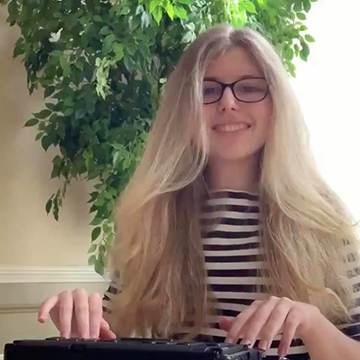 From the Editor: On July 15 Kaleigh Brendle, a rising high school senior from New Jersey, delivered this presentation to an audience of more than seven thousand people at the virtual convention of the National Federation of the Blind. Here is a portion of the introduction given by NFB President Mark Riccobono.
MARK RICCOBONO: We celebrate a lot of the work we do collectively in the National Federation of the Blind, but this agenda item is truly about a movement that this young lady spearheaded. She was the one who really called the College Board to task and organized blind students, and we just provided the technical assistance to give her voice power from New Jersey. I am pleased to introduce Kaleigh Brendle!
KALEIGH BRENDLE: Good afternoon. Before I begin, I would just like to express what a true honor it is to be able to speak to all of you today. My name is Kaleigh Brendle. I am seventeen years old, and I am a rising senior in the Scholar Center for Humanities program in New Jersey. Since birth I have possessed a condition that left me visually impaired.
As many of you know, living with blindness can be a challenge, but that which challenges us strengthens our resolve and solidifies our courage.
In keeping with that philosophy, I strive to challenge myself in all aspects of life, most notably the classroom. Since third grade my curriculum has consisted of rigorous courses. As I grew older, the level of classes I could take grew more strenuous. In high school the option arose for me to participate in courses classified as AP or Advanced Placement.
Advanced Placement courses are essentially collegiate classes that high school students across the world are eligible to enroll in. Students who perform well on the final exam for an AP course may be eligible to receive college credit. This makes the exams important for both academic and fiscal reasons, as AP courses are more cost effective than regular college classes.
The curricula and final exams for these courses are created and administered by an organization called the College Board. This organization also presides over other standardized tests such as the SAT (Scholastic Aptitude Test). This past year, I was offered the opportunity to take four AP courses. I submitted my accommodation plan, asking for hard copy Braille exams. For such visual courses as AP biology, requesting a Braille copy meant that any diagrams or graphics would be produced for me in tactile form. I requested the common accommodation of breaks as needed to prevent such factors as eye strain or finger fatigue from interfering with my performance.
I was granted all of the accommodations I requested. Since accommodation plans applied to all College Board exams, I encountered no difficulties with the SAT when I took it this past December. I was provided with everything I needed. Thus, I expected that the AP exams would be no different.
Then the pandemic struck, and everything began to take an unexpected turn. The College Board announced that it was shortening and digitizing its exams with no intention to provide Braille for blind and deafblind students. The College Board's solution for providing exams that included graphics was something called alternative text, or alt text. Screen reading software will read alt text if it is coded into an image. However, large blocks of text are not a substitute for the spatial information contained within a graph. Moreover, the alt text is not visually accessible. Therefore, if VoiceOver or JAWS were to malfunction, a parent or teacher of blind students would be unable to assist the student by reading the description.
The College Board's website informed me that 65 percent of my AP biology exam score would depend upon my ability to interpret and analyze a single graphic successfully. If there were a lab whose data was expressed in an XY coordinate plane with multiple lines for the experimental and control groups or other variants, I would not be able to feel and explore the graph and derive the information I needed through touch, as other students would through sight.
Executives at the College Board suggested that blind and deafblind students use our Braille displays. However, these devices are extremely expensive, and they only display a fraction of a sentence at a time. So for those English-heavy exams where students need to navigate quickly between lengthy passages, a Braille display could prove inefficient.
I also desired to see what would happen if my technology were to glitch. As Dr. Natalie Shaheen expertly phrased it, blind students have more opportunities for our devices to glitch, possessing two additional variables pertaining to our assistive technology. When I spoke with a College Board representative, I learned that any time it took me to resolve an issue with my technology would count against me in terms of my exam completion time. For example, if I had an hour to complete an exam and assistive technology glitches ate up forty-five minutes, I would have fifteen minutes to test. Of course, I could request a makeup exam. But if my devices were to glitch during that makeup, I would have no more opportunities to test. The suggestion I received then from multiple College Board executives was, "Use a device with fewer problems." No one can foresee when technology will malfunction. I found that suggestion absurd and slightly offensive.
At this point I desired to see whether any other blind students I knew were experiencing this. I explained the problem on social media, and it currently has received almost 90,000 views. Teachers, parents, and students began to contact me. Some students were unaware this was even a problem. Some had figured out that they faced a problem, but, like me, they were unsure if anyone else was enduring this. Many felt alone and exhausted with fighting constantly for their needs to be met.
I orchestrated a Zoom call for students only, where we all expressed our feelings. It was a powerful experience for all of us. Nicholas Spohn, a student with aspirations to study mechanical engineering, recalled, "I alone could not stand up to the discrimination from College Board. It was great to know that other blind students also believed that our accommodations should not be reduced or eliminated during this pandemic." Nicholas later went on to join our complaint.
At the same time, I was contacting the Office of Civil Rights at the US Department of Education and preparing to file a class complaint. I also reached out to Valerie Yingling, the legal program coordinator of the National Federation of the Blind, for assistance. I began working closely with her and with Sharon Krevor-Weisbaum, a managing partner of the law firm Brown, Goldstein & Levy. With the experience of those individuals and my knowledge of the situation, we began to assemble the necessary documentation. Other students, including Ryan, Mitchell, and Nicholas signed on as complainants. "The Americans with Disabilities Act was created with the intent to provide students with an equal opportunity on standardized and other exams," asserted Ryan, one of the aforementioned complainants, who was intent on pursuing a career in children's advocacy. He added, "Without accommodations, students with disabilities would be at a severe disadvantage to their nondisabled counterparts, and the entirety of their educational future would be jeopardized. Filing a complaint against the College Board was the last thing we wanted to do, but advocating for our rights and the rights of other disabled students who needed a voice was a necessity."
He's exactly right. Even after we filed, we did everything in our power to compromise. As the complaint was submitted, I worked with Chris Danielsen of the NFB to draft a press release. The day after we filed, the press release circulated far and wide. Reporters began to pick up the story, including individuals affiliated with major media outlets such as Fox News and The New York Times. That very same day we cross-filed with the US Department of Justice. I spent the next three weeks on the phone with attorneys, executives, governmental officials, and the media. As someone who desires to become a disability rights attorney and later run for office, I was and am extremely grateful for the experience. However, I spent so much time attempting to ensure the accessibility of my exams that I hardly had time to study for them. If I couldn't access them, studying would not help anyway, so I did everything I could to resolve the issue.
I came in contact with the CEO of a Braille transcription company, who expressed that if the College Board could provide the exams, his staff would produce the Braille. But the College Board wouldn't do it. Apparently it was concerned about security. It was fearful of us cheating. The NFB and I suggested many solutions it could implement to ensure that cheating wouldn't happen, but it would not listen.
Finally, the College Board agreed to meet with us over Zoom to discuss the situation. I had the honor of representing the students involved, and I became part of an incredible team. This team consisted of technology specialists: Valerie Yingling; Sharon Krevor-Weisbaum; Kevin, an esteemed disability advocate with Brown, Goldstein & Levy; and NFB President Mark Riccobono, who allocated his support for our cause and expressed an earnest desire to assist us in any way he could.
We spent hours in discussion with the College Board's accessibility executives, and after two days they finally heard us. They listened to us. And they were ready to create an agreement.
The first call I made following this amazing breakthrough was directly to the students. Throughout the entire process, I always kept the students informed, posting recap calls every step of the way. The relief and joy on those calls were unlike anything I have ever experienced.
Christopher Abel, another complainant whose passions lie in finance, had this to say: "I was not surprised to hear the great news of our success. I knew we had a fantastic team of students and NFB leadership, and we were only seeking equal accommodations for blind students. Given the solutions our team had provided to the College Board, it was simply much easier for it to fulfill our needs than to fight to exclude us. I was certainly relieved to learn that our battle had finally reached its conclusion. I was proud to work and get to know so many intelligent blind students and advocates."
In the following days, we solidified our agreement. Again I collaborated with Chris Danielsen to create a press release. According to our agreement on the NFB's website, any student, regardless of whether they had already taken the test with College Board's improper accommodations, would be eligible to receive a hard copy Braille exam in September if they so desired. On May 29, we withdrew our complaints. The press release was issued, and College Board began to fulfill its agreement.
I sincerely wish that the situation had not climbed to the zenith that it had, but all of us students were lucky to have one another and the NFB to guide us through that turbulent time. Now other students will also be able to utilize this experience as an example of the type of self-advocacy they can exemplify. This is an assertion the complainant Mitchell, a future broadcast journalist, firmly believes, stating, "It doesn't stop with College Board. Blind people will face challenges and inequalities at virtually every turn. Don't sit idly by."
I agree. Every voice is powerful. No one should be afraid to raise their voice in the name of equality and opportunity.
I want to thank President Riccobono and the National Federation of the Blind for permitting me to share this story with you. I ask you to remember that if ever an accommodation that you require is being denied or revoked, fight for what you know you need! This May I showed that I am not blind to injustice. If the situation arises for you, I encourage you to do the same.
Thank you.
MARK RICCOBONO: Hey Kaleigh, are you done with your advocacy now? Is that it? You got more to do?
KALEIGH BRENDLE: There will always be more advocacy barriers in the way, but whenever I can, I strive to eliminate those.
MARK RICCOBONO: Congratulations on your work and on becoming a member of the National Federation of the Blind. We look forward to seeing much more of you in the future. And thank you for organizing blind students. Really tremendous! Thank you for being here.
KALEIGH BRENDLE: Thank you.