American Action Fund for Blind Children and Adults
Future Reflections Convention 2020 NOPBC CONFERENCE
Students Speak: Building and Using Your Blindness Network
by Trisha Kulkarni, Precious Perez, and Qualik Ford
From the Editor: At the NOPBC Conference, three student leaders spoke about their lives and the evolution of their feelings about blindness and activism. Trisha Kulkarni is pursuing an undergraduate degree in computer science at Stanford University. She serves as a board member for the National Association of Blind Students (NABS), the student division of the National Federation of the Blind. Precious Perez, who is pursuing undergraduate degrees in music education and vocal performance at Berklee College of Music, serves as president of the Massachusetts Association of Blind Students and is a member of the NFB of Massachusetts affiliate board. Qualik Ford is a member of the class of 2020 at Parkville High School in Maryland and the Maryland School for the Blind. He serves as president of the Maryland Association of Blind Students. NOPBC President Carlton Anne Cook Walker moderated the panel.
Carlton Anne Cook Walker: Precious, please share with us what the NFB has meant to you and how you are continuing to shine in the interesting times in which we live.
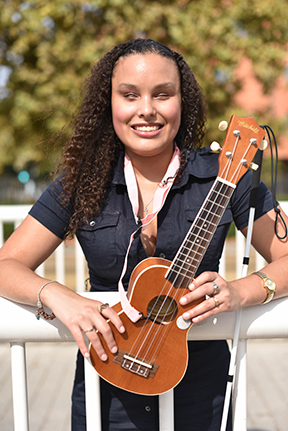 Precious Perez: I got involved with the Federation when I was fifteen years old. It was at the Massachusetts state convention. The president of the student division said, "I'm stepping down. Who wants to be president?" There was silence in the room, so I said, "Okay, I'll do it!" I've been president of the Massachusetts Association of Blind Students ever since then.
I attended the BLIND, Inc., summer program in 2017. NFB has shown me that I am capable of doing what I want to do. I grew up with all of the services I needed. I was surrounded by wonderful people who encouraged me to advocate and showed me what it meant to do that. NFB strengthened that philosophy and showed me how to apply it to my own life and the things that I'm doing. I'm currently pursuing a degree in music education, and I'm also a performer. My goal is to teach blind students and sighted students in the public schools. I hope to use my experience from the different communities I represent—I'm Puerto Rican, and I come from a low-income background. My goal is to use the avenues I have to inspire the next generation and teach kids of that generation that they can do whatever they want to do in life. It's something that I have a passion for. I think there are still a lot of stereotypes prevalent in our society. I want to use the gifts I've been given to abolish those stereotypes.
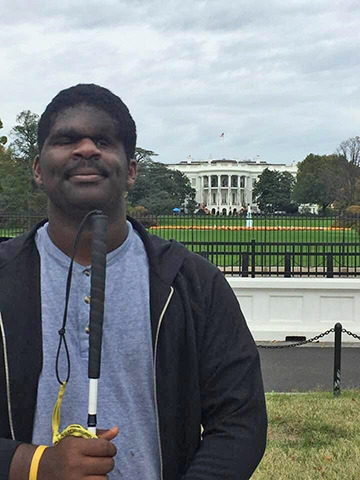 Qualik Ford: That was great! My name is Qualik Ford, and I'm president of the Maryland Association of Blind Students. I'm also on the Youth Leadership Committee of the World Blind Union North American Division. Technically I've been a Federationist my whole life. When I was born my dad brought me down to the Jernigan Institute to show me off!
When I was in high school I got active in the Federation, and I started looking for leadership positions. I was looking to grow as a student and as a person. I saw how some of the blind students around me viewed themselves, and I didn't like it. They seemed to think they were less than their sighted peers. Once a friend told me, "I don't think I better have kids." I asked her why not, and she said, "I was trying to feed my baby cousin, and I accidentally put the bottle up to her forehead instead of her mouth." I said, "That was a mistake. If someone taught you how to do it, you'd get it." When you've got pressure from the people around you, telling you that you can't do things, it gets you into very wrong thinking.
There are so many blind people who are out there doing things, making waves! On my own board, my secretary runs her own nonprofit. I think that is totally awesome! My vice president has been teaching in the BELL Academy for years. So many blind students are doing things when they have the tools to help them grow!
In school I had a lot of people looking out for me and helping me mature. I finished high school, and I'm going to the Louisiana Center for the Blind on August 4. I'm really excited about that! It's a chance for me to refine my blindness skills before I go off to college. Eventually I want to become a teacher of the visually impaired. I want to go to Louisiana Tech and learn the structured discovery method that we all prize. I want to make sure that my students know they can do a lot with their lives—go skiing, go to Space Camp and learn about astronauts. There are so many opportunities! My goal is to push for change for everyone.
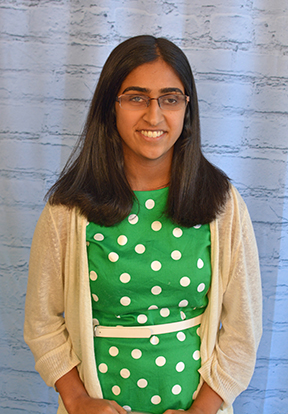 Trisha Kulkarni: I'm originally from Dayton, Ohio. I lost my vision unexpectedly when I was in seventh grade. During high school I learned Braille and technology. I was an NFB scholarship winner when I was eighteen, the summer after I graduated from high school. That's when I first met the National Federation of the Blind, and my life has transformed since then! It's crazy that it's only been a couple of years, because I feel like this is my family.
I serve as a board member of the National Association of Blind Students (NABS), and it's been an honor to serve as chair of the Legislative and Advocacy Committee. For the past six months I've had the chance to work with Carlton, encouraging students to advocate for themselves and to advocate for other students who might not have the resources that we have.
I am a rising junior at Stanford University, majoring in computer science. I honestly don't know how I'm a junior already! It feels like I just started! I want to use my technical knowledge and the resources I've gained through NABS to have an impact wherever possible. I'm waiting to know what that will look like.
CW: I'm going to throw out a couple of questions for you guys to answer. What would you tell your younger self, five, ten, fifteen years ago—okay, you're pretty young to talk about fifteen years ago! What would you tell your parents? Not that they've done horrible things, but what do you wish they had known?
Qualik Ford: I grew up with two blind parents, so in theory I had a very ideal situation. But I think my mom had a hard time adjusting. A lot of things were going on. From 2010 until now there have been revolutionary changes in technology, for instance, and it's hard for her to understand that things for me are very different from what she experienced growing up. It's important for us to have active conversations so she understands. I have to grow with the opportunities I have. I definitely have it easier than she did. I appreciate that she had knowledge of blindness, but I wish I could have given her that boost to expand her understanding and help her be more open-minded.
The second thing is that I would tell myself to be more physically active, to get myself out there. On the local and national levels the NFB has so much going on. When I went to my very first NABS seminar—that was huge! There were all these young leaders who had so much going for them. It blew my mind! It sent me onto a path where I knew I wanted to be like them. I needed to grow. I wanted to get everything I needed. I was learning things I never learned at a younger age, and it changed my life.
Precious Perez: I'm going to go with five years ago, because I don't remember much about my life when I was eleven. When I was sixteen I was terrified of college because I didn't know what to expect. I was terrified about what came next. I knew I had goals, but I didn't have any idea how to reach them. I had been underestimated all the time. I was blind, and I had a high-pitched voice, and people treated me like a cute little girl. Looking back, I wish I could tell myself, "You're going to do more than you think you're going to do. Give it time. Pursue the things you're passionate about. Lean on the people who support you, inside and outside the Federation. Believe in yourself. When you believe in yourself, even if other people don't, you have the power to succeed."
Trisha Kulkarni: When I lost my vision my parents and I had to fight furiously to get my accommodations. Under the circumstances I think my parents did everything they could. They got me started in learning Braille and assistive technology and cane travel. I think we all needed to understand that even though independence is the goal, that doesn't mean that you have to go it alone. If my parents had known about the NOPBC, they could have spent their energy much more efficiently. They could have worked to change the system rather than just fighting for me day to day. That's something I also had to learn the hard way. Now that I've connected with other blind people, I realize that even though you can be independent and do everything you need to do, you start at a higher point if you learn through the collective knowledge of our organization.
Carlton Walker: Thank you so much. Enjoy convention!