American Action Fund for Blind Children and Adults
Future Reflections Convention 2020 GENERAL SESSIONS
Equal Justice Under Law: A Blind Clerk Blazes a Trail behind the Scenes at the Supreme Court
by Laura Wolk
Reprinted from Braille Monitor, Volume 63, Number 8, August-September 2020
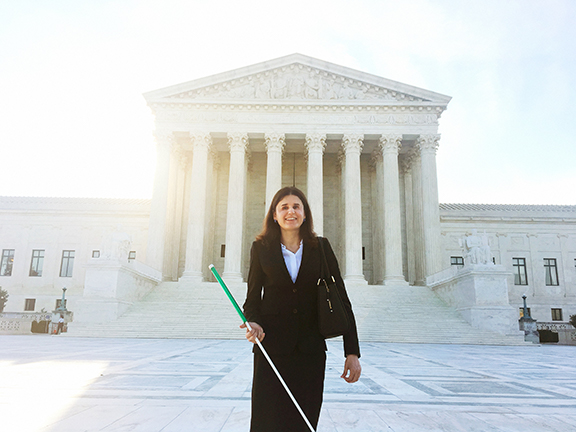 Introduction by Mark Riccobono: Our next presenter is the first of our Notre Dame graduates on the agenda! This is an individual who you can really say grew up in the Federation in Pennsylvania. Her dad actually started our parent's division in Pennsylvania. She has a law degree from Notre Dame, juris doctor summa cum laude, and she went to Swarthmore, where she got a BA in psychology. She has been serving as a law clerk to the Honorable Clarence Thomas, and she has been an active member of our National Association of Blind Lawyers, including successfully advocating and leading the way to make sure some of the technology companies make sure their tools work effectively for blind lawyers. I am proud to introduce Laura Wolk.
Thank you so much, President Riccobono. Good evening, everyone. It is such an honor to be with you tonight. As President Riccobono mentioned, I went to my first state affiliate convention when I was very, very young. It's been a while since I've been to one, a national convention in person. So it's really an honor for me to be here presenting this evening.
As President Riccobono mentioned, I just last week finished up a year clerking for Justice Clarence Thomas at the Supreme Court of the United States. I hope in hearing that sentence you know it was an extraordinary year for me. It was a transformative year for me personally and professionally—I mean in every aspect of my life, including what it means for me to be a blind person in the United States.
I'd like to give a little sense of what it means to be a law clerk, for those who might not be familiar with what that job entails. Then I'll talk a bit about two main takeaways that I took from the job. I think they are broadly applicable to everyone who is currently involved in the National Federation of the Blind.
There are nine justices on the Supreme Court. Each justice has four clerks assigned to him or her, and each clerkship lasts one year. You spend a year of your life working very intimately with a justice. Your job duties break down into two main categories: you assist the justice preparing for oral argument, and you also assist even with the drafting of the opinions that ultimately become the decisions of the Supreme Court. Sometimes that means you assist the justice with preparing an opinion for the majority of justices on the court or the entire court, and other times it means that you prepare or you assist with drafting an opinion for a smaller number of members or even for the justice writing only for himself or herself. So it is an incredible experience.
It is a great responsibility, and there is a lot of trust reposed in a law clerk. You have to be 150 percent there every day, every hour of every day. Without the assistance of the law clerks, the Supreme Court cannot function. Beyond the access and the amazing mentorship and lifelong relationship that you create with your justice, being a law clerk is so extraordinary because you also get to interact with the other eight justices on the Supreme Court. You also get to interact with all of the clerks from the other chambers. There were about thirty-nine of us this past term. You get to work with these bright lawyers, these young minds who are going to go out and do great things in the legal field, whether they go to firms or back to the government. You get to spend a year learning from them, debating with them, sometimes very heatedly arguing with them. You get a front row seat for an entire year into the inner workings of this very important institution to our government that so few people and even very few lawyers will ever get to witness.
From the moment I walked in the door on my first day to last Friday, when I tearfully pulled myself out of the building for the last time, it felt very surreal. Every day it felt surreal to me that I was there, that my workplace was the Supreme Court of the United States. The conversations that I got to have, the people that I came to call friends—this was an experience I will keep with me for the rest of my life.
I don't think that my approach to the job is uncommon. I think that many of my co-clerks and other clerks approach the job with a sense of humility and an understanding of the responsibility that has been given to them. But I would be lying if I didn't acknowledge that I also felt a particular responsibility and a particular honor to be asked to serve in that position as a blind person. It is increasingly difficult to succeed in the higher echelons of our career paths, and I felt that I was being asked to do something very good, not just for myself but for the entire movement of the organized blind. I had the opportunity to spend a year with the eight other justices and hopefully to show them that blindness is not an impediment. I could spend the year talking about accessibility and the need for young people coming up into the institutions to know about accessibility and to realize the massive gap between what a blind person can do if given all the tools and resources and what a blind person is allowed to do by virtue of the various obstacles put into our path that we have no control over and have constantly to fight against.
When I say I carry that responsibility with me, I don't mean that to imply any negative connotation. It felt like an honor to me that I would be asked to do that and to participate in the long line of work that the NFB has done for the past eighty years even to make this opportunity possible for me. From those experiences, I've done a lot of reflecting this year—a lot of reflecting on what this experience has meant to me personally and professionally, but also the takeaways, as I mentioned earlier, that can broadly be applied to all people in the NFB and all of your friends who might not yet be part of the NFB.
There are two takeaways I would like to share with you this evening. The first is that, as I alluded a moment ago, I firmly believe that this opportunity would not have been possible for me if I were not a member of many communities. I think it is absolutely imperative that we as blind people include ourselves in as many communities as possible in society. Faith-based communities, civic engagement communities, sports, whatever it is that makes you feel alive and makes you feel like you are flourishing in what truly interests you about life. We need to include ourselves and integrate ourselves into those communities.
I think a lot of times there is an understanding that we focus on where the barriers are. We say, there are barriers to education, so we have to talk to the educators. There are barriers to employment. We have to talk to the employers. We have to talk to the developers. That is very true, very necessary. Very, very important hard work is being done. But the fact remains that educators do not spend 100 percent of their time educating, and web developers do not spend 100 percent of their time web developing. They are human beings, and they are going out into communities, living their lives in robust and rich ways. The more blind people who are out there, people they can encounter in any capacity whatsoever, it makes a huge difference. Let's say someone is hiring, and maybe they casually mention at a dinner party that they have a blind job candidate. We increase the chances that someone is going to say, "Oh, I know a blind person. This person, just because they're blind, doesn't mean they can't do the job," or play the sport or take the leadership role or go to Harvard Law School. I really encourage anyone who's out there listening tonight—if there ever has been something you wanted to try, if you have been holding yourself back for fear of what it would be like to try to get into that community, I really encourage you to do that.
I have experienced this because of the pandemic in a very concrete and tangible way this year. I will give you one example. I am a runner. I use running not only as a way to stay physically active, but also for benefits to my mental health. It also helps me to clear my head and to process ideas and arguments that I'm actually stuck on when I'm thinking about a legal argument.
When the pandemic struck, all of that was stripped away from me immediately. I could tell almost instantly that it was impacting my work because this was a way that I handle stress, and I was in a very stressful job. So I wrote to my friends in my running communities (some of them have blindness-related aspects and many do not), and I asked for help. The next thing I knew, friends came to my aid and provided me with a bike and a trainer so that I could continue to exercise in my apartment and stay focused. When I first took myself out of my comfort zone to show up at running events and ask sighted people if they would run with me, I never imagined it would impact me professionally, that running would affect my career development. I also never could have imagined that my year on the Supreme Court would include a pandemic and going remote and being in quarantine! My running community, which I never expected to show up and help me in this once-in-a-lifetime opportunity, really pulled through for me.
The second takeaway that I want to share with you all is not going to be groundbreaking if you are a lifelong Federationist, but I think it bears emphasizing as many times as necessary. In order to be successful as a blind person in the United States in 2020, we have to be comfortable being uncomfortable. Okay? President Riccobono mentioned my clerkship on the Supreme Court. But I had two previous one-year clerkships before then, and I also spent a year at a firm. I've had four jobs in four years. All four of those places either had never hired a blind person before or had not hired a blind person in a very long time. Four times I had to go through the process of teaching an entire institution how to make things accessible for me. It is very, very difficult sometimes, disheartening sometimes. Even when you have amazing support, it can be really disheartening. But if you've ever been to a training center and held a chainsaw, if you've ever walked with a cane for the first time, if you've ever confronted your fear of pulling a stroller or a shopping cart behind you, you know that all of these things help us learn to be comfortable being uncomfortable. The more comfortable we get having difficult conversations, the more we gain control over the conversations themselves. The more we get comfortable talking to a supervisor and remaining calm when things get heated and stressful, the more we have the power. We regain the power to direct the conversation back to us and our needs instead of what other people tell us our needs are or what might work better than what we're proposing.
Ideally we should be living in a world where universal design is the norm, where things are designed to be accessible from the ground up, where there's no discrimination, no stigma, no bigotry. We've made immense progress, but that world is not where we are, and it's not where we'll be tomorrow.
We're faced with a choice. What do we do with these circumstances? If we learn to be comfortable being uncomfortable, if we embrace that instead of becoming angry or frustrated or disheartened, then we develop ourselves the qualities of leadership. We develop grit. We're adaptable. We're resilient. We're smart. We're flexible. We're creative. We're all of the things that a company needs today. We are all the things that a family needs, that a community group needs. These are the qualities of a good leader. So if we collectively embrace that, we'll not only be making our own lives better as individual blind people, but we will be making the lives of every other blind person in the country better. All of our successes are connected.
I want to close with that. As President Riccobono said, I have grown up in the Federation. I am thankfully aware of the history that has come before me and the very hard work that our leaders have done. I am very grateful for that work, and I know that the extraordinary opportunity I have just had would not have been possible without it. I feel that in each of our lives, our role is to work to break down accessibility barriers. Even if we don't make things perfect, you are adding one more step on top of a flight of stairs. When I came along, even though it was still a very steep climb, I didn't have to jump from the bottom all the way to the top. I could climb. I'm very, very appreciative of that! I hope that through this past year and through the other work I've done so far in my career, that I have added a step for the next person. I look forward very much to seeing what comes next for us in the years to come. Thank you.