American Action Fund for Blind Children and Adults
Future Reflections Winter 2021 LETTER FROM THE EDITOR
What Is the National Federation of the Blind?
by Deborah Kent Stein
From the Editor: As we launch this brand-new year, Future Reflections reaches a milestone. In 2021 this magazine celebrates its fortieth anniversary. For the past four decades Future Reflections has shared information and ideas with parents and teachers of blind children, promoting the programs and initiatives of the National Federation of the Blind, and spreading a positive philosophy about blindness. You can browse through nearly forty years of our back issues at https://www.nfb.org/resources/publications-and-media/future-reflections.
 Today Future Reflections is sponsored by the American Action Fund for Blind Children and Adults and by the National Organization of Parents of Blind Children (NOPBC), a division of the NFB. The NOPBC is deeply committed to advocating for parents. Training parents to advocate at state and local levels is a core component of its mission. Each year parents from across the country attend the Parent Leadership Program (PLP) at Washington Seminar and the NFB National Convention to build connections and share ideas.
Ten years ago, at the 2011 Washington Seminar, NOPBC Past President Carol Castellano invited me to talk to the Parent Leadership Program on the topic "What Is the NFB?" In celebration of forty years of Future Reflections, here is my answer to Carol's question. I believe it is as relevant today as it was ten years ago.
When Carol asked me to give a talk called "What Is the National Federation of the Blind," I thought, this will be easy! I've been active in the NFB for almost twenty-five years; I can answer this question.
But when I started to think about it, I realized that defining the NFB is kind of like describing your brother or your best friend. It's very hard, at least it is for me, to describe someone I know really well. I know so many aspects of that person that nothing I say really does them justice. Defining the NFB is a lot like that.
Not long ago I gave a copy of Future Reflections to someone who was completely unfamiliar with the NFB and blindness. After she read most of the articles, she commented, "This magazine is about community." The NFB and the NOPBC are many things to many people, but I think the idea of community is core to who we are and what we do.
As I'm sure you're well aware, blindness is a low-incidence disability. If you have a blind child, your kid is probably the only blind child in your neighborhood. They may well be the only blind student in your town, or even in your whole school district. Raising a child who experiences the world in nonvisual ways, when nobody around you ever has had to figure out solutions to the challenges you face, can leave you feeling terribly isolated at times. When you attend an NFB or NOPBC event, suddenly you're not alone anymore. All around you are people who have asked the questions you're asking, who share many of the struggles you're living through, and who have found solutions to some of the problems that baffle you.
Still, there are other places and organizations where you can make connections with families that have blind children. What makes the NFB and the NOPBC unique?
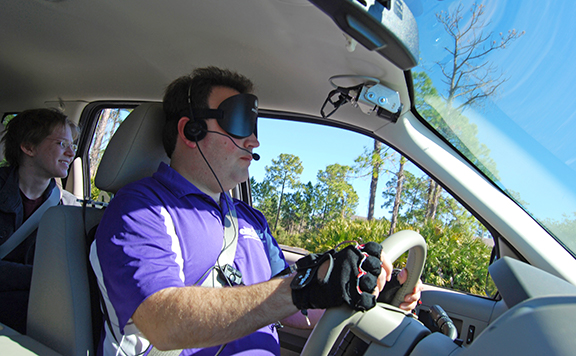
I'm sure you've heard that the day before yesterday [January 29, 2011] a blind man, Mark Riccobono, drove a car adapted with a tactile interface at the Rolex 24 in Daytona Beach, Florida. Maybe you've also heard that a few years ago another blind man, Erik Weihenmayer, climbed to the summit of Mount Everest. The NFB promoted the research that built the car that could be driven independently by a blind person, and the NFB helped sponsor Erik Weihenmayer's mountaineering team on the Everest expedition. The NFB dares to think big when it comes to the abilities of blind people. We believe that, with the proper training and technology, and with a positive philosophy about blindness, a blind person can accomplish just about anything.
We're not just talking about the big, glitzy feats that get attention in the press. We know that blind people can be teachers, doctors, attorneys, accountants, scientists, parents, machinists, and artists. We want that full range of possibilities to be available for your children. We want your children to grow up knowing that their life choices do not have to be restricted because they are blind.
Most people in the blindness field talk about independence as the goal for every blind child and adult. But independence means different things to different people. For people who have a narrow view of what blind people can do, people who don't really believe in the abilities of blind people to live full and productive lives, independence might mean the ability to keep track of one's clothes and the money in one's wallet, to prepare a simple meal, and to walk to familiar places around the neighborhood. Those things are fine, if that's what a person chooses. But in the Federation, we want blind people to know that they have many, many choices beyond the bare bones of independent living. True independence means taking for granted that blindness will not stop you from doing the things you want to do. It means you will be comfortable trying on new experiences, meeting new people, and stretching beyond the safe and familiar.
We often hear people say that the Federation is a radical organization. That comment has always puzzled me, and I'm still not too sure what people mean. But there is one basic tenet of our philosophy that I think seems radical, maybe even preposterous, to a large part of the public: our conviction that it's okay to be blind. Just five little words—it's okay to be blind. Sometimes it's really, really hard for people to take that in! In the NFB we don't believe that blindness is a tragedy. We don't think it's frightening or distressing or heartbreaking—any of those things people tend to think when they haven't had the chance to get to know us.
We recognize that blindness is just one of the myriad characteristics that are part of the human condition. It may cause us inconvenience at times, even frustration, but if we have a positive philosophy about blindness, it also can be a teacher. Blindness can teach us to be resourceful. It can teach us to think creatively. It can teach us to be assertive, to advocate for ourselves and for others. It can teach us to think for ourselves and not to take assumptions as truth.
So this is the NFB, as I see it: a community of blind people and our families and friends, a community drawn together by a belief that blind people are as capable as anyone else of working and playing and making contributions in every field of human endeavor. We are a community of people who believe that it really and truly is okay to be blind.
Welcome to the Federation. We're very glad you are here. We hope you will be with us for a good long time!