American Action Fund for Blind Children and Adults
Future Reflections Winter 2021 PERSPECTIVES
A Climber of Trees
by Kaylee Nielson
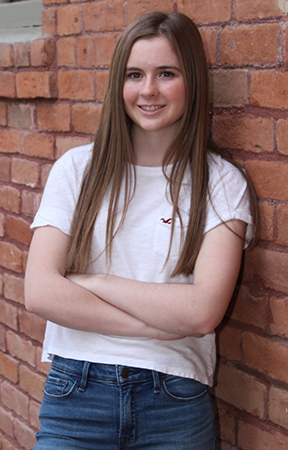 From the Editor: "Live the life you want!" is our motto in the NFB. In this article Kaylee Nielson explains how she approaches vision loss as an adventure in a life that welcomes challenges. Kaylee won an NFB National Scholarship in 2019. She is now a sophomore at Wellesley College in Wellesley, Massachusetts.
I was a tree climber as a kid. I would stand at the bottom of trees that were five times my height, analyze the branches, and say, "I got this," a mentality that caused worry lines on my parents' foreheads as I looked down at them from twenty feet. I lived for the challenge, for the calloused hands and scraped knees, and for seeing the world from a new perspective, looking out from the treetops—what a rush of adrenaline!
The older I got, the less cool it became to define my identity as a tree climber. Perhaps in anticipation of the day when my middle-school self would become too proud to tell the world that I was a tree kid, I was given another path that offered many of the same benefits. The summer before my seventh-grade year I lost my central vision, causing me to become legally blind. Though not as much fun as standing in a treetop, this new path also offered me challenge, scraped knees, and a new perspective on the world.
My vision loss was the result of a mutation on the ABCA4 gene, which I had unknowingly inherited from my parents. Despite my attempts to memorize the E chart and pretend that nothing had changed, my sudden inability to read my textbooks, recognize my soccer teammates, or make eye contact with my parents made it a little difficult to ignore what was going on. Though the journey ahead of me seemed completely foreign, I soon learned that, unlike climbing a tree, in order to conquer this new challenge, I was going to need help from anyone willing to give it. The blind and low-vision community was quick to welcome me, and in time I learned to welcome it back. I found people who could relate to what I was going through, technology that made my schoolwork possible, researchers that have dedicated their lives to finding a cure for my disease, and teachers who were eager to support me in everything from accessibility to advocacy. I refused to let my visual impairment define me, and, even more difficult, I found a way to embrace this part of my narrative.
Thanks to my vision loss, most of my pride and grace went out the window a long time ago. I have fallen down stairs and have been asked to read aloud in class by teachers who forgot I could not see the page. I have failed presentations because I had to memorize every slide while my peers could read off notecards. I have said "hi" to people who were not talking to me but rather to the person next to me. But making a fool of myself so many times has given me the courage to try new things, put myself out there, and become the person I most want to be. I have found the confidence to walk tall, my white cane in my hand.
I am a tree climber, and I am blind, in that order. I am the person who took the stairs just because you asked if I would prefer an elevator when you saw my cane. I am the girl who does handstands against her bedroom walls because it is fun. I am the person who sits down at the piano with my eyes closed to make sure I can still play my favorite song, even if my vision degenerates further and I lose my peripheral vision as well. I am the person who stands at the bottom of a tree five times my height, analyzes the branches, and then looks down at you from the top to wave and say, "I told you—I got this."