American Action Fund for Blind Children and Adults
Future Reflections Special Issue: COVID and Beyond RESOURCES AND SOLUTIONS
During COVID-19 and Beyond: American Printing House for the Blind Is There for Parents and Teachers
by Amy Lynn Smith
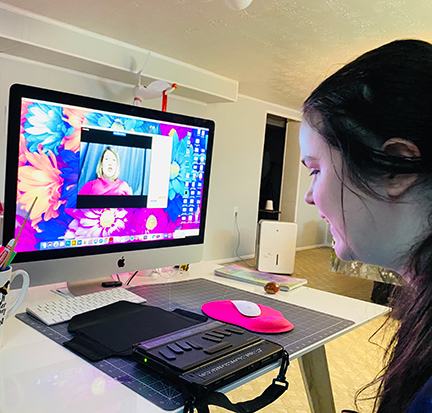 From the Editor: Based in Louisville, Kentucky, American Printing House for the Blind (APH) has been a resource for parents and teachers and blind and low-vision children since 1858. Through its long history APH has evolved to meet the needs of each new generation. In this article Amy Lynn Smith describes what APH is doing to support families and teachers during the COVID-19 crisis. Many of these programs will continue and grow, even when students return to the classroom.
Ever since COVID-19 appeared, the disruption to daily life has impacted everyone. Blind and low-vision students have faced unique challenges, such as not having their accessibility tools at home and having to work with their Orientation & Mobility (O&M) specialists via videoconference, which isn't ideal for a high-touch teaching discipline.
When the country shut down in March 2020, American Printing House for the Blind (APH) leaped into action. APH provided support for parents who were helping their children learn at home and for teachers seeking new ways to work with their students.
Giving Parents a Helping Hand
APH ConnectCenter is dedicated to providing a wide range of year-round supports for parents and for career-age and older adults. During COVID-19 APH stepped up even more in response to families' needs.
For example, the ConnectCenter's Information & Referral (I&R) Line (1-800-232-5463), which provides assistance with a variety of questions, saw a significant increase in calls. Many calls came from parents who wondered how their children would get the services they normally received in the classroom or from other providers that had shut down.
Melanie Peskoe, digital content and engagement specialist at the ConnectCenter, was an I&R representative in the early days of COVID-19. She says I&R often referred callers to the Center's FamilyConnect website. The website offers a variety of helpful hints, including resources parents can create using items found around the home.
In more than one instance APH has shipped products to parents. APH even sent one parent an All-In-One Board, normally used for conferences, at no cost, because her son was struggling without the board he had to leave behind at school. "Through this pandemic, I've seen APH put people over profits time and time again," Peskoe says.
According to Olaya Landa-Vialard, director of APH ConnectCenter, APH has given away other products students needed but didn't have at home. What's more, the center began hosting monthly webinars in May 2020 through its three online channels. FamilyConnect serves parents of school-age children. VisionAware is a channel for older adults facing vision loss, and CareerConnect is tailored to working-age adults.
"One of the webinars was an O&M panel of specialists talking about ways they were trying to approach direct instruction virtually," Landa-Vialard says. "O&M isn't just about independent travel; it's also monitoring and safety, so how do you monitor if you're on the other end of the screen?"
Another APH ConnectCenter webinar introduced parents to the National Homework Hotline for Blind/Visually Impaired Students, which is staffed by professionals trained in all areas of instruction. As a parent of two sons with low vision, Peskoe, who has low vision herself, found this webinar, along with many others, very helpful in providing at-home instruction. The webinar also included offerings provided by other departments at APH, such as Virtual ExCEL Academy. Originally created in partnership with Paths to Literacy, these free webinars are organized by age groups for students learning from home, which included Peskoe's younger son.
Over the summer of 2020, APH offered Virtual ExCEL Summer Camp. Students had the chance to learn, play, and socialize with other kids, with sessions available later for replay. The Virtual ExCEL Academy has proved very popular, with approximately three thousand webinar registrations from twenty countries at the height of the COVID pandemic. As a result APH will provide ExCEL sessions three days a week throughout the 2020-2021 school year, and it will offer the Virtual ExCEL Summer Camp again this year.
APH ConnectCenter plans to continue its webinar offerings even after the worst of COVID-19 is over. What's more, the center is in the midst of building a Transition Hub where families can search for resources nationwide to help their high school and even middle school students prepare to transition from K-12 to college or directly to careers.
"We're creating a one-stop shopping platform that's searchable, so parents can find resources wherever they live," says Kathryn Botsford, digital content strategist and lead researcher at the APH ConnectCenter. "And it won't just be phone numbers—we're vetting the organizations and listing all the services they offer." Expected to launch in July 2021, the Transition Hub is funded by the Gibney Family Foundation.
Guiding Teachers through Uncharted Territory
Students aren't the only ones who have faced school-related challenges during COVID-19. Teachers have had to find new ways to help their students learn, and APH is providing a wide range of support.
For example, APH Access Academy webinars are a virtual version of an offering APH has provided for years. These webinars deliver the education and training teachers, parents, and users need to get the most out of APH products and services, and they offer information on other resources as well. Most webinars also provide ACVREP (Academy for Certification of Vision and Rehabilitation Professionals) continuing education credit.
"Our instructors have primarily been people in the field—whether that's an O&M instructor, a teacher of the blind and visually impaired (TVI), a vision rehabilitation specialist, or really anyone from the field," says Leanne Grillot, APH's national director of outreach services. "A majority of attendees are TVIs. When we offer anything in the realm of vision rehabilitation or O&M, those specialists come out of the woodwork, because their access to professional development is much smaller than TVI offerings."
Educators also have support during COVID-19 through the APH Hive, and that support will continue for the long term. The APH Hive is a new virtual platform that provides e-learning opportunities broken up into short segments. This format makes it easy for educators, professionals, and parents to learn at their own pace, whenever it's convenient.
"Our purpose is to equip and build capacity, so anybody working with students with visual impairments can respond to their unique needs," says Amy Campbell, APH learning management system administrator. "We want to be a single resource for professional development that stimulates background knowledge, provides study in specific content, prompts critical thinking, and offers opportunities for professionals to reflect on new knowledge."
The Hive houses four categories of content: Assessment, Early Childhood, Core Curriculum, and Expanded Core Curriculum, with all courses offering ACVREP credit. Moving forward, APH intends to build a community of practice through The Hive. Instructors will support teachers to improve student outcomes, including sharing tips on adapting APH products to the needs of students with varying abilities.
"In the future, people will be able to come to The Hive to collaborate and support one another, or even provide or receive mentoring," Campbell adds. "Plus, The Hive will expand to offer connections to outside resources called professional communities, where experts can house their content for the greater good of the field."
Getting Products to the People Who Need Them
In addition to assisting teachers and other specialists in adapting to virtual learning, APH is making sure the products students need remain available. In fact, APH released a number of new technology products even as other tech companies were pressing Pause.
"It was really important for us to get those products launched," says Greg Stilson, director of global innovation. "And we had to make a huge change in the way we shipped them, too. Instead of sending them to schools, which were closed, we shipped them to teachers' and students' homes, because we recognized the urgency of getting the products to these kids."
Four of the most significant products APH released during the COVID pandemic were the Mantis®Q40; the Chameleon®20 intelligent refreshable Braille displays; and two Braille embossers, PixBlaster® and PageBlaster®. According to Stilson, these are the first two embossers APH has ever released that schools can buy with the use of Federal Quota funds.
"Timing is everything," Stilson says. "In a year when students were struggling to get Braille-embossed class materials, we were shipping embossers to kids' or teachers' homes. We heard stories of TVIs doing Braille embossing, then dropping off the materials on kids' doorsteps. We couldn't have picked a better year to finally release an embosser on Quota." The Braille displays are also a great help to students, who can hook them up to their computer or smartphone and access course content on demand.
In addition to releasing new products, APH has continued the product training they provide to educators and other specialists—except they're offering them as webinars instead of in-person trainings. "Teachers log in to learn about these new products, so they have an understanding before they go online to teach them," Stilson says. "We went from very broad overviews to introduce the products to task-based webinars that teach the most common tasks students use these products for."
These webinars, which Stilson describes as "impromptu trainings," remain available on demand—a benefit for busy educators who might not always be free to attend live trainings. They also helped populate some of the content on The Hive.
COVID-19 brought challenges for educators, specialists, parents, and students, but it also has created learning opportunities. There's no question that APH will keep thinking creatively about everything from product development to training, to make sure everything they offer is as robust and accessible as possible, no matter how the world continues to evolve.