American Action Fund for Blind Children and Adults
Future Reflections Summer 2021 TEACHING AND LEARNING
Clear Skies
by Charles Pat McKenna
Reprinted from The Sounding Board, the Newsletter of the NFB of New Jersey, Spring 2020
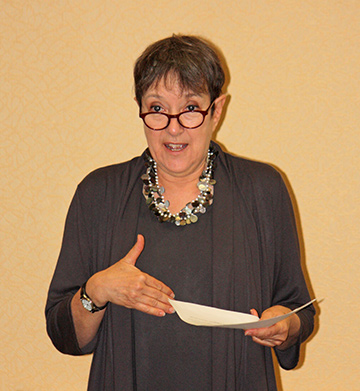 From the Editor: On November 5, 2019, the blind community lost a gifted and dedicated teacher, Barbara Shalit. As one parent wrote, "Barbara was a Braille teacher extraordinaire. She made sure her students learned not only the Braille code, but also how to type, how to read charts and graphs, and how to examine illustrations in order to gain full tactile literacy." A few months before her passing Barbara found time to write an article for Future Reflections, "Tactile Fluency: Expanding the Concept." In the article below Charles Pat McKenna, one of Barbara Shalit's former students, pays tribute to the teacher who shaped his life. Pat McKenna is an attorney who lives in central New Jersey.
I was four years old, happy and inquisitive. I was four, playing in the woods near my home, the sun bright, the sky clear.
Then something happened. Something bad. I was sick. There was a hospital room, and machines, very serious doctors, and very sad relatives. I never thought I'd be able to go home again. A view, I learned years later, that was unanimously shared.
But I did go home. I was weak and compromised, thin and fragile, but finally I was able to go home. I was happy to be better, but I was not unscathed. Something had changed. The sun wasn't so bright. The sky wasn't so clear. I was blind.
What does a blind kid do?
I was five, and blind. Kindergarten was to start in the fall.
We lived in a wooded part of New Jersey—me, my single mom, and my kid brother. We were unsure what would come next, uncertain whether I would even be able to go to school.
What does a blind kid do?
"Pat," my mom calls. "She's here."
I join my mom at the front door. Outside I hear the sound of a gentle, late-summer rain. Our guest is tall and polite. She has a soft, pleasant voice and seems very kind. She sounds smart, and wise, and elegant, and reassuring.
"My name is Ms. Shalit," she says. "I'm going to be your Braille teacher."
She was part of something called the New Jersey Commission for the Blind and Visually Impaired, and she would teach me Braille, as well as the other essential skills I would need to succeed, skills that would build my independence, my confidence. We would work together at home and at school. She told me, "Yes, of course you'll be going to kindergarten."
I sit at my mom's dining-room table, and we talk. Ms. Shalit works with other kids who can't see, too, and she likes to travel, and she has a big dog named Clyde.
"Here," she says. I recognize the sound of paper. "Feel this." A sheet of thick paper is on the cool, smooth surface before me. "It's the Braille alphabet."
A gentle touch guides my left hand to the paper's top left corner. "Start here and move right."
I do, encountering small clusters of bumps. I feel and explore each grouping.
"How did you make these bumps?" I ask.
"Dots," she corrects. "And I'll show you. There are two ways we can make Braille letters."
Fascinated and utterly absorbed, I run my fingers over the dots again and again. Ms. Shalit quietly steps back and has a conversation with my mom that I'm not supposed to overhear, but I interrupt, because I'm curious, and I'm five.
"Is this letter a T?" I ask, indicating a grouping of three dots, two side by side over a third.
"No," she says. "That's an M. Here, this one is a T."
My hand is gently guided to a different character. She shows me Braille numbers 1 through 10. Mom makes tea for her, and we talk long into the afternoon. "Well," she says finally, "we should probably wrap up for today. I'll be seeing you again in a week. Do you have any last questions for me?"
I do, the first of what would be so, so many questions. Ms. Shalit didn't just teach me Braille. She taught me how to be independent, how to be confident.
Over the months and years that followed, we would sit together at home, or in an unused room in my elementary school, and cover a multitude of different subjects. We would practice writing and reading Braille and work on orientation and mobility. We discussed the planets in the solar system and the impact of the last ice age. We studied basic arithmetic using paper clips as props, and we talked about France, and why leaves change their color. I learned to use a Perkins Braillewriter and a slate and stylus, and how to figure out the answers to questions such as, "How do I know when a word starts with a silent K?"
Ms. Shalit showed me how to order books from Recording for the Blind (RFB, which has since been renamed Learning Ally). We read about the giant Pacific octopus, the function of chloroplasts, and the contributions of founding fathers such as John Hancock. She taught me to use a manual typewriter and a talking calculator, and she helped me understand the difference between an atom and a molecule.
Sometimes we met in an empty classroom, smelling of chalk dust, art supplies, and sneakers. At other times we met at my house, sitting for long and fascinating hours at my mom's dining-room table, Clyde waiting patiently in her car. Once she came to the house for a lesson with her leg in a complicated cast, the result of a bad skiing accident.
And the lessons continued. Through hot summer days, winter snowstorms, and even a power outage, we would meet to review Grade 2 Braille and the Nemeth Code and to practice the multiplication tables. Wooden models, raised-line drawings, and a tactile globe made it possible for me to learn about the geography of each of the fifty states and the locations of the Tropics of Cancer and Capricorn, and to discern, "How big is the Amazon?" Using sets of 3D models we studied geometric shapes such as the rhombus, the cone, and the octahedron, which was my favorite. And I always had more questions.
"Why do the days grow shorter in the fall and longer in the spring?" "Do all birds migrate?" "For a word like (other): Do I write that in Braille using the THE contraction followed by r, or by using the TH contraction followed by the ER contraction?"
Ms. Shalit was my teacher of the blind and visually impaired (TVI) through the end of fourth grade. She was a guide, a mentor, and a light that came at a time in my life when one was needed most. She was the definitive force, teaching me the skills I needed to be independent, to be confident.
That first visit is still fresh in my mind. It's a good visit, but my unaccustomed fingers are numb from running over the same Braille characters so many times. A few dots are a little flatter than they were before. Outside, it's clearing, the rain has moved on. She finishes her tea, returns the cup to the kitchen counter, and collects her things.
She stands in the open front doorway. Outside the air smells clean.
"I'll be seeing you again in a week. Any last questions for me before I go?"
"Yes," I say. "What can a blind kid do?"
"Anything," she says. "Anything."