American Action Fund for Blind Children and Adults
Future Reflections Summer 2021 ROADS LESS TRAVELED
Inclusion in the Theatre: Embracing Your Passion for Performance
by Elizabeth Rouse
From the Editor: Elizabeth Rouse graduated from Central College in Pella, Iowa, where she earned degrees in English and theatre. She serves as president of the Iowa Association of Blind Students and as treasurer of the National Association of Blind Students. She plans to enter law school after she completes her training at the Louisiana Center for the Blind.
"Go up to the board and draw an image from last night's reading assignment."
The professor's instruction seemed simple enough, but I felt my palms start to sweat as I rose from my chair. As the only freshman in an upper-level theatre history course, I wasn't yet confident in my understanding of the material, let alone my artistic abilities to recreate it in front of my peers. Nevertheless, I walked to the board, picked up a piece of chalk, and began drawing an image from my favorite scene of the Greek myths I'd barely finished reading. I paid little attention to my peers as they completed the same task. I figured I wouldn't be able to see their drawings, anyway. When I finished, I returned to my seat to wait. But my professor stopped me in my tracks.
"Now, I'd like all of you to gather around one another's work and describe, in detail, the images you drew so that we all understand how you saw the scenes unfolding."
The professor didn't target me or call me out for being blind. She simply took an assignment and incorporated visual descriptions into her curriculum. With one simple statement, she changed the trajectory of my college career. From that day on, theatre became a part of me.
During my four years of study at Central College, I played many roles (pun intended) in the theatre department. I was tasked with stage managing, lighting and sound design, and even directing. One of the most memorable adventures for me was stepping onto the stage as an actor. I was fortunate enough to be cast in four main-stage productions, the first of which took place during my sophomore year and the latter three during my senior year. Through trial and error, I learned valuable lessons about how to access my scripts in Braille, how to navigate the stage with and without my cane, and how to make my interactions and gestures authentic when I performed. Many of the lessons I learned took time and effort, and all of the discoveries grew out of trial and error. Confronting the challenges wasn't fun at the time, but I can reflect upon my experiences and take pride in all that I accomplished.
The first show in which I acted provides many great examples of the challenges I had to overcome, beginning with the audition process. When the director announced the upcoming show, ANON(ymous) by Naomi Iizuka, I immediately felt the desire to participate. I had read the play in my first theatre course during the previous academic year, and I fell in love with the script. So when the auditions were announced, I took action.
I met with the professor in her office and asked about the audition process. She was thrilled at my interest and gave me a script. She suggested that I have the Student Support Services office on campus transcribe the material into Braille. When I asked which scenes she wanted me to read from, she slyly told me to have the script transcribed in its entirety. I think she knew from the get-go that I'd be participating in that show one way or another.
After the first cast read-through of the script, my next challenge came into focus—navigating the rehearsal/performance space and set. My director told me that I could portray my character as blind, which would allow me to use a cane of sorts. However, I doubted that her original image of the show included a blind character. I decided to rise to the challenge of stepping into a sighted role. Over the next few weeks I became familiar with the stage, working closely with the show's technical director. Any time an element was added, taken away, or modified, he called me into his office and explained the alteration. Then we would explore the set nonvisually together. Every shift was an adjustment, but in addition to the interactions I shared with my director and technical director, I also built relationships with my fellow cast and crew members. Nearly everyone was receptive to my requests and questions, and together we became a cohesive unit. Throughout the rehearsal process I worked with everyone individually, incorporating unique blocking into our scenes that looked natural and authentic to the audience and served as a covert means of guiding me from one side of the stage to another when necessary.
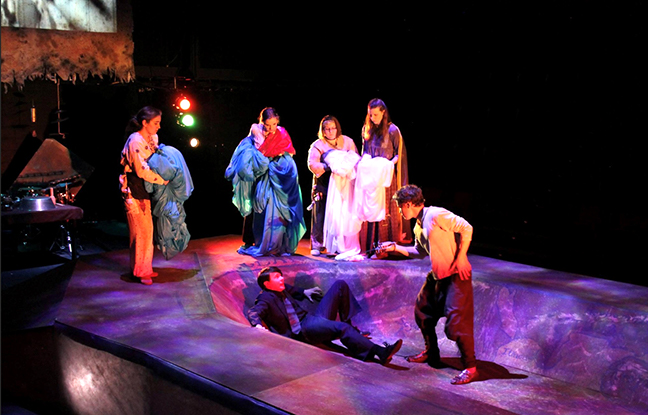
My experience did include some difficult conversations though. I recall asking my director rather bluntly if she intentionally was keeping me on one side of the set because she was afraid that I would hurt myself en route to a different location. Fortunately, she and I maintained a relationship rooted in honesty, and we were able to navigate her hesitation together. I ended up using my feet and the guidance of others to act on many parts of our set, which consisted of an elevated, circular rim with a lower portion in the middle. Not all of my attempts were successful; in fact, I almost slipped during a performance. One of my fellow cast members was paying close attention and found a way to assist me without breaking character. Our creative minds were put to the test on so many occasions, but no one ever made me feel that I was a burden or an inconvenience. Instead, the relationships I developed during that show allowed me to succeed in a realm that most people would not expect.
One of the more difficult challenges I faced involved the use of gestures and facial expressions. In the theatre body language is essential to convey character, emotion, and expression. The play I first participated in, per my director's wishes, used classic gestures such as motioning to the sky whenever a reference to the gods appeared in the script. At first I struggled to portray emotions without prompting, since I do not experience facial expressions and gestures in my everyday life. Interestingly, the level of expressiveness that my director wanted was not the norm for my fellow cast members either, so we spent many rehearsals exploring expressions and movements in front of our director. Often she would identify something she liked and wanted to keep, and we had to learn to recreate whatever we had done. Because we were all learning from one another, I was not the only one asking questions such as, "What did I do with my face?" or "Can I feel the motion you're making with your arms?" Did I sometimes ask follow-up questions, requesting more specifics or feedback on my imitations and interpretations? Of course I did, but those questions never made me feel uncomfortable or embarrassed. At the end of the day, my learning and success made our show a more cohesive and enjoyable performance. Theatre is all about learning to act out, act odd, and act on.
While each lesson took time to learn, I'd like to share the most valuable takeaways that affect the actor and the spectator alike.
First, don't be afraid to get your hands dirty! My first step when I familiarized myself with the set for any performance was to go in and explore. I'd contact my school's technical director and find a time when we could venture onto the set so I could learn where steps, doors, and scenery were located. After we finished our walk-through, the technical director answered any questions I still had. When things were added or modified in any way, we'd go through the process again. Communication was the key to obtaining information. The same rule can apply for backstage participants and spectators; you'll never know what sensory options are available to you until you ask.
Next, learn to laugh at yourself! Theatre is filled with not-so-comfortable conversations. I can't count the number of times I had to ask if my facial expression was appropriate for a given scene or admit that I needed an extra hand getting off the stage when the lights went out. The more comfortable you are with the situation, the more easily you can convey your needs to those around you.
Don't be afraid to devote yourself wholeheartedly to the experience! As a member of the audience, I find myself laughing uproariously and bawling into my hands without a care in the world of what those around me are thinking about me. Theatre impacts each of us uniquely. If a friend and I see a show together, I may find it hilarious while my friend finds the plot depressingly sad. It's okay to have your own thoughts and opinions about what you interpret from a particular script or performance. The people onstage live for audience reactions, and you may just be the one person in the audience who picks up on a subtle joke or pop culture reference they've been dying to convey.
Finally, understand that theatre is a means of give and take! Actors don't parade around a stage for their own benefit. They love the art so much that they practice day in and day out to put on a performance that means something to them. If you're passionate about theatre, find a way to become involved. Audition for your dream role. Take tickets at your local performance space. Write a play. Make theatre mean something to you in whatever way you know how.
Simon McBurney once said, "Theatre is the art form of the present: it exists only in the present, and then it's gone." I invite you to meet me onstage and not let this beautiful art pass you by.