American Action Fund for Blind Children and Adults
Future Reflections Winter 2022 TRAVEL
The Road Back: Rebuilding Travel Confidence after COVID
by Michelle Chacon and Tabitha Mitchell
From the Editor: During a year of virtual classes, blind students had limited opportunities to practice their mobility skills. Now, as the world opens up again, they may be reluctant to venture out and travel independently again. In this article Michelle Chacon and Tabitha Mitchell discuss the issues surrounding independent travel after the lockdown. Michelle Chacon is an orientation and mobility (O&M) instructor, and Tabitha Mitchell is the parent of a blind daughter. This article is based on a workshop that was presented by the National Organization of Parents of Blind Children at the 2021 NFB National Convention.
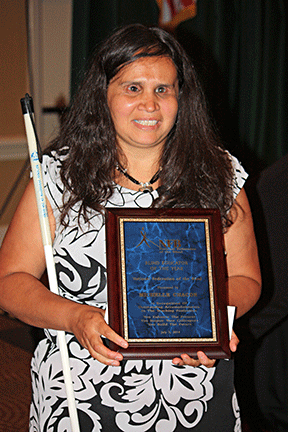 Michelle Chacon: I'm an orientation and mobility specialist, and I'm a blind adult myself. I have grown-up children who are sighted, and we've all survived our year at home during the pandemic.
Getting out after being at home can be very tricky. I work in a public school district with lots of families who were eager to get their kids back into school, because they felt that's the setting where they benefited most. I've also worked with families that were quite fearful of going back. They had a lot of anxiety about how the schools would keep students from getting sick. So we have quite a spectrum of needs and approaches. We had to do our best to meet families where they were. I believe the best help for students is having strong support at home.
First of all, how to get out the door? Kids had to get used to wearing masks in public places. They had to learn to social distance. We're used to approaching people when we have questions. We're used to going into stores and navigating through the aisles. Now, there are all those lines on the floor, telling us to go this way and not to go that way. If you don't have anyone with you to explain it all, it can be very confusing.
Despite these challenges, we want to get our students comfortable using their canes again. We need to get them comfortable with heading out the door and walking in their neighborhood again. They need to walk the streets, visit the park, and maybe stop in at a convenience store. The mall can be a little unnerving for families when they are first starting to go out again.
Some people can't wait to get out again. They look forward to being with friends and being out there doing things. But a lot of individuals don't like the change, going from being quiet at home to being in the middle of a lot of activity. It can be quite a challenge!
One of my students went back to school right away. The school was about 25 percent filled, with the rest of the students still attending remotely. The corridors were pretty empty! This kiddo was really excited to be back with his friends, and he adjusted very well.
I had other students who felt ready to go back to school, but their parents were terrified. The kids struggled with remote learning, but we made it work. We were able to schedule some outings toward the end of the year. They had the chance to be with friends at the park or to meet at an ice cream store with outdoor seating. We worked hard to bring down the anxiety level, to show kids that their friends were still their friends.
Overall, we tried to convey the message that our students could still get out and do things, but we needed a variety of approaches. In some cases we had to take baby steps. In other cases kids got right back into the swing of things. Be sure you can listen to your children's or students' anxieties and try to face your own.
I would love to hear from teachers and parents who are here on Zoom. How have you managed to get back into community functions? What have been your concerns? What can we do to make it all a better transition?
Tabitha Mitchell: Hello, I'm Tabitha. I'm an NOPBC board member. My youngest child, my fifteen-year-old daughter is blind. I just dropped her off for an O&M session, and that's thrilling.
One piece of advice I have for parents is to go back to the IEP. Try to get your child's O&M instruction bulked up a lot for ESY (Extended School Year) in the summer. My daughter had been in the house for months; she had hardly been out. She has LCA (Leber congenital amaurosis) with potential kidney complications. She felt that she had a bit more of a high-risk profile than the rest of us.
I am a public health professional, and I was able to calm a lot of my daughter's anxiety by assuring her that she could use a full-blown respirator. It's not much harder to breathe through than a standard mask. Lots of people wear them every day for eight- or ten-hour shifts on the job. That calmed her nerves and really got her rolling! When we had the opportunity to get her back into O&M through the ESY over the summer, she didn't hesitate. She was ready to pick up her cane and get out there.
I've noticed that a lot of kids are unsure what to do. They know they'll have to touch a lot of things when they're out, and they worry about exposure to COVID. The other day my daughter went into Target, using the respirator. We revisited the universal precautions about handwashing that she'd been hearing all year. Once we were able to have that family dialog, she was much more comfortable. When the O&M instructor asked, "Hey, you want to go to McDonald's next week?" she was totally fine with that. We need to find out where our kids have trepidations and figure out how to work through them.
Michelle: One thing you can do is put together a little travel kit with wipes and hand sanitizer. Kids can learn to use hand sanitizer after they've touched something. They can use wipes in the restroom.
Before the pandemic travel routes might be quite involved, taking a couple of hours. Now they may be down to just an hour or so until kids and parents are comfortable. We need to recognize when it's time to quit.
Tabitha: We discovered that our daughter experienced a lot of fatigue from holding her cane when she resumed O&M instruction. She doesn't use her cane at home. She literally had not touched the cane in months! It created a very interesting situation! I felt as if I were going back to our early years, having to remind her, "Have you got your cane? Don't forget your cane!" It was pretty strange! The cane has always been kind of an extension of her body, but now there were times when she would grumble about taking it with her.
I think the hybrid model at school helped us. They had her at school two days on and two days off. Fridays were at-home days for everyone. The nature of that hybrid modeling put the cane back in her hand intermittently, not for a full day.
I knew we had to get her out so she could get past the fatigue from having the cane in her hand again. I began to take her with me when I ran errands. It required her to walk to the car. She could get used to the weight of the cane again.
Michelle: Those little outings are very important! Even a walk around the block can help. You go through the list of what you have with you when you go out the door, and of course you ask, "Have you got your cane?" Bit by bit you can extend the length of time you're out there. If parents have a cane at home for themselves, they can bring it when they go out with the little ones.
One thing you can do is use the structured discovery method to explore the yard. In an apartment building you can experiment with travel in the building itself. You can go downstairs to check the mail or visit the laundry room.
In my family we played a game around structured discovery. We have a lot of spare canes around, and we all put on learning shades. We'd walk around the yard and see what we could find. We did it with the mindset that we were entertaining ourselves.
Tabitha: A scavenger hunt is always fun—going around the neighborhood. You can even have one in the back yard, setting up items to find. You can have a sound scavenger hunt, listening for things in the environment. These are all things you can do to wake up those travel skills, get them up and ready to go.
One thing that was important for us was the addition of the mask. It doesn't block your ears, but it is another thing to work through. In my line of work it's called personal protective equipment. It takes a bit of time to get used to it. One issue is volume. People have to speak a little more loudly and clearly with the mask. In the classroom teachers will prompt the kids; they'll say, "You need to speak up, you're wearing a mask."
It was a different story when my daughter was out for O&M lessons. When she had to talk to someone—for instance, asking for information in a store—she had to remember to speak up. Sometimes I'd remind her, "You have to speak up when you're wearing that mask." How did you work through that with your students, especially the younger ones?
Michelle: I'm very glad you asked about this! When you're wearing a mask, I think you already might feel a bit self-conscious. My voice is rather soft. It doesn't always carry well, and if people have some degree of hearing loss they don't always hear me. Even people without a hearing loss sometimes say, "What?" and ask me to repeat things. When I have a mask on I feel like I'm yelling at the top of my lungs.
When I work with young children, it can be hard to hear their voices when they're wearing their masks. We had to practice using our outdoor voices. We did some role-playing on our route or going through our activities. Practicing ahead of time is very helpful.
Tabitha: Do you have any words of wisdom we can pass along to parents regarding the IEP process when it comes to O&M in the time of COVID? We used COVID as an opportunity, pointing out that our daughter hadn't been able to use her cane for a year or more. It worked to our advantage. I stated the obvious: "She has not used her cane for this period of time because we have been following COVID restrictions. She has lost skills, and we need some remediation." When she finally resumed O&M it was a remediation. They based her IEP on where she was now, not on where she left off a year ago.
I urge other parents not to feel odd about using the negative. That's where we are. At our IEP meeting I emphasized our negative reality. We were able to use my daughter's COVID loss to get O&M instruction over the ESY session, and we also got more minutes into her IEP for the upcoming year.
Michelle: A lot of our students have benefited from compensatory time to address these areas. They had lost the opportunity to be out there gaining independence during the pandemic. It's very important to spend time getting them back to where they were before COVID. Parents, you are powerful, and you are the best advocates for your children. Your children need to become strong advocates for themselves. We're trying to get our kids ready for adulthood. Building good orientation and mobility skills is part of that picture. Everybody needs to be able to navigate, whether it's on foot or in a wheelchair.
Tabitha: It's very easy for us as parents to get caught up in the minutiae of the IEP process. We get caught up in the grades and the classes, with making sure our kids get their materials in accessible formats. It's easy for us to let O&M fall to the O&M instructor without checking in. We just assume they're doing what they need to do.
Emmy has always been a very independent cane traveler. We've always done structured discovery activities at home. When she was little we were never bashful about getting her out of the grocery cart and letting her walk with her cane at Costco or the supermarket. Now that she's fifteen college is not an abstraction any more.
For years we didn't use a bus system because we lived in rural Virginia. Two years ago we moved to Hawaii. It's fantastic that now we have bus service. The bus runs right by our house! It's exciting that we can make the bus a normal part of Emmy's life. I regret that we didn't spend more time on public transportation when she was younger. In Virginia we did work on how to use Uber, and she learned to use the app. We practiced a lot during COVID, when social distancing was a requirement. She learned to use the Maps app, found out what she could do with it and what she couldn't. All of this helped keep O&M in her brain.
Even now though, with college in Emmy's future, I feel we're not where we need to be with O&M. We sometimes joke about our reality. People ask me what we're doing today, and I say, "Learning to cross the road." She's going to be in college in three more years, and she's just learning to cross at an intersection! That's problematic! We need to keep these gaps in mind. We need to help our kids get caught up on the opportunities they missed when things shut down.
Michelle: Absolutely! I agree one hundred percent! The confidence factor is key. If kids have confidence, then they're willing to try new things. They're willing to get out and explore and learn where a new restaurant is. We need to support them and find opportunities wherever we can. It's so important to get our kids there, feeling comfortable and confident!