American Action Fund for Blind Children and Adults
Future Reflections Winter 2022 ADVOCACY
Empowering an Empire: An Interview with Lachi
by Lizzy Muhammad Park
From the Editor: Lizzy Muhammad Park is the host of Scene Change, the monthly podcast of the NFB Performing Arts Division. This article is based on her interview with singer and songwriter Lachi, whose latest release, "Say the Word," which deals with disability and disability pride. You can find this interview and much more at www.nfb-pad.org.
 Lizzy Muhammad Park: I'm the vice president of the National Federation of the Blind Performing Arts Division and the host of Scene Change. Today I'm interviewing a professional. She is professionally managed, she has lots of songs out, she is a novelist, she is an award-nominated songwriter, and she is a diversity and inclusion advocate. Welcome to our show, Lachi! Who is Lachi the artist?
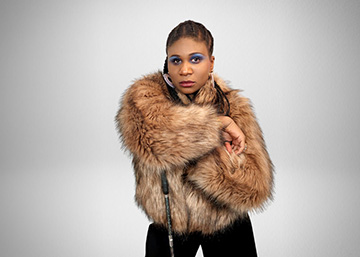
Lachi: The first thing I'm going to do is describe how I look. I thought this was going to be video, and I think everyone should know how dressed up I got. I'm wearing a pink shirt, a gold necklace with a musical note on it, another necklace with a butterfly, and gold bracelets. I'm wearing pink eye shadow and eyeliner. I have long black hair, and I'm wearing red lipstick. I am a Black woman, and I'm sitting in my chair in my living room.
I am a loud and proud blind woman. I write songs about my experience. I write songs about empowerment and about knowing who you are and being as strong as you can be, being the boss you were put on this earth to be.
A lot of my songs started out with me attempting to empower myself. I started out as a pretty shy kid, not really knowing how and where to fit in because of my blindness. In that solitude I harnessed my music and my writing and my love for performance. The only time anyone saw me shine was when I performed.
Eventually, I tried to go along the narrow road and get a day job, but my spirit was just too big for the desk. Now here I am in New York City, doing what I can to show people, not only in the disability community but in the entertainment industry, that folks can lead with what they once assumed was adversity. They can lead with it and it can be their platform, it can be what makes people listen to them. It can be what makes them sell whatever they need to sell. It happened for me. I'm amazed at how much my acceptance of my blindness has really brought me out.
Lizzy: You definitely have to come to a convention sometime and perform for us!
You said that performing was your time to shine. Do you remember your first performance?
Lachi: My first ever performance was in the third grade. I had never played an actual piano before, but I was hit with the random spirit. I went to the front of the class and kind of doodled around on the piano, and I started playing chords. I played for twenty-five or thirty seconds. I had never said a word before that in school. When I was done playing the teacher said, "Wow! That was really good! Have you ever played the piano before?" I said, "Not really."
The teacher called my mother and told her I had to get into music, and she told her where the nearest Yamaha store was. That was the next place my mom and I went.
That was the first time I got feedback that was "Wow! You are amazing!" Up to that point we were just dealing with social workers, hearing, "Which school will she need to go to?" "Which bus will she need to get on?" No one knew what to do with me. But in that moment someone knew exactly what to do, and here I am now, still doing music.
Lizzy: Would you say that's where your path began, that day you played those chords?
 Lachi: My path to professional music started when I met a guitar player who was totally blind. He played the guitar and I sang. The two of us got together right after I graduated from NYU (New York University). We started playing around town, and eventually we went down to South by Southwest to play. South by Southwest is a big annual festival in Austin, Texas, that celebrates the convergence of the tech, film, and music industries. I wrote to a bunch of record companies and told them I was going to be playing there, and I said I'd love for them to come hear me. Funnily enough, someone came. They said, "I love what you are doing! Take my card. Call me when you come back to New York." It turned out he worked at a sub-label under the recording company EMI. We met several times, and eventually, I got signed. That began my path toward music as a profession, as opposed to music as a hobby.
Lizzy: But you didn't start out at NYU studying music, did you?
Lachi: I started out at UNC (University of North Carolina). My dad was an accountant. He said, "You're not going to do music for a career. You're good at math." I studied math and economics and business and management. While I was at UNC I joined the Glee Club, and I even started my own a cappella groups. Music allowed me to make friends and feel confident, which was something I hadn't felt before.
While I was at UNC, I started playing the piano every Saturday night. Folks would gather for my piano concerts, and eventually those concerts grew into Piano Nights. It became a rowdy weekly thing. Finally, people started saying, "Why aren't you pursuing music?” “Why are you in my economics class?"
Finally, I went to my counsellor. His name was Paul Cole. I said, "I want to pursue music. I want to move to New York, but I want to be smart." He said, "So move to New York." I tell people about him all the time. It turned out he played in a Beatles cover band at night! He said, "Go for your dreams," and I moved to New York.
Lizzy: Did you work any jobs before getting into music?
Lachi: While I was signed to EMI I was working. I was trying to juggle working for the City of New York and eventually working for the US Army Corps of Engineers while I was trying to tour and do shows. I was having a really tough time juggling all of that. Folks at the Corps would come to my shows, and then they'd see me at my desk, and they just didn't get it!
Finally, I sat down with my supervisors, and they said, "Here's the trajectory. Next year you'll get a raise, and in two years you'll get this raise, and in another year you'll be a Level 8 . . .," I thought, my whole life is mapped out. I have health care. I have PTO. Why would I ever leave this job?
But I didn't have the brain space to do my job and music. Whatever runs me was pointing me toward music. I had to take a leap and say to myself, I'll have to figure out health care. I'll have to figure out how to keep paying New York rent. I have to figure out how to do what I need to do.
Lizzy: I can tell you really have fun with your music. What's a day in the studio like for you?
Lachi: There are several scenarios. Sometimes there's me in the studio by myself, which is how it's been since COVID. Sometimes there's me doing vocals in someone else's studio. Then sometimes there's someone else doing vocals in my studio. No matter what the situation is, I am a lighthearted goofball in the studio. I don't care if I'm with a Sony producer or a seven-year-old who's going to be the next big star—I love to be that person who's having fun and allowing a twelve-hour session to feel like two hours.
When I'm behind the knobs I don't need to look at the keys, and I don't need to look at the screen—I can barely see it anyway. I'm all about shortcuts. Sometimes people come into the studio and say, "Wow! I can't believe you can navigate with shortcuts and presets for all those crazy tricks you use!" I say, "I'm a producer who knows how to use Pro Tools. That's what a producer who knows Pro Tools does." Any good producer uses shortcuts and doesn't look at the keys.
In my songwriting and performing I have fun, too. In my music I talk about heartbreak, but I have fun as well.
Lizzy: Can you share some of your audio production technology secrets?
Lachi: I like Pro Tools because it has a much smaller learning curve than some of the other programs out there. It's the universal software that most people use. Pro Tools works with a lot of accessible software. I use all of the keyboard shortcuts. I'm also all about pre-sets. If there's a way to pre-set the track you would like for a bass instrument, any kind of effects you want to create, you can pre-set a lot of those options so you don't have to keep starting it up and trying to find everything. It's a pain to make all your presets, but it's the most worth-it thing.
Another thing I encourage folks to do is to label all of your tracks. Label all the sections and the areas of your tracks—for instance, the chorus, the pre-chorus, the verse. Automation is a blind person's friend. If you can push a button and everything happens, and you know it will, that's really helpful!
Lizzy: I imagine you faced some sort of injustice that made you want to work toward equality and raise awareness.
Lachi: One experience that stands out for me happened while I was working for the federal government. My parents were immigrants, and I grew up in a neighborhood where not a lot of people looked like me. I was almost spoiled by a false sense of white privilege. Because I have low vision, I was almost literally colorblind. I could see enough to know what people look like, but I didn't have the mechanism to behave one way with white people and another way with people of color.
When I worked for the federal government I had one experience that made me think, I'm Black, and I can't do certain things because of that. My supervisor asked me to do a certain task. It was four-thirty, and I was doing it and taking my time, because I assumed my supervisor would leave at five. But he stuck around until I finished at about five-thirty. I turned in my work and said, "Signed, sealed, and delivered!" He said, "Are you getting an attitude with me?"
The next day I delivered an envelope to a woman on another floor. When I got back to my desk I was called into the office. They told me the woman on the other floor said that I walked in angrily and dumped the folder on her desk.
Those two incidents back-to-back reminded me that not only am I Black, but I'm a Black woman. Society has the idea that when you see a Black woman, no matter what she does, she's being aggressive. It can be positive, like, "Hey, she's a boss!" or it can be seen as, "She's coming at me." As someone who has low vision I get in trouble a lot for doing things like not waving back at people or giving someone a weird look.
Lizzy: Are you a cane user?
Lachi: Right now I use it at night. One of my favorite things to do is put on heels and walk around at night with my cane. It gets people out of my way! It does make life easier!
If you're a white woman, you're stereotyped as a woman. If you're a Black woman, you're stereotyped as a Black person. If you are a blind Black woman, you're stereotyped as a blind person. You always get stereotyped as the less known of your minority identities.
When I worked for the government I had difficulty figuring out how to advocate for myself in terms of being blind because my blindness was invisible. Instead of people seeing that I had issues because of my blindness, they thought other things were going on.
Lizzy: I'm also a Black blind woman, but I'm seen as a blind person because I have a guide dog or I use a cane. I don't get accused of having attitude, but I get, "Oh wow! You're actually intelligent!" which is also infuriating. Are these the things that made you want to become an advocate?
Lachi: My last year at the Corps I had a lot of complications with my eyes. I realized I was going to get to a point where I couldn't pretend to be sighted any more. I had to advocate for myself and advocate for other people who were in my position.
When I was younger there weren't folks like me out there. There were Black singers, there were female actresses, and there were Ray Charles and Stevie Wonder. But I didn't see myself there. One day my manager, Larry Salzman, said, "Why do you keep your condition from the public? Why don't you celebrate it?" He didn't say it in an empowering way; he was more inquisitive. He said, "I'm motivated by you. I'm empowered by you. Why don't you do that for other people so they can go on their paths the way you go on your path?" That got me thinking that I didn't have anyone to do that for me. So that's why I'm here doing this.
Lizzy: Talk a bit about your music.
Lachi: It's kind of a progression. In my tone of voice and my lyrics and the power in singing my phrases, it's all a reflection of my own growth.
Lizzy: Tell us about what you're doing as a performing advocate?
Lachi: I love incorporating music into my advocacy. What I want to do is focus my advocacy into representation in the media, specifically music. We don't have any folks advocating for accessible venues, for accessible ProTools systems and digital audio workstations. There really isn't anybody going hard at this in a major way. When I talk to people about my advocacy, there's still a level of separation. That comes tumbling down when I perform. People get exactly what I meant, they get the real me. I love to incorporate my messages into my live performances so people can feel the genuineness and the authenticity that you get at my most divine; that's when I'm performing!
Lizzy: I think you would be a great person to join the Performing Arts Division. You talk about authenticity in music. That's what we do in all of the performing arts. We need someone who is a professional, who's doing this full-time, who's really pushing for accessibility in a professional way.
You talked about how you struggled in the past with self-acceptance and feeling confident around your blindness. How has that changed?
Lachi: There's the you when you speak to others, there's the you when you speak to yourself, there's the you when you speak to your mother. And there's some sort of core you. When I perform, those extra layers come down, and you're getting the core me.
I used to have issues with self-advocacy and self-acceptance and disclosure around my blindness. The music industry is rough. There isn't a place for advocacy. Sometimes I would walk into a room with a big Sony exec or a Universal guy, and I didn't want them to feel uncomfortable. I wanted them to see me for the talented young woman I was. I would keep my blindness hidden. But that meant I couldn't really do my work. I'd have these complicated situations where I was trying to advocate and wondering if they'd believe me, thinking maybe I shouldn't say anything at all. The turmoil that began when I was young sort of grew with me as I grew. Finally, I had to put a stop to it. It's a rough change because you have to figure out how to remain self-confident. You have to learn how not to approach things insecurely, even as you battle your insecurities.
The way I advocate, I walk into a room and say, "Hi, I'm blind. How are you?" Let's keep it fun, keep it light. I don't want it to be awkward when I say I need this or that. It's a fun positive joke, and we're all in on it.
Lizzy: Does it work to get rid of the weird vibes?
Lachi: It's scene setting. It sets the tone of, Hey, I'm strong enough to put my adversity out there. I'm looking at my adversity as strength, so do that with me. And folks do it. It rarely misfires.
I go to events by myself, with no guide, and I put myself through it. I figure, let's have fun and make it work. I appreciate when someone makes sure they have someone with them in those situations. What I do is overkill.
Lizzy: I'm glad you're sharing that it's possible to go to these events and meet people independently. Have you found things pretty accessible for you as a blind performer? If there are inaccessibilities, how do you work around them?
Lachi: A lot of software does not include accessibility natively. There are a lot of issues about DJ software and DJ phone ware. A lot of DJs DJ from their phone, but many of the apps are inaccessible. Then there's the stigma around being a performer with a disability. It's huge! People assume you're some kind of struggling musician on the corner, maybe with a guitar that has four strings. Actually, many of the musicians I've met have disabilities, often hidden ones. Many people have neurodiversities, but because of the stigma they choose not to disclose.
The music industry is still very old school. It's all about who you know, who you signed with, who produced your album. Old-school stigmas still survive. Biases are still strong, even though people are more careful how they talk about them. So I'm going to be the one that's loud! I'm saying, "I'M BLIND!" I walk into the room and get things done on behalf of people with disabilities.
Lizzy: Sex appeal is a big part of the music business. People with disabilities aren't usually thought of as attractive in that way. Is that part of the issue?
Lachi: I have a complicated relationship with that question. Looks were not my biggest concern growing up. I felt people should like my music for itself. But I wasn't happy with the response I was getting from the industry. Eventually I started to work on my looks and shape how I presented myself. I started with a few things, like my nails and my hair, and I got more attention. That boosted my confidence, and I focused even more on my presentation. The more I worked on my appearance, the better the response.
Before I started to work on how I looked, people infantilized me. It's not great that the shallowness of looks ends up showering you with positive reinforcement. But if you've got the tools, I say use them!
When musicians with disabilities land a big meeting with an agent or a record producer, too often the first thing they hear is, "We have no idea how we're going to market you." If you walk into an interview radiating confidence, they'll know where to put you.
Lizzy: Your music really speaks to your confidence. You have a lot of power bops, that's what I call them. What's your hope for the future?
Lachi: I'm on a mission to release songs that the average person can listen to and say, "Wow! That's me! I feel empowered by that song!"
I am tired of people thinking I am some kind of exception! I'm done with that! One in four people in this country has a disability! We are not exceptions, we're part of culture!
Lizzy: Tell us a little more about your journey and how you got here. How did you keep going?
Lachi: I believe it is an innate part of my being. I don't want to be underestimated because of my blindness. I used to live in a place of, I can do it despite my blindness. When I didn't get a role in the school play I worked on tech, and I got an award for being the best tech. When I applied to NYU, I got a rejection letter, and I thought, in spite of this, I'm still going to go to NYU.
When I moved to New York, my parents were set against it, and we had a huge fight. I had no money, and they weren't going to back me. I didn't have a place to stay, but I went anyway.
Over time my despite trip has changed in a beautiful way. Now I feel that everything I do is because of my blindness. The places I've performed are because of my blindness. I'm speaking to you because of my blindness. I've met amazing people because of my blindness. It's a beautiful paradigm shift, and I embrace every moment of it.
Lizzy: Thank you for coming! Come back any time. Thank you to the whole team! Lachi, how can people find you?
Lachi: You can find me on Instagram, Twitter, YouTube, Facebook, and Clubhouse. Look for @lachimusic, or you can log onto my website at lachimusic.com. I'm running a YouTube series called Off Beat where I'm documenting my journey from low vision to no vision. Please check it out at youtube.com/lachimusic.